Featured
Automated Guided Vehicles (AGV) Have Evolved into Smart Autonomous Mobile Robots (AMR) and Are Improving the Efficiency of Operations in Factories
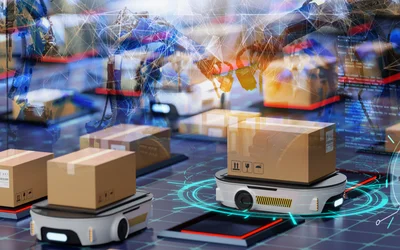
Automated Guided Vehicles (AGV) Have Evolved into Smart Autonomous Mobile Robots (AMR) and Are Improving the Efficiency of Operations in Factories
Automated Guided Vehicles (AGV) Have Evolved into Smart Autonomous Mobile Robots (AMR) and Are Improving the Efficiency of Operations in Factories
When deciding if cellular connectivity or LoRaWAN is right for your IoT project, it helps to start with the use case and work backward to the tech. This guide will give you what you need to know to do just that.
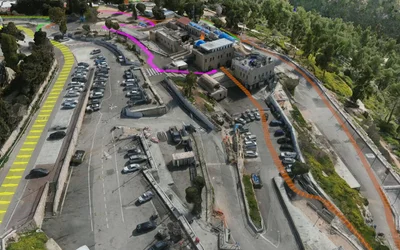
Today, billions of people benefit from GNSS daily, whether navigating at sea, surveying, mapping, farming, guiding heavy machinery or performing thousands of other tasks. GNSS is also now providing a foundation for many IoT applications in the logistics and transportation sectors.
This article is a practical PLC programming guide covering the five IEC 61131-3 languages, the scan cycle that governs how your code actually runs, ladder and structured text examples, and the mistakes that cost engineers the most commissioning time.
23 minutes read.
18 minutes read.
18 minutes read.
15 minutes read.
13 minutes read.
17 minutes read.

Semiconductors
Nordic Semiconductor is a fabless semiconductor company specializing in wireless technology that powers the IoT.
181 Posts

High Tech
High Tech Campus Eindhoven is Europe's smartest square km and has the ultim...
49 Posts

University for science and technology
Freedom and individual responsibility, entrepreneurial spirit and open-min...
43 Posts

Higher Education
Work together. Create smart machines. Serve society. University of Michiga...
40 Posts
embedded world North America is the premier trade show and conference dedicated to the community of innovators and developers in the embedded tech ecosystem.
How Embedded Systems, AI, and Human-Centered Design Are Driving the Future of Robotics
Learn why teams still lose half their development time to test and fix, and what changes when you get real visibility into the target.
Mario Mauerer, maxon's Global Business Development Manager, Robotics, discusses what it takes for robotic deployments to be successful in complex real-world environments.
Join Prof. Fei Chen as he explores advanced bimanual manipulation and teleoperation techniques shaping the future of intelligent human-like robots in this expert-led robotics session.
'Link-bots' can move, explore, cooperate without sensing or computation
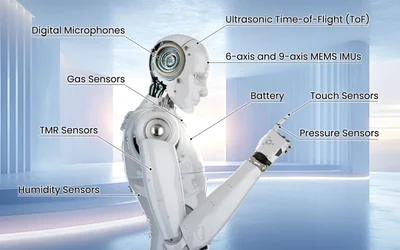
This article is part 4 of a 4-part article series on TDK's advanced robotics.
Automated Guided Vehicles (AGV) Have Evolved into Smart Autonomous Mobile Robots (AMR) and Are Improving the Efficiency of Operations in Factories

5 minutes read
When deciding if cellular connectivity or LoRaWAN is right for your IoT project, it helps to start with the use case and work backward to the tech. This guide will give you what you need to know to do just that.

9 minutes read
Today, billions of people benefit from GNSS daily, whether navigating at sea, surveying, mapping, farming, guiding heavy machinery or performing thousands of other tasks. GNSS is also now providing a foundation for many IoT applications in the logistics and transportation sectors.

4 minutes read
Spectra is the IoT conference for Particle’s connected ecosystems. From enterprise customers, partners, and advocates, to builders, developers, and users, Spectra is your opportunity to learn and discuss IoT market trends, industry opportunities, and challenges.
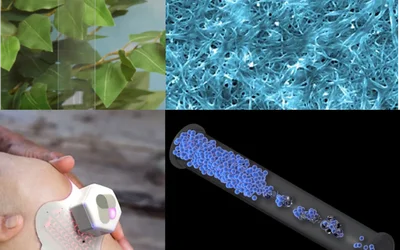
A washable wearable biometric device using printed electronics technology provides real-time data for telemedicine. Integrated into a sleeve, the sensors monitor muscle activity. The data, transmitted to an online platform, facilitates remote health monitoring.

5 minutes read
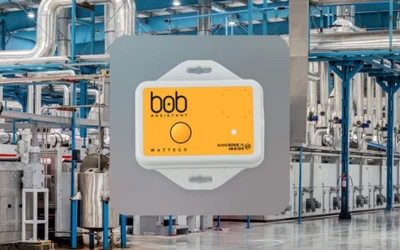
Machine reliability is managed by understanding machine data in a process known as predictive maintenance. In this article, we look at how the BoB Assistant proactively monitors an air circulation vent with the help of the akenza platform.

3 minutes read
Ski navigation devices using Bluetooth LE wireless connectivity to relay data to smartphone apps to provide turn-by-turn audio navigation, start-and-end point navigation, and tailored routes based on ability are becoming increasingly available.
4 minutes read
Single Board Computers are radically improving indoor agriculture by optimizing environmental conditions, enabling IoT applications, and integrating AI for sustainable, efficient farming.
As part of TechBlick series on additive and printed electronics, Michael LeFebvre draws upon his four decades of industry experience to highlight 3 recent technical and application innovations impacting transparent 5G antennas, ADAS, and wearable therapy all based on printed & additive electronics
8 minutes read
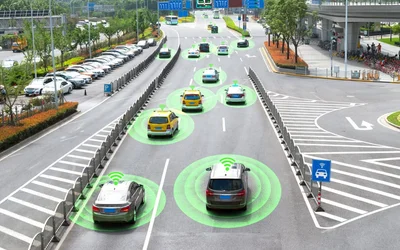
The automotive industry undergoes a profound transformation through the IoT's power. Vehicle connectivity and autonomous driving redefine transportation, offering innovative opportunities. Embracing IoT's potential, our daily lives are poised for a significant shift in the automotive sector.
Researchers create a new simulation tool for robots to manipulate complex fluids in a step toward helping them more effortlessly assist with daily tasks.
Immersive experiences that enhance the understanding of unfamiliar environments, facilitate more effective collaboration, enable better decision-making in high-pressure situations and create a common language between different organizations.

4 minutes read
These days, with the advance of digital transformation using AI, IoT, and other technologies regarding energy measures, it is no exaggeration to say that a paradigm shift is underway regarding the resolution of energy and environmental problems.
3 minutes read
Discover the latest product release of akenza. This update is packed with new features that make it even simpler and faster to connect, control, and manage IoT devices all in one place.
4 minutes read
Firmware Over The Air (FOTA) demystified using LwM2M

5 minutes read