Featured
Exploring Silicon Photonics: Shaping the Future of Optical Communication
Exploring Silicon Photonics: Shaping the Future of Optical Communication
Exploring Silicon Photonics: Shaping the Future of Optical Communication
There are times when scientific progress comes in the form of discovering something completely new. Other times, progress boils down to doing something better, faster, or more easily.
More stable clocks could measure quantum phenomena, including the presence of dark matter.
Photoresist, a light-sensitive material, is essential in photolithography for transferring intricate circuit patterns onto semiconductor wafers. This article explores positive vs. negative photoresists, detailing their chemical mechanisms, processing parameters, and performance traits.


Higher Education
ITMO University is one of Russia's leading higher education and research institutions, specializing in Information Technology, Opt...
17 Posts

Machinery Manufacturing
We Are Giving Human Materials the Superpowers of Nature Using Lasers
1 Post

PICs are unlocking faster wireless technologies like FSO, 6G, and ISAC, with real solutions already emerging for today's biggest challenges.
Aluminum oxide PICs are gaining attention for their broad wavelength coverage, low optical losses, and support for on-chip optical amplification. In this discussion, Steve Stoffels, the CEO of Aluvia Photonics, explains where the platform fits and how teams can design with it.
Inverse design enables compact, foundry-ready silicon nitride photonic components
XIVER's Sreekanth Chirayath on why photonic innovations fail on the production line and how designing for manufacturing from the start changes the outcome.
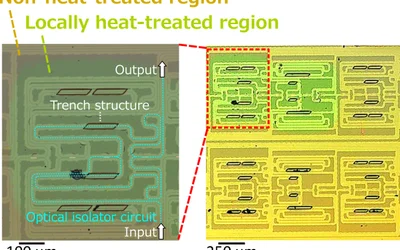
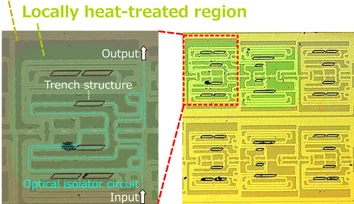
A laboratory device reaches 13.6 dB of isolation at 1540 nm, with heat confined to a window 700 micrometres across instead of the whole wafer going through a furnace.
PICs are unlocking faster wireless technologies like FSO, 6G, and ISAC, with real solutions already emerging for today's biggest challenges.
Aluminum oxide PICs are gaining attention for their broad wavelength coverage, low optical losses, and support for on-chip optical amplification. In this discussion, Steve Stoffels, the CEO of Aluvia Photonics, explains where the platform fits and how teams can design with it.
Inverse design enables compact, foundry-ready silicon nitride photonic components
Exploring Silicon Photonics: Shaping the Future of Optical Communication
There are times when scientific progress comes in the form of discovering something completely new. Other times, progress boils down to doing something better, faster, or more easily.

4 minutes read
More stable clocks could measure quantum phenomena, including the presence of dark matter.
Lasers have become relatively commonplace in everyday life, but they have many uses outside of providing light shows at raves and scanning barcodes on groceries. Lasers are also of great importance in telecommunications and computing as well as biology, chemistry, and physics research.
3 minutes read
Integrated photonics, also known as planar lightwave circuits or integrated optical circuits, revolutionizes optical communication by leveraging the properties of light to process and transmit information. This cutting-edge technology offers superior efficiency and compactness compared to traditional electronic components, paving the way for faster and more energy-efficient communication systems. With its interdisciplinary nature encompassing materials science, quantum physics, and electrical engineering, integrated photonics presents an exciting and promising field of study and research in today's digital era.
A perovskite-based device that combines aspects of electronics and photonics may open doors to new kinds of computer chips or quantum qubits.
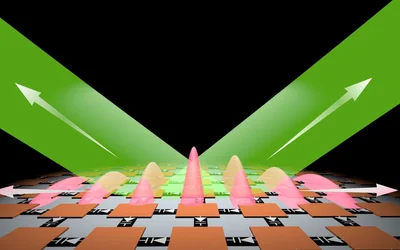
Photonic time crystals, whose properties change periodically, promise significant advances in microwave technology, optics and photonics. Researchers at the Karlsruhe Institute of Technology (KIT), together with partners at Aalto University and Stanford University, have now produced a two-dimensional photonic time crystal for the first time and demonstrated important applications.

3 minutes read
We proclaim 2022 The Year of Innovation. In this "End of the Year" list we highlight 25 Campus high-tech, innovative companies, including multi-nationals, startups, scale-ups and everything in-between. These are companies of the future, and they’re all here at HTCE.

7 minutes read
Using green light and a double-layered cell, PhD researcher Riccardo Ollearo has come up with a photodiode that has sensitivity that many can only dream of.
Photonic fibers borrow from butterfly wings to enable invisible, indelible sorting labels.

4 minutes read
In a significant advance for impactful technologies such as quantum optics and laser displays for AR/VR, Columbia Engineering’s Lipson Nanophotonics Group has invented the first tunable and narrow linewidth chip-scale lasers for visible wavelengths shorter than red.
Engineers at Caltech and the University of Southampton have collaboratively designed an electronics chip integrated with a photonics chip (which uses light to transfer data)—creating a cohesive final product capable of transmitting information at ultrahigh speed while generating minimal heat.
3 minutes read
Researchers from the Cluster of Excellence "3D Matter Made to Order" Print Microstructures by Crossing Red and Blue Laser Beams - Publication in Nature Photonics
3 minutes read
The start-up QuiX Quantum will develop prototype photonic quantum computers over the next four years.

3 minutes read
Device opens the door to applications in optical communications, sensing, and the search for exoplanets

2 minutes read