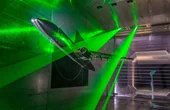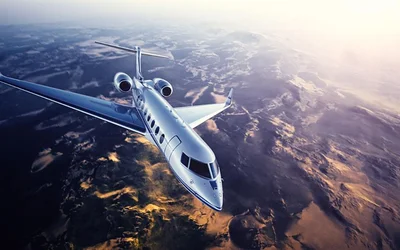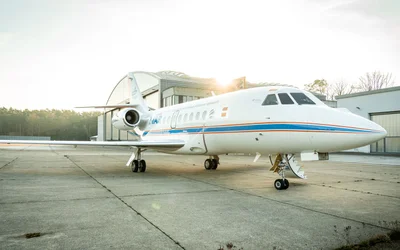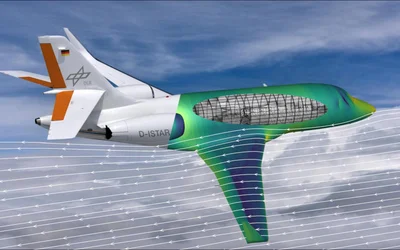
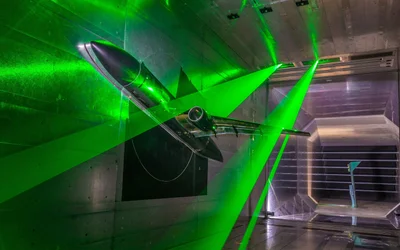
In wind-tunnel tests, the German Aerospace Center (Deutsches Zentrum für Luft- und Raumfahrt; DLR) has investigated the lift generated by commercial aircraft using state-of-the-art measurement and simulation technologies.

2 minutes read
Tagged with

Aerospace
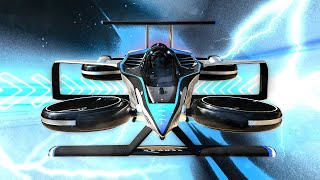
Airspeeder is the world’s first racing series for electric flying cars. Our mission will accelerate eVTOL (electric vertical tak...
26 Posts

Higher Education
At Embry-Riddle Aeronautical University, what we do -- and do best -- is te...

Higher Education
Founded in 1861, the University of Washington is one of the oldest state-su...
In wind-tunnel tests, the German Aerospace Center (Deutsches Zentrum für Luft- und Raumfahrt; DLR) has investigated the lift generated by commercial aircraft using state-of-the-art measurement and simulation technologies.
2 minutes read
In a collaboration to strengthen sustainability in aviation, Boeing [NYSE: BA] is partnering with NASA and United Airlines for in-flight testing to measure how sustainable aviation fuel (SAF) affects contrails and non-carbon emissions, in addition to reducing the fuel's life cycle climate impact.
4 minutes read
Power electrification and automated driving are being promoted at a remarkable speed for automobiles owing to advances in electronic technologies such as batteries, motors, and power electronics. On the other hand, strict safety requirements are imposed on aircraft engines. Therefore, electrifying them has been considered unfeasible on both a technical and commercial basis, which resulted in efforts in that area being shelved.

10 minutes read
In this episode, we delve into the remarkable achievement of the German Aerospace Center (DLR) as they successfully execute the maiden flight of their hybrid demonstrator aircraft.

16 minutes read
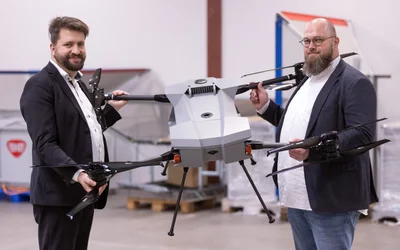
How Fiberthree, Drywise, and the Auriol drone by Third Element Aviation take flight

5 minutes read
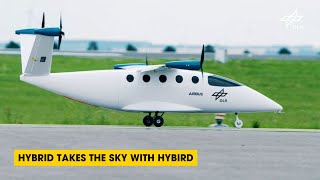
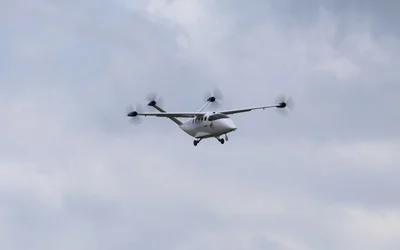
HyBird is a small, hybrid-electric aircraft concept. Its goal is to serve routes of less than 1000 kilometres and with low passenger volumes in a climate-compatible way. The German Aerospace Center (DLR) has now successfully conducted the first flight of a 1:4 scale demonstrator of HyBird at the National Experimental Test Center for Unmanned Aircraft Systems in Cochstedt.
3 minutes read
ISTAR flights focus on the flight-mechanical and flight-dynamic characteristics of the modified Dassault Falcon 2000LX. Novel sensors measure how the aircraft behaves during specific flight manoeuvres.
4 minutes read
Air taxis and flying cars may seem like science fiction, but for Onland, founder of Serendipity, these are real-world technologies he’s helping cities and countries prepare for now.

4 minutes read
Sustainable aviation fuels (SAFs) significantly reduce the climate impact of aviation in terms of both its carbon footprint and other climate impact not related to carbon dioxide. In the future, the targeted use of SAFs in contrail regions can help to rapidly reduce the climate impact of air transport. Flight tests using aircraft powered by 100 percent SAF are to take place again in order to prepare for this transition.
3 minutes read
Alauda Aeronautics today unveils the Airspeeder Mk4, the first crewed version of its flying racing car. Designed and built in Adelaide, South Australia, the Airspeeder Mk4 is the world's fastest hydrogen electric Vertical Take-Off and Landing (eVTOL) aircraft.

2 minutes read
Decarbonisation of aviation relies on a combination of many incremental steps and outright technological breakthroughs. To succeed, both approaches need to exist inside a collaborative ecosystem. In this spirit, Airbus and two leading European research institutions, DLR and ONERA, are exploring how high-performance computing can improve our understanding of the relationship between aerodynamics and aircraft efficiency.
3 minutes read
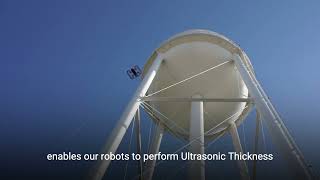
Intelligent flying robots are making their way into the Non-Destructive Testing industry. These robots are gaining attention in providing the industry with a safer and superior alternative to traditional methods.

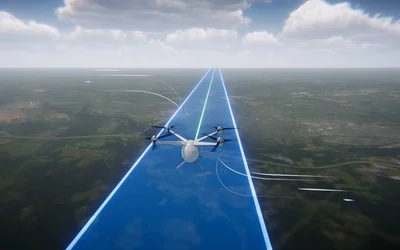
Tabletop exercises allow researchers to explore options and test scenarios in fields from military strategy and cybersecurity to disaster response planning. Now, NASA is using tabletop exercises to test how electric air taxis will fit safely into the national airspace – allowing passengers to one day hop across town or to a neighboring city by using new highways in the sky.

3 minutes read
During COP27 people across the world flew to Sharm El Sheikh to discuss action on climate change. Aviation is a crucial way to bring us together to tackle this challenge – but it is also a major contributor to the problem.
Hummingbirds have extreme aerial agility and flight forms, which is why many drones and other aerial vehicles are designed to mimic hummingbird movement. Using a novel modeling method, researchers gained new insights into how hummingbirds produce wing movement, which could lead to design improvements in flying robots.

3 minutes read