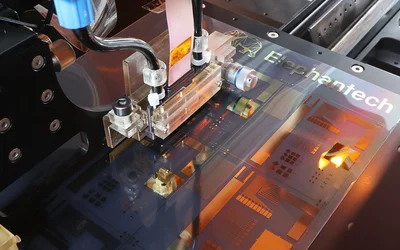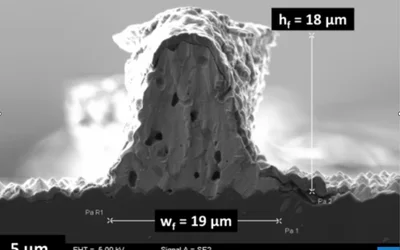

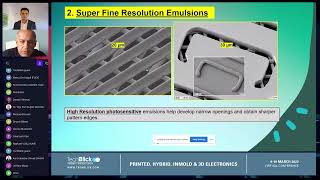
Screen printing never ceases to advance and is entering into ultrafine line printing territory. FERNANDO ZICARELLI explains in this short 5-min talks important considerations to achieve fineline printing and further push the resolution down:

Tagged with


Additive Manufacturing
We help innovative engineers 3D print end-use components they can trust usi...
12 Posts

Manufacturing | Procurement
The digital all-in-one solution for effortless procurement of custom parts
12 Posts
Screen printing never ceases to advance and is entering into ultrafine line printing territory. FERNANDO ZICARELLI explains in this short 5-min talks important considerations to achieve fineline printing and further push the resolution down:
Many FDM users are haunted by a printing issue known as ghosting. Often caused by vibrations in the printer, 3D print ghosting can usually be fixed by following a few simple steps.
Looking to get started with your first 3D printer? Get to know the main differences between the two most popular technologies - Resin 3D printers and Filament 3D printers.

8 minutes read
Here, the additive nature of the process means that the production process is environmentally friendlier and does not involve etching chemicals. Furthermore, the digital nature of the patterning (inkjet printing) means that designs can be changed faster.
While acetone works in combination with ABS, it is not viable for smoothing PLA prints. Fortunately, there are alternatives to acetone for PLA. From chemical solvents to manual techniques, here are the ways you can post-process and smooth a PLA 3D print.
PLA is one of the fastest filaments out there, your PLA print speed is also determined by print settings, hardware, and other factors.
The current advancement in multi-material additive manufacturing technologies has provided unique opportunities to create 3D printed structures with not only complex geometries at several length scales, but arbitrary deposition of multiple materials (i.e., soft or hard) in 3D space.
We first discuss emerging and existing applications for ultra fineline screen printing, outlining how evolution of screen printing can unlock various electronic applications. Next, it will review other printing technologies extending the linewidth resolution to sub-micron range
Taking advantage of low-cost, high-resolution desktop resin 3D printers combined with PDMS soft-lithography we have developed an optimised microfabrication pipeline capable of generating a wide variety of customisable devices for cell culture and tissue engineering in an easy, fast reproducible way
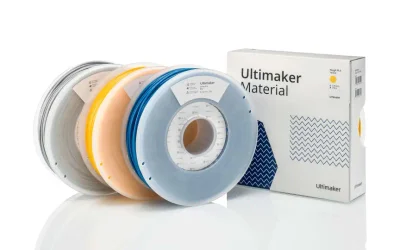
Tough PLA is one of the easiest to use, most functional, and most popular materials Ultimaker sells. If you’re not convinced yet, here are some great reasons you should be using it.

3 minutes read
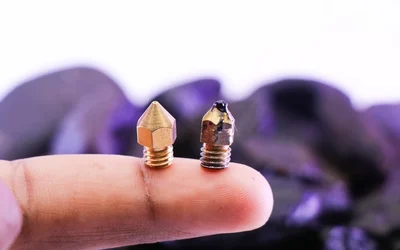
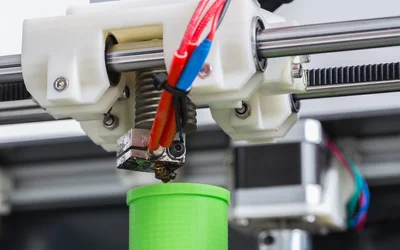
Filament sticking to nozzle? This article looks at how to get it flowing properly with improved print settings and general maintenance.
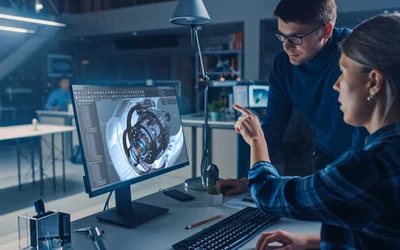
Most beginners start their 3D printing journey by downloading 3D models from the internet. But knowing how to make a 3D model for printing using CAD software opens up a world of possibilities.
Accelerate design cycles. Lower development costs. Reduce waste.

4 minutes read
When setting up your 3D printer for the first time or swapping out components, knowing how to perform E-step calibration is vital for ensuring the right amount of filament gets extruded.
Polyjet is a 3D printing technology that offers great accuracy and uniquely allows you to alter the part’s material properties in different places on the build. For the right part or prototype Polyjet is a great option, but understanding the capabilities and limitations is key.