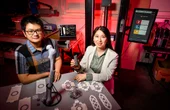
This week Parker and Stephen welcome Kent Johnson to the show to discuss ethics in engineering. It’s a topic that has been alluded to throughout Circuit Break, but this is the first time Parker and Stephen have delved into it with a real expert on the matter.
Columbia engineers have built a new AI that shatters a long-held belief in forensics–that fingerprints from different fingers of the same person are unique. It turns out they are similar, only we’ve been comparing fingerprints the wrong way!
Artificial intelligence (AI) is a wide-ranging tool that enables people to rethink how we integrate information, analyze data, and use the resulting insights to improve decision making
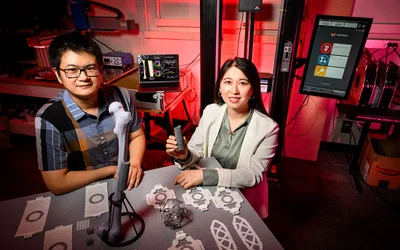
"MechStyle" allows users to personalize 3D models, while ensuring they're physically viable after fabrication, producing unique personal items and assistive technology.
A simulation of an individual patient's brain tumors, kept up to date with readily available data, can identify whether dietary treatments and drugs are likely to work.
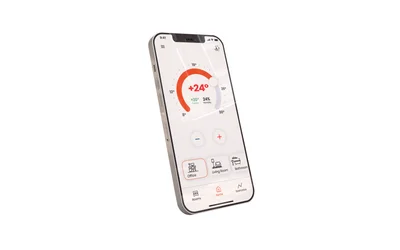
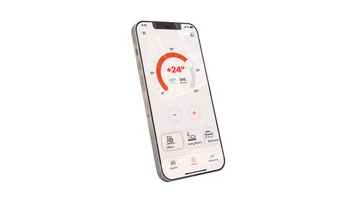
Hey Tuya showcases how agentic Physical AI evolves assistants from isolated commands into systems that learn context, coordinate devices, and act reliably across real-world environments.
This episode celebrates five years of The Next Byte with a recap of 2025, highlighting standout episodes through The "Saucies" Awards, reflecting on major trends, sharing predictions for 2026, and thanking the global listener community.
Matroid builds no-code computer-vision detectors that can spot everything from microscopic material defects to real-time safety hazards on a factory floor.
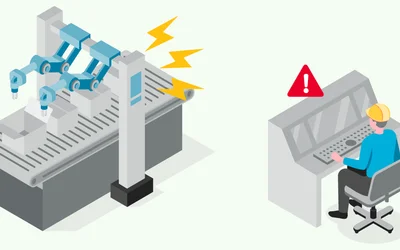
In large-scale warehousing and distribution operations, conveyor belts are an essential infrastructure that must operate with near-zero downtime to ensure the timely delivery of products. The presence of loose or foreign items on a conveyor belt can pose a serious risk to these operations.
In this post, we'll walk through how to evaluate that progress using the same metrics our platform provides automatically, so you can build detectors that get smarter, sharper, and more reliable over time.
This week Parker and Stephen welcome Kent Johnson to the show to discuss ethics in engineering. It’s a topic that has been alluded to throughout Circuit Break, but this is the first time Parker and Stephen have delved into it with a real expert on the matter.
Columbia engineers have built a new AI that shatters a long-held belief in forensics–that fingerprints from different fingers of the same person are unique. It turns out they are similar, only we’ve been comparing fingerprints the wrong way!
Smart retail — those retail outlets that use data and automation for better decision-making and store operations — can provide retail managers with insights and help them unlock efficiencies that enable better customer service and improve revenue potential.
The German Research Center for Artificial Intelligence will be presenting new technologies for agriculture in three exhibit halls at the International Grüne Woche, which will take place in Berlin from 19 to 28 January 2024.
An interdisciplinary project at Caltech has designed a new type of catheter tube that impedes the upstream mobility of bacteria, without the need for antibiotics or other chemical antimicrobial methods.
Every day, the average person inhales a staggering 11,000 liters of air, amounting to more than 300 million liters over a lifetime (as reported by TheWorldCounts).
High-performance microprocessors with AI hardware acceleration are revolutionizing Edge AI, enabling advanced computer vision capabilities directly on devices for real-time data processing and analysis.
Changes in small blood vessels are a common consequence of diabetes development. Researchers at the Technical University of Munich (TUM) and Helmholtz Munich have now developed a method that can be used to measure these microvascular changes in the skin – and thus assess the severity of the disease.
From space robots to self-driving cars, Stanford’s Autonomous Systems Lab looks to push the boundaries of exploration and boost the safety and efficiency of everyday tasks.
Novel drone navigation technology developed by Kenji Shimada was put to the test in an active Japanese tunnel construction site, enabling drones to approximate where a collision may occur and prevent it.
In this episode, we discuss an additive manufacturing breakthrough from MIT that enables inkjet printers to print soft materials that were deemed unsuitable before, print more accurately, and print ~660 times faster than comparable printer technologies!
One of the biggest transformations happening in wireless IoT connectivity right now is the introduction of artificial intelligence (AI) and machine learning (ML).