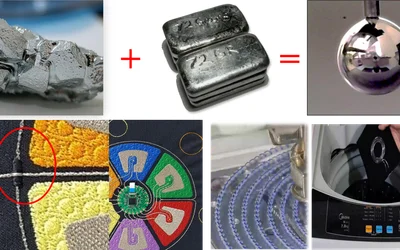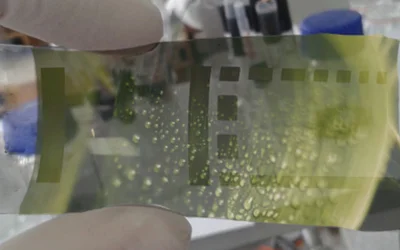
In this article you will learn more about liquid metals, a material that never ceases to amaze. It is water-like at room temperature but with metallic properties. Here you will see how researchers want to make them printable or turn them into conductive, stretchable, and washable fibers for e-textiles.
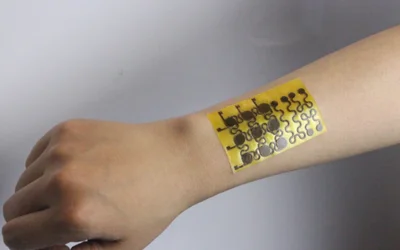
A washable wearable biometric device using printed electronics technology provides real-time data for telemedicine. Integrated into a sleeve, the sensors monitor muscle activity. The data, transmitted to an online platform, facilitates remote health monitoring.
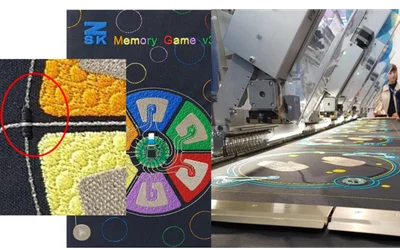
Mass manufacturing electronic textiles and in doing so combining textile based wiring and sensors with PCB electronics is no easy task. In this article, you will learn about an innovative approach to enable embriodery of PCBs and conductive wiring/sensors in mass produced e-textiles
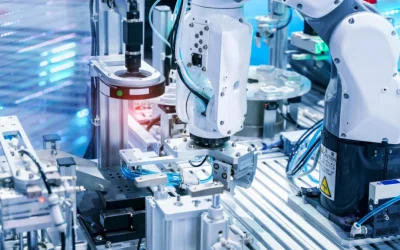
Learn how edge AI in wireless vibration sensors improves machine health monitoring, extends battery life, and enables smarter predictive maintenance in factories.
In this article you will learn more about liquid metals, a material that never ceases to amaze. It is water-like at room temperature but with metallic properties. Here you will see how researchers want to make them printable or turn them into conductive, stretchable, and washable fibers for e-textiles.
A washable wearable biometric device using printed electronics technology provides real-time data for telemedicine. Integrated into a sleeve, the sensors monitor muscle activity. The data, transmitted to an online platform, facilitates remote health monitoring.
Mass manufacturing electronic textiles and in doing so combining textile based wiring and sensors with PCB electronics is no easy task. In this article, you will learn about an innovative approach to enable embriodery of PCBs and conductive wiring/sensors in mass produced e-textiles
Digital manufacturing has revolutionised the fashion industry, and it's no surprise. By definition, fashion is a popular or the latest style of clothing, hair, decoration, or behaviour, so why wouldn't the latest innovations in manufacturing be of interest?
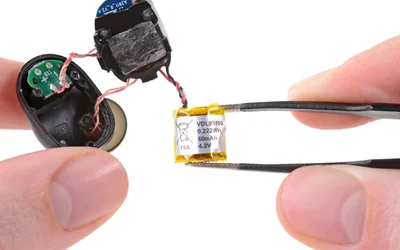
TechBlick's presentation reviews printed electronics' industrial applications, dispelling the notion that it's solely a technology of the future. The talk showcases various commercial success stories incl. photovoltaics, displays, sensors, HMIs, 3D electronics, MLCCs, PCBs, semicon packaging, etc
A novel stretchable film has been developed for soft & stretchable circuit / electronic solutions, outperforming existing films like TPU. Here you can learn about case studies showcasing its potential in pliable PCBs, stretchable hybrid PCBs, and truly stretchable electronics.
PCBA design capabilities are crucial to the future of wearable technology. Wearables and PCBA design are inextricably linked since both have a significant influence on each other. As wearable devices become more popular, electronics designers and manufacturers are designing smaller, denser, and more flexible devices.
Medsled, a team from ITMO University, has developed a concept of a smart armband for monitoring the condition of hospital patients. Unlike its competitors, the new solution doesn’t have a screen and can transport data directly into a medical information system.
Article #7 of Power Management for Tomorrow’s Innovations Series: Power supplies utilized in the medical industry must be compact, reliable, long-lasting, and robust.
Article #5 of Power Management for Tomorrow’s Innovations Series: Single-Inductor Multiple-Output (SIMO) architecture enables design engineers to extend the battery life, and reduce the circuit board size for hearables and wearables
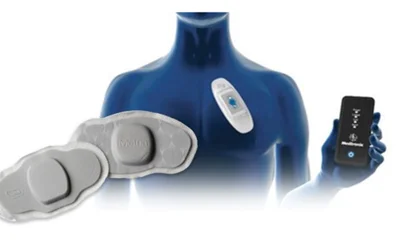
As wearable electronic devices continue to be more prevalent, it becomes an ever-greater challenge for companies that manufacture them to keep their competitive edge. It is vitally important for manufacturers that each device is effective, cost-efficient and reflects the highest quality available.
Article #2 of the "Why Edge?" Series. Edge AI increases battery life, reduces latency, and in many cases, eliminates the need for cloud communication, making wearable devices more user-friendly and secure.