Featured
A short guide to the current trends and challenges of human-machine interface.
A short guide to the current trends and challenges of human-machine interface.
A short guide to the current trends and challenges of human-machine interface.
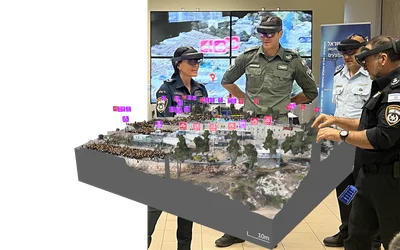
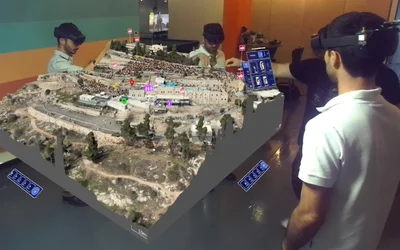
The Israeli police will implement advanced training methods using XR in order to prepare for the next annual Lag Ba’Omer (Jewish religious holiday) pilgrimage to Mount Meron in Israel where 2 years ago, 45 people were killed in a stampede.
Immersive technologies and high-speed telecommunication standards are enabling new ways to work remotely.
Smart city IoT enhances urban life by boosting efficiency, sustainability, and living standards. It addresses challenges like data privacy and scalability, while offering significant benefits despite these hurdles.




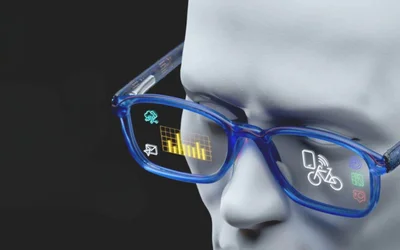
Direct Retinal Projection (DRP) technology enables practical AR experiences, with zero focal strain and an all-day wearable system.
Learn how photonic integrated circuits are reshaping the future of imaging, and why PhotonDelta is inviting engineers to rethink how PICs can tackle imaging challenges of today and power the next generation of innovation.
The Photonics & Intelligence Behind TDK's Innovative AR Stack
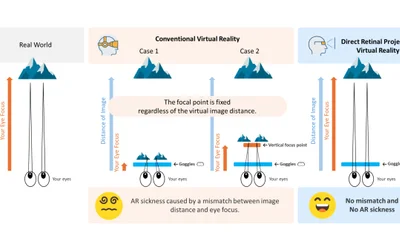
Direct Retinal Projection (DRP) technology eliminates vergence-accommodation conflict, delivering focus-free, high-resolution AR and VR experiences with unmatched comfort, clarity, and optical efficiency.
Direct Retinal Projection (DRP) technology enables practical AR experiences, with zero focal strain and an all-day wearable system.
The Photonics & Intelligence Behind TDK's Innovative AR Stack
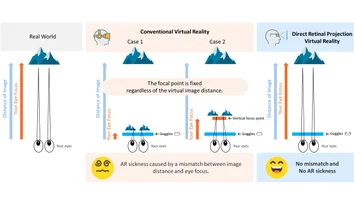
Direct Retinal Projection (DRP) technology eliminates vergence-accommodation conflict, delivering focus-free, high-resolution AR and VR experiences with unmatched comfort, clarity, and optical efficiency.
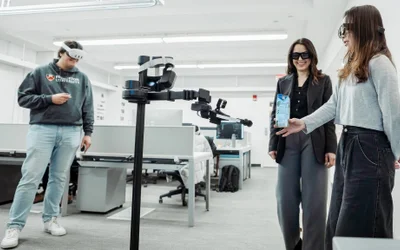
Computer scientists at Princeton are working to bring virtual reality into the physical world, with the potential to enhance a variety of experiences, including remote collaboration, education, entertainment and gaming.
A short guide to the current trends and challenges of human-machine interface.
The Israeli police will implement advanced training methods using XR in order to prepare for the next annual Lag Ba’Omer (Jewish religious holiday) pilgrimage to Mount Meron in Israel where 2 years ago, 45 people were killed in a stampede.

2 minutes read
Immersive technologies and high-speed telecommunication standards are enabling new ways to work remotely.

7 minutes read
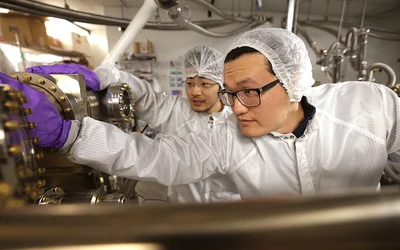
In a significant advance for impactful technologies such as quantum optics and laser displays for AR/VR, Columbia Engineering’s Lipson Nanophotonics Group has invented the first tunable and narrow linewidth chip-scale lasers for visible wavelengths shorter than red.
Marketing engineering products and services requires a strategic distribution of content in various forms. Using a combination of tech articles, e-books, newsletters, social posts, events, podcasts, and other sponsored content can significantly boost brand awareness.
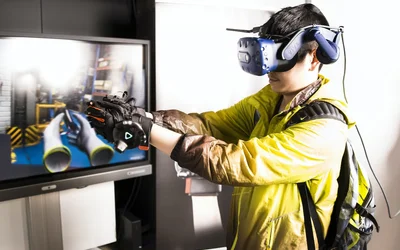
Axl Chen is the founder and CEO of Surplex, a new full-body tracking technology company aiming to change the gaming industry and professional sports.
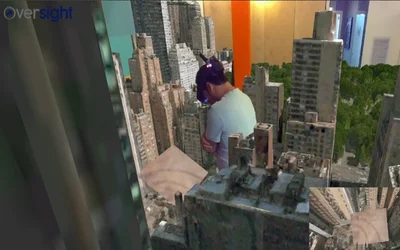
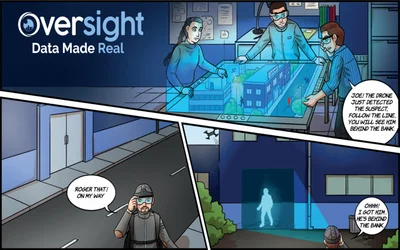
Oversight is actively changing data management by embracing XR (Extended Reality) technology so that we can meet the challenges of data management in the modern world.
2 minutes read
Prof. Zetian Mi’s team are the first to achieve high-performance, highly stable green micro-LEDs with dimensions less than 1 micrometer on silicon, which can support ultrahigh-resolution full-color displays and other applications.

3 minutes read
Columbia engineers invent a flat lens that exclusively focuses light of a selected color—it appears entirely transparent until they shine a beam of light with the correct wavelength onto it, when the glass turns into a lens.
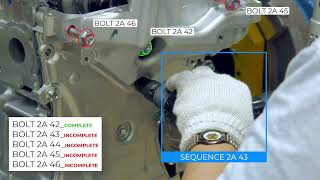
Deep-learning algorithms are enabling powerful video analytics. A practical use in manufacturing is monitoring human actions in manual operations. Some assemblies require specific torquing sequences, which can't always be tracked with traditional methods. AI-based Computer Vision advances quality management.

3 minutes read
Article #3 of the Enabling IoT Series. This article looks at how Time of Flight (ToF) sensors are used for this purpose and are changing the way we can interact with VR, and other video technologies.
For real-time geo-registration, Oversight uses a physical engine and digital twins to make image matching algorithms more agnostic to variations.
2 minutes read
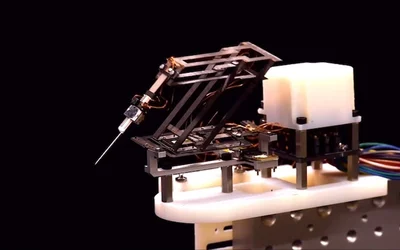
Article #8 of Improving Lives with Digital Healthcare Series: Advancements in electronics have transformed the healthcare sector. The focus is on improving the experiences of users by utilizing cutting-edge technologies like advanced drug delivery systems, wearables, surgical robots, and more.
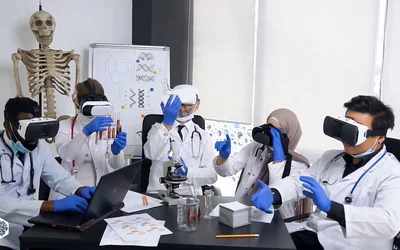
Article #6 of Improving Lives with Digital Healthcare Series: Immersive technologies enabled by modern sensing and connectivity systems can be effective pedagogical tools in making medical education safer, accessible, personalized, and engaging.
Using AR/VR technology, Oversight gives emergency responders the ability to literally SEE THROUGH WALLS and strengthens the connectivity between control rooms and field operators.
5 minutes read