Feasibility of applying high-refractive-index resins to AR optical devices demonstrated
The NH762 grade from NTT-AT reached 65 nm meta-optical features on EV Group's SmartNIL imprint process, with pattern height moving about 2.2% across 25 consecutive imprints.

23 Sep, 2026. 4 minutes read
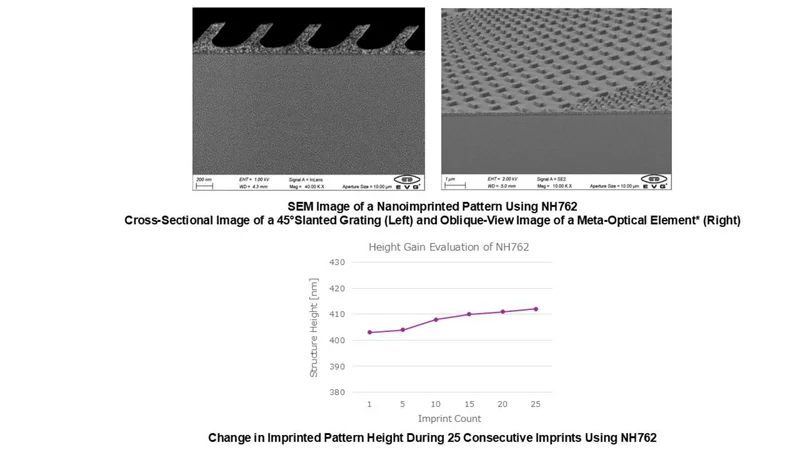
Image of nanoprinted pattern
What is the announcement
NTT Advanced Technology and EV Group announced that they have jointly evaluated NH762, one grade in NTT-AT's NH700 series of UV-curable high-refractive-index resins, on EVG's SmartNIL nanoimprint process using EVG's NIL UV/AS5 working stamp material. The two companies report replication of 350 nm line-and-space structures, 45 degree slanted diffraction gratings, and meta-optical elements down to 65 nm minimum feature size, without defects or deformation, plus a 25-imprint run in which pattern height changed by about 2.2%. The NH700 series is specified at refractive indices of 1.8 and 1.9, in cured films 200 nm to 1 µm thick. The master mould came from Techsendo Photomask.[1][2]
Why does it matter
A high-index resin is not what sets an AR display's field of view. The waveguide substrate carries the light, and the grating sitting on top of it has to match that substrate's index, because a mismatch costs light at the interface.[5] Getting there is a materials problem with a known ceiling. These resins reach their index by loading the polymer with metal oxide nanoparticles, and the two usual choices pull against each other: titanium oxide raises the index but is photocatalytic and degrades the resin under ultraviolet light, while zirconium oxide is stable and struggles to carry a formulation past 1.8.[6] Light resistance, not index, is what these materials fail on.
NTT-AT said as much in its own words when it launched a 1.9-index nanoimprint resin in August 2024, reporting that photostability falls off sharply above 1.9 compared with resins at 1.8 or below.[3] Competitors sit in the same band and say where they measured it. HighRI Optics publishes 1.8 to 2.00 at 590 nm, and Pixelligent's PixNIL SCS1 is 1.86 at 589 nm, already tested on an EVG SmartNIL system. Nor is a matched 1.9-index polymer on EVG equipment new: Schott, Inkron, EV Group and the waveguide designer WaveOptics imprinted one onto 1.9-index glass wafers in January 2020.[7][8][9]
What moves here is the difficult end of replication. A 45 degree slanted grating is an undercut structure, so releasing the stamp without tearing it is where heavily loaded formulations tend to fail, and the master mould decides whether the geometry can be made at all, since it has to be produced by tilted-angle etching before anything can be copied from it.[10] Reporting slanted gratings and 65 nm meta-optics alongside a 2.2% height drift over 25 consecutive imprints puts public numbers on the step that usually stays behind a customer agreement, which is what a process engineer choosing a resin and working-stamp pair actually needs.
Technical specifications
| Spec | Value | Source |
|---|---|---|
| Material | NH762, from NTT-AT's NH700 series of UV-curable high-refractive-index resins | Release[1] |
| Refractive index, NH700 series cured film | 1.8, 1.9 | Release; product page[4] |
| Refractive index of NH762 specifically, and its measurement wavelength | Not stated | - |
| Cured film thickness | 200 nm to 1 µm, typically 300 nm | Release |
| Transmittance | Greater than 90%, including reflection loss | Product page |
| Haze | Below 0.1% | Product page |
| Imprint process | EVG SmartNIL with EVG NIL UV/AS5 working stamp | Release |
| Structures replicated | 350 nm line and space, 45 degree slanted gratings, meta-optics to 65 nm minimum feature | Release |
| Consecutive imprint stability | About 2.2% change in pattern height over 25 imprints | Release |
| Environmental testing | Damp-heat and light exposure, changes described as extremely small | Release |
| Damp-heat and light-exposure test conditions and duration | Not stated | - |
| Imprint throughput and substrate used | Not stated | - |
| Master mould | Techsendo Photomask | Japanese release[2] |
NH762 cannot be specified from what has been published. Its index is given only as the 1.8 and 1.9 of the series, with no measurement wavelength, and a resin's index varies with wavelength: NTT-AT's distributor data quotes a range rather than a point value for other grades in the family.[11] Matching a substrate needs both the grade and the wavelength. The rest is narrower. The environmental results arrive without conditions or duration, which weakens the durability claim without unsettling it, and 25 imprints is real evidence of release performance that has simply not been carried as far as a production working stamp's service life.
Recommended reading
Display technologies for Augmented and Virtual Reality. How diffractive waveguides and the surface relief gratings this resin is imprinted into actually work.
References
- NTT-AT and EVG Demonstrate the Feasibility of Applying High-Refractive-Index Resins to AR Optical Devices Using the SmartNIL Process, NTT Advanced Technology and EV Group via Business Wire, 9 September 2026.
- NTT-AT and EVG joint evaluation, Japanese-language release, NTT Advanced Technology via PR Times, 8 September 2026. Carries the master mould attribution that the English version does not.
- A high-refractive index resin for nanoimprinting with excellent photostability has been developed, NTT Advanced Technology, 30 August 2024.
- High refractive index resin, NTT Advanced Technology product page.
- Solvent-free, transparent, high-refractive index ZrO2 nanoparticle composite resin for scalable roll to roll UV-nanoimprint lithography, Optical Materials, 2021. Peer-reviewed study of index tuning by nanoparticle loading and of substrate index matching.
- UV-Curable Nanoimprint Resin with High Refractive Index "HILUCIS", Sanyo Chemical. Technical page setting out the titanium oxide and zirconium oxide tradeoff.
- Ultra-high refractive index materials for patterning diffractive optical elements with nanoimprint lithography, HighRI Optics, SPIE Proceedings, 2023.
- High Index, UV Stable NIL Formulation for AR Waveguides, EV Group and Pixelligent. Joint vendor white paper.
- SCHOTT, Inkron, EVG, and WaveOptics: Global AR leaders team up to enable next-gen waveguides at Photonics West, EV Group, January 2020.
- Fabrication of slanted gratings with high refractive index starting from master nanoimprint mold, PubMed listing, 2024. Peer-reviewed study of why the master mould governs slanted-grating nanoimprint.
- Nano Imprint Lithography Resins, ams Technologies. Distributor listing for NTT-AT resins, quoting index as a wavelength-dependent range.