What Is a Programmable Automation Controller (PAC)?
What a programmable automation controller is, how PACs are built and programmed, and how to choose between a PLC and a PAC.

20 Aug, 2026. 18 minutes read

The electric wire behind the control board.
Key Takeaways
A programmable automation controller (PAC) is a multi-domain industrial controller that integrates logic, motion, drives, and process control on a single platform, using a single development environment and a shared tag name database. 2
The ARC Advisory Group coined the term in 2001 to separate this class of hardware from the traditional PLC, and defined it by capability rather than by form factor. 3
PACs typically run a real-time operating system, sometimes alongside a general-purpose Linux partition, and expose standard protocols such as EtherNet/IP, PROFINET, Modbus TCP, and OPC UA. 9,12-14
Memory/I/O scale is the clearest practical dividing line: mid-range PACs offer roughly 3–64 MB of user/program memory and up to 128,000 I/O points, well beyond compact PLCs, though the PLC/PAC line keeps blurring, so choose on capability (multi-domain control, tag-based development, edge/enterprise integration), not the label on the box. 1,3
The PLC and PAC categories have converged. Choose on multi-domain need, tag-based development, enterprise data integration, and edge processing, not on the label a vendor prints on the box. 1,3
Introduction
The term programmable automation controller carries no single certified definition, unlike IEC 61131-3 for programming languages 5, so definitions vary by vendor and engineer. It is best understood as a category rather than a fixed specification: a controller class that emerged as processing power, memory, and networking became cheap enough to unify logic, motion, drives, and process control on one platform.

This guide defines what a Programmable Automation Controller is, examines how it differs from a PLC in practice, breaks down its architecture and programming model, and compares the two head-to-head across memory, I/O, cost, and application fit.
What is a Programmable Automation Controller (PAC)?
A programmable automation controller (PAC) is an industrial control device that combines the deterministic, ruggedized execution of a programmable logic controller with the computing power, open architecture, and data handling of a PC. 2
MITRE classifies the PAC as an embedded programmable control device that coordinates automation across integrated software, peer controllers, human-machine interfaces, and other networked systems within industrial control systems, and notes that PACs often add advanced capabilities for process control, motion control, drive control, and vision applications on top of that base. 1
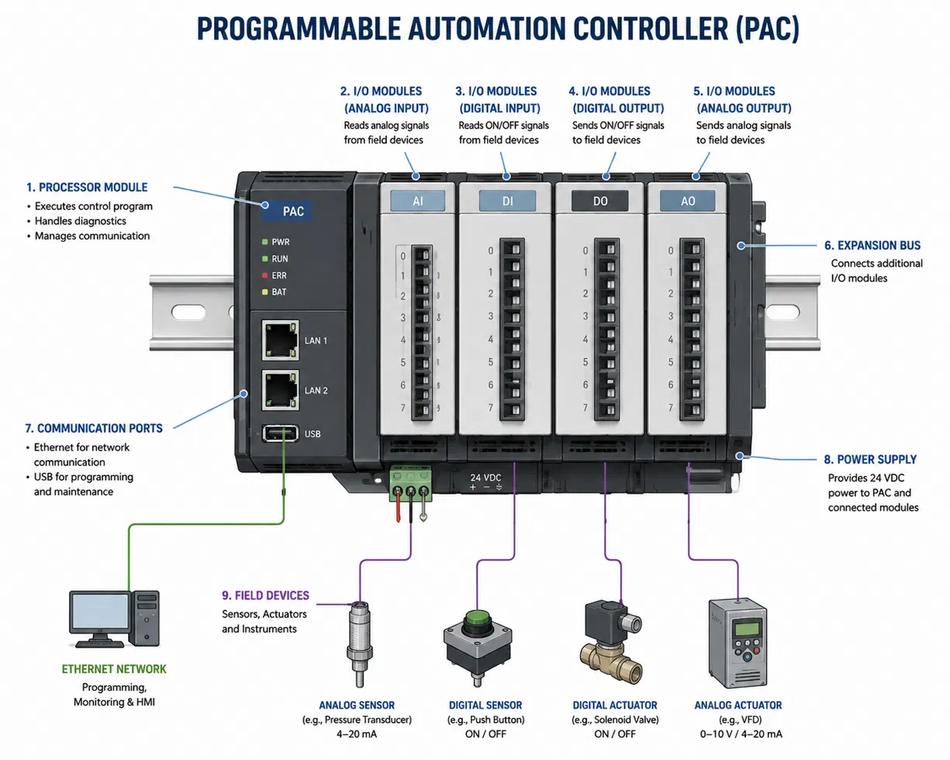
The distinction matters because modern automation systems rarely need discrete logic alone. They need coordinated motion, PID loop control, recipe handling, historical data logging, and a path for production data to reach a database. Traditional PLCs met those needs by bolting on separate, separately programmed cards. 2 A PAC has them designed in. If you want the underlying fundamentals first, start with our comprehensive guide to what a PLC is.
Industrial analyst firm ARC Advisory Group coined the acronym in 2001 to differentiate this class of hardware platform from the traditional PLC. 3 As Control Design explains, the basic premise of the PAC is the integration of all those add-on functions into one platform by design, rather than assembled from separate modules after the fact. 3
How the PAC Category Emerged
The PAC exists because two different starting points converged on the same requirement.
The first path was making a PLC more like a PC. Applications that diverge from discrete relay-replacement logic become hard to express in ladder logic. Mathematically complex tasks such as PID temperature loops involve floating-point arithmetic, and older PLCs needed separate hardware cards to perform them, as Opto 22 documents in its white paper on PACs in industrial automation. Adding network connectivity and enterprise data integration meant adding processors, gateways, converters, and middleware running on a separate PC. 2
The second path was making a PC more like a PLC. Industrial computers already handle networking and data communication well, but a general-purpose operating system is not optimized for deterministic control. Reaching deterministic or near-deterministic operation required I/O expansion cards and real-time extensions to the operating system.2
Vendors closed the gap from both directions at once, folding PLC-grade deterministic control into a platform that also carries a PC's configurability and enterprise connectivity. The result is the PAC. 2
The ARC Criteria: What Makes a Controller a PAC
ARC defined the PAC by what it does, not by its shape. According to the criteria documented in the Opto 22 white paper 2, a programmable automation controller should:
Operate on a single platform across multiple domains, including logic, motion, drives, and process control.
Use a single development platform with common tagging and a single database for development tasks across disciplines.
Tightly integrate controller hardware and software.
Be programmable with software tools that can design control programs supporting a process that flows across several machines or units.
Operate on open, modular architectures that mirror industry applications, from machine layouts in factories to unit operations in process plants.
Employ de facto standards for network interfaces, languages, and protocols, allowing data exchange in networked multi-vendor systems.
Provide efficient processing and I/O scanning.
TechTarget's own summary of ARC's criteria confirms the same requirements independently, and frames the standards-based use of TCP/IP and Ethernet as what makes multi-vendor compatibility practical rather than theoretical. 4
Read those criteria as a checklist for evaluation. Opto 22 offers a blunt rule of thumb: if you need to add processors, network interfaces, or middleware to give a controller more PLC-like or PC-like features, look at controllers that match the PAC characteristics more closely. 2
PAC Architecture: What Is Inside
Processor and Operating System
The processing subsystem is where PACs separate most clearly from compact programmable controllers. Three current designs show the range of approaches.
Emerson's PACSystems RX3i CPL410 runs a quad-core processor with a real-time hypervisor, executing deterministic control on VxWorks concurrently with an Ubuntu Linux partition, so control and analytics coexist without interfering with each other. 9
Opto 22's groov EPIC uses an industrial quad-core Arm processor running a real-time open-source Linux OS, with published specifications of 2 GB RAM and 6 GB of user space on the PR1 processor, or 3.75 GB RAM and 22 GB on the PR2. 10
NI's CompactRIO pairs a Linux Real-Time controller with a user-programmable FPGA in the chassis, I/O modules connect directly to the FPGA rather than through a bus, which cuts control latency for the fastest loops. 11
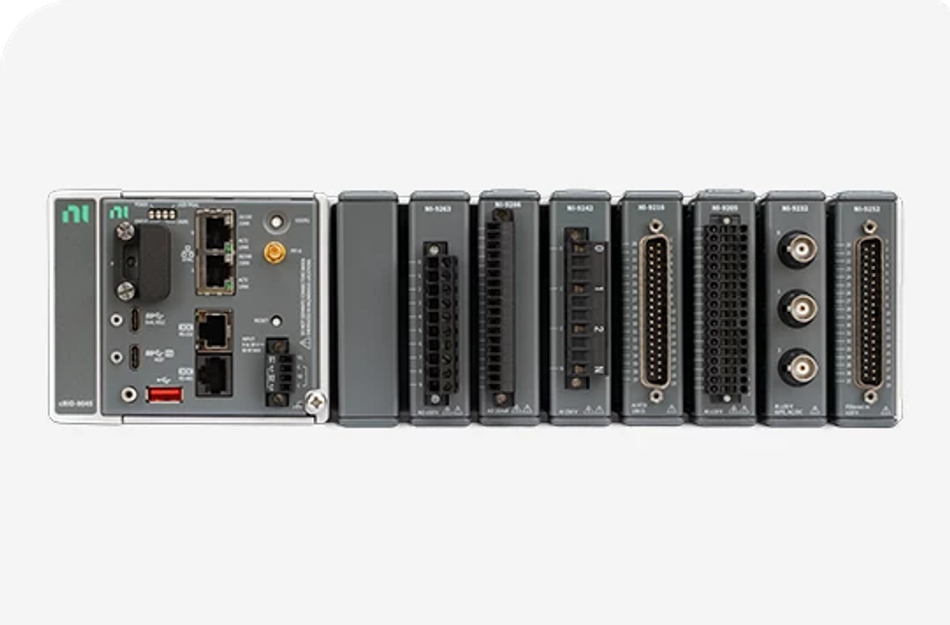
The pattern is consistent: a real-time execution environment for control, plus general-purpose compute for everything else.
Memory and Program Storage
Memory capacity is the most concrete, checkable difference between a small PLC and a PAC.
Rockwell Automation's ControlLogix 5580 family offers 3 to 40 MB of user memory, a 1 Gbps embedded Ethernet port, and delivers 5 to 20 times the performance of the earlier 5570 controllers. 8 Emerson's CPL410 carries 64 MB of RAM and 64 MB of non-volatile flash for the control application, with a separate 2 GB of RAM and 50 GB SSD for the Linux edge partition. 9
Compare that to a compact PLC measured in kilobytes of program memory, and the reason PACs suit recipe-driven, data-heavy, or multi-axis applications becomes obvious.
I/O Architecture
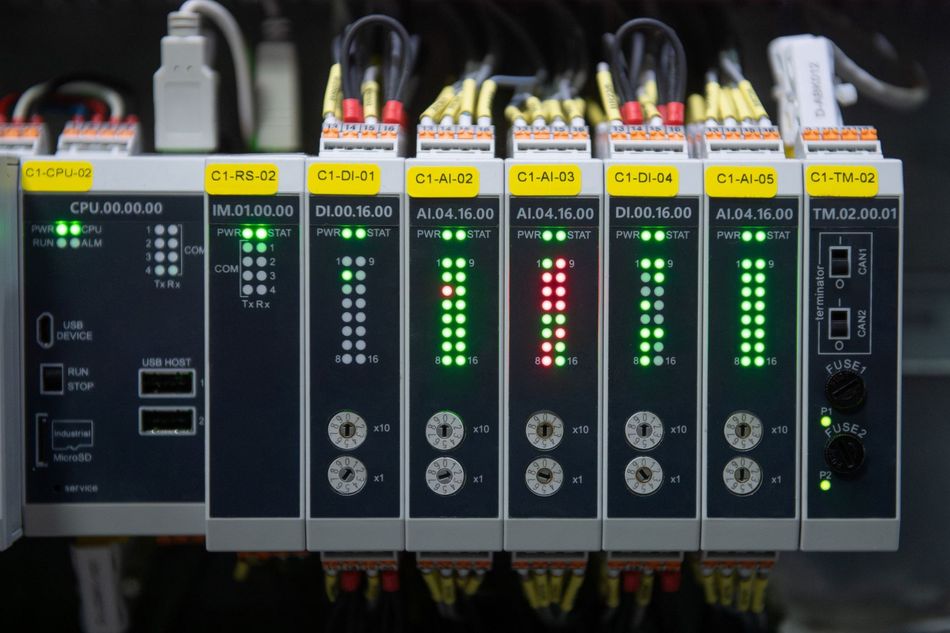
PACs handle digital, analog, and serial I/O concurrently, and they usually support remote I/O over the same industrial Ethernet used for everything else. Scale and resolution both matter here.
The ControlLogix family reaches a maximum of 128,000 digital and 4,000 analog I/O points. 8 The groov EPIC chassis accepts 0, 4, 8, or 16 modules with up to 24 channels each, and its analog inputs offer 20-bit resolution at 0.1% accuracy. 10 Sensors and actuators that lack native Ethernet connect through these I/O modules, which then communicate with the controller over the plant network.
Recommended Reading: What is a PLC (Programmable Logic Controllers): A Comprehensive Guide
Programming a PAC: IEC 61131-3 and Tag-Based Development
The IEC 61131-3 Languages
Programming languages for programmable controllers are standardized in IEC 61131-3. The current fourth edition was published on 22 May 2025 and specifies a suite consisting of the textual language structured text (ST) and the graphical languages ladder diagram (LD) and function block diagram (FBD), plus sequential function chart (SFC) elements for structuring the internal organization of programs and function blocks, per the IEC. 5
Two changes are worth knowing. The 2013 third edition added object-oriented extensions, including classes, interfaces, and methods on function blocks. Instruction list, one of the original five languages, was deprecated in that edition and is no longer part of the language suite in the fourth edition, which instead adds UTF-8 strings and their associated functions. 5 PLCopen builds on the standard with additional specifications for motion control function blocks, safety, and XML exchange schemes. 7
The practical consequence for PAC users is that you can mix languages inside one control strategy: ladder logic for interlocks that maintenance staff must read, structured text for algorithms and data manipulation, function block diagram for process loops, and sequential function chart for batch or state-driven sequences.
Tag-based Addressing and the Shared Database
The single most underrated PAC advantage is the tag name database. In a register-addressed PLC, a value lives at an address such as N7:12, and its meaning exists only in documentation and in the programmer's head. In a tag-based PAC, that value is a named, typed variable, and the same tag name database is shared by every tool in the integrated development environment (IDE).
Register-addressed (PLC) | Tag-based (PAC) | |
Example reference | N7:12 | Motor1_Speed |
What it means | Documented separately, memorized by the programmer | Self-descriptive, typed variable |
Shared across tools | No, must be manually mapped between programs | Yes, same tag used in logic, HMI, and historian |
Risk when systems grow | Mapping errors, out-of-sync values | None, single source of truth |
Opto 22 makes the point directly: the IDE used to program a PAC includes a single tagname database shared by all development tools, so one software package addresses current and future automation needs instead of several packages and utilities from different vendors. That shared database is also what lets the HMI, the historian, and the control program refer to the same object without a mapping layer. 2
Recommended Readings: HMI Technologies: The Ultimate Guide to Human-Machine Interface Innovations
Dropping to General-purpose Languages
Where IEC 61131-3 is a poor fit, PACs let you go lower or higher. MITRE notes that PACs support IEC 61131 languages plus C and C++ for advanced control. Emerson's RX3i can run applications in IEC 61131-3 languages and C. 9 The groov EPIC supports flowchart-based PAC Control, IEC 61131-3 languages through CODESYS, optional secure shell access for custom applications, and Node-RED for data flows. 10 CompactRIO is programmed in LabVIEW with Real-Time and FPGA modules.11
This is a genuine architectural difference, not a marketing one. Vision algorithms, custom filtering, protocol adapters, and machine-learning inference are all awkward in ladder logic and straightforward in C or Python.
Networking and Enterprise Integration
Industrial Ethernet
A PAC is expected to speak standard network technologies rather than a proprietary fieldbus. The three protocols you will meet most often are EtherNet/IP, PROFINET, and Modbus TCP.
EtherNet/IP, an industrial Ethernet protocol built on standard TCP/IP with the Common Industrial Protocol (CIP) layered on top, combines standard Ethernet and TCP/IP with CIP. ODVA describes it as running on standard, unmodified Ethernet infrastructure, using TCP/IP and also UDP for real-time cyclic data transmission, with CIP Sync, CIP Motion, and CIP Safety extending it into synchronization, motion, and safety-rated applications. 12
PROFINET performance is concrete on real hardware: the Emerson CPL410 supports embedded PROFINET with I/O update rates as fast as 1 ms across up to 32 devices, plus Modbus TCP, Ethernet Global Data, DNP3, and HART passthrough on the same controller. 9 PROFINET University makes a useful observation about naming: in PROFINET terminology, a PLC, a DCS, and a PAC are all simply called controllers, which is a reminder that the network layer does not care about the marketing category. 14
OPC UA and the Path to Enterprise Systems
Getting data off the controller and into business systems is the second half of the PAC value proposition. OPC UA is the usual mechanism. The OPC Foundation describes it as a platform-independent, service-oriented architecture with object-oriented information modeling, layered security including encryption and X.509 certificate authentication, and a publish-subscribe mechanism for many-to-many configurations, spanning everything from an embedded microcontroller to cloud infrastructure. 13
In practice, a PAC will exchange data with an OPC server, an operator interface, and a SQL database at the same time as it runs control, and that SQL database in turn feeds ERP, OEE, and supply chain management systems. Handling those tasks simultaneously without extra processors, gateways, or middleware is, in Opto 22's framing, a hallmark of a PAC. 2
Edge Computing
Edge computing has become the clearest current differentiator. The CPL410 embeds PACEdge with a Linux partition, an OPC UA client, a Python interpreter, an SQLite database, and an Apache web server alongside the control runtime. 9 The groov EPIC supports MQTT with Sparkplug payloads and a RESTful API to the processor. Both let you preprocess, aggregate, and buffer data locally instead of shipping raw tags to a central historian.
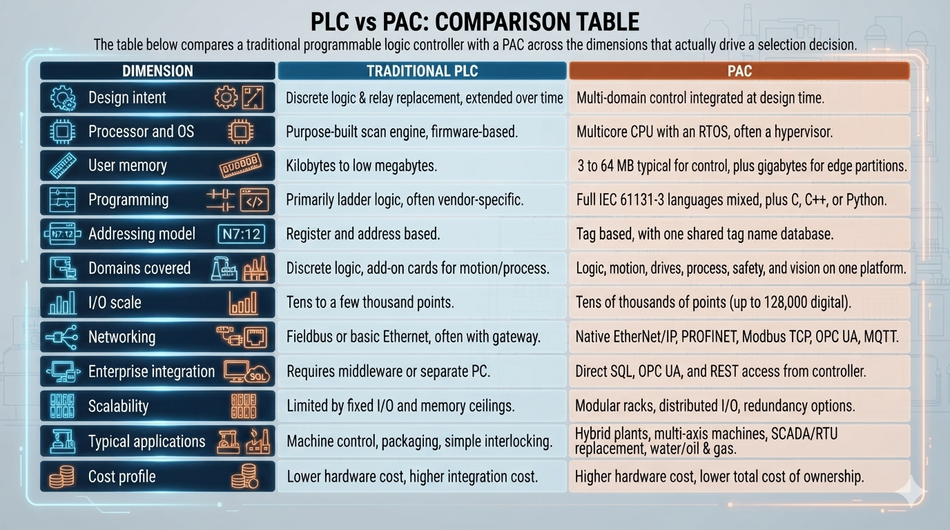
PLC vs PAC: Comparison Table
The table below compares a traditional programmable logic controller with a PAC across the dimensions that actually drive a selection decision.
Dimension | Traditional PLC | PAC |
Design intent | Discrete logic and relay replacement, extended over time with add-on modules | Multi-domain control integrated at design time |
Processor and OS | Purpose-built scan engine, firmware-based execution | Multicore CPU with an RTOS, often a hypervisor running Linux in parallel |
User memory | Kilobytes to low megabytes | 3 to 64 MB typical for control, plus gigabytes for edge partitions. 8,16 |
Programming | Primarily ladder logic, often a vendor-specific dialect | Full IEC 61131-3 language set mixed in one strategy, plus C, C++, or Python.5 |
Addressing model | Register and address based (for example N7:12) | Tag based, with one shared tag name database across all tools.2 |
Domains covered | Discrete logic, with add-on cards for motion or process | Logic, motion, drives, process, safety, and vision on one platform. 1 |
I/O scale | Tens to a few thousand points | Tens of thousands of points (up to 128,000 digital on ControlLogix).8 |
Networking | Fieldbus or basic Ethernet, often with a gateway | Native EtherNet/IP, PROFINET, Modbus TCP, OPC UA, MQTT. 9,12-14 |
Enterprise integration | Requires middleware or a separate PC | Direct SQL, OPC UA, and REST access from the controller. 2,13 |
Scalability | Limited by fixed I/O and memory ceilings | Modular racks, distributed I/O, redundancy options |
Typical applications | Machine control, packaging lines, simple interlocking | Hybrid discrete and process plants, multi-axis machines, SCADA and RTU replacement, water treatment, oil and gas |
Cost profile | Lower hardware cost, higher integration cost for complex systems | Higher hardware cost, lower total cost of ownership on complex systems |
Two warnings about this table. First, it compares a traditional PLC with a PAC. High-end programmable controllers from every major vendor now meet most PAC criteria, and MITRE's own asset classification notes that PACs share much of the same functionality as a PLC, including many of the same advanced process, motion, and drive control features. 1 Second, the boundary is commercial as much as technical. Some vendors market the same silicon as a PLC in one catalog and a PAC in another.
Scalability, Determinism, and Performance
A PAC is still a real-time controller, and the scan cycle still governs behavior. Reading inputs, executing logic, and writing outputs happens on a repeating cycle, and what you care about is the worst-case cycle time, not the average.
Where PACs differ is task structure. Instead of one monolithic scan, a PAC typically supports multiple tasks at different priorities and periods: a 1 ms motion task, a 10 ms machine logic task, a 500 ms process loop, and a background task for data logging and communications. This is how a single controller runs coordinated motion and slow PID loop control without the slow work stealing time from the fast work.
Concrete performance anchors help when sizing a system:
The standard ControlLogix 5580 controller supports up to 256 axes of integrated motion over EtherNet/IP and up to 300 nodes on its embedded 1 Gb Ethernet port. 8
The GuardLogix 5580, the safety-rated variant of the same platform, scales from 100 to 250 EtherNet/IP nodes depending on catalog number, and reaches SIL CL 2 / PLd with a primary controller, or SIL CL 3 / PLe with a primary controller plus a safety partner. 17
The Emerson CPL410 supports 1 ms PROFINET I/O update rates, with media redundancy (MRP), PROFINET system redundancy, and OPC UA non-transparent server redundancy for high-availability architectures.9
If your application needs coordinated multi-axis motion, VFDs under closed-loop control, or hot-standby redundancy, those numbers are the ones to check against your cycle budget. For context on how response times compare across architectures, our guide to the difference between PLC and DCS covers the performance envelopes of centralized and distributed approaches.
Recommended Reading: What is a Distributed Control System (DCS)?
PAC vs PLC vs DCS vs Industrial PC vs RTU
The controller landscape is crowded, and the categories overlap. The distributed control system (DCS) in particular shares a lot of ground with modern controllers in hybrid plants. A short orientation:
Controller type | Core strength | Where it fits |
PLC | Fast, reliable discrete logic at low cost | Machine control, packaging, conveyors, interlocks |
PAC | Multi-domain control plus data and networking | Hybrid plants, multi-axis machines, data-heavy applications |
DCS | Plant-wide continuous process control with integrated operator displays | Refineries, chemical plants, water treatment |
Industrial PC | Maximum compute, general-purpose software | Vision, analytics, soft control with real-time extensions |
RTU | Remote telemetry over constrained links | Pipelines, wellheads, lift stations, dispersed assets |
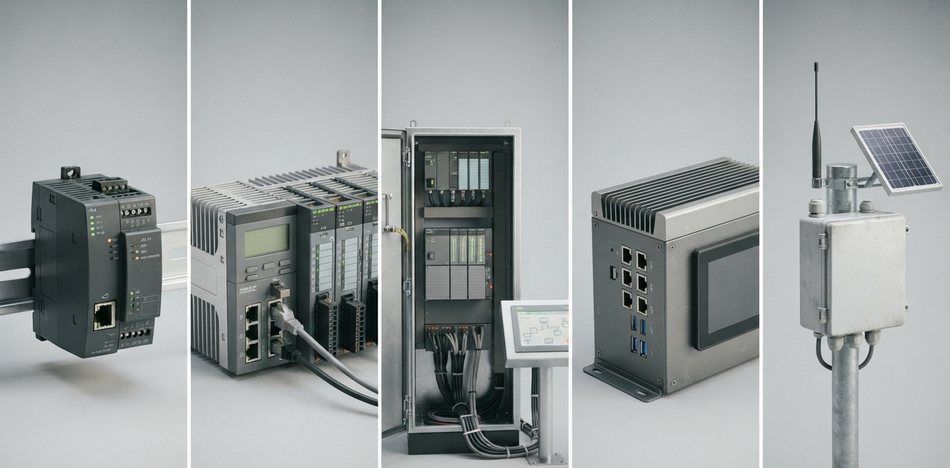
The RTU comparison deserves detail because PACs increasingly replace them. A remote terminal unit is a controller-like device installed at a remote site to collect sensor data, typically as part of a SCADA network, sending data to a SCADA master and receiving commands back. Traditional PLCs were not built for the low-bandwidth, intermittent communication links common at remote sites, which is why RTUs emerged as a specialized product class for telemetry over radio and leased lines. 15
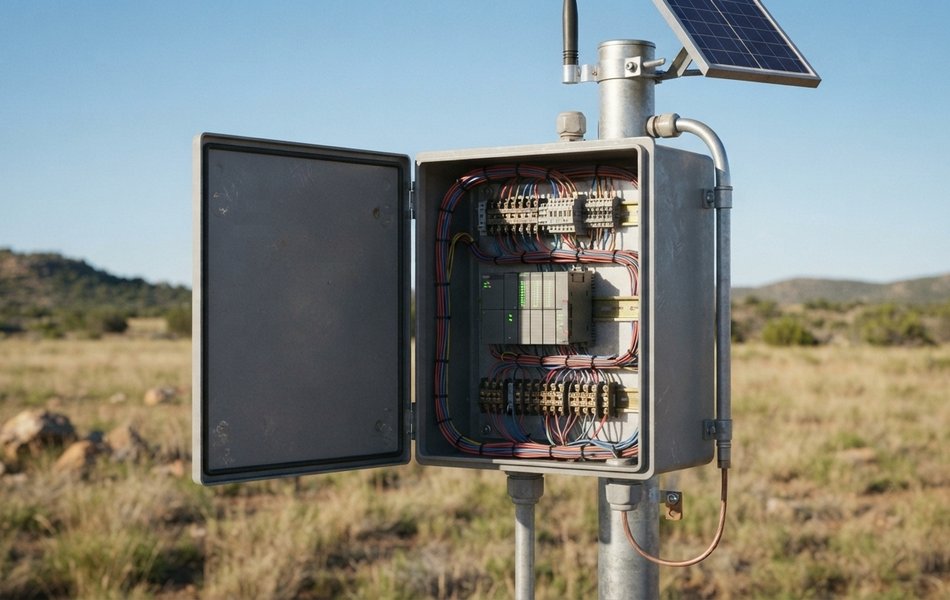
The problem is that legacy RTU communications were designed for private radio or leased lines. Modern IP-based wired and wireless networks are more flexible and often cheaper, so retrofitting old RTU technology rarely makes sense. PACs offer better communications, versatile I/O, and broad temperature and shock specifications, which make them a strong replacement when proprietary networks are retired.
PACs also displace PC-based data acquisition hardware in the field. A DAQ system gives fast signal acquisition and storage but is typically built around general-purpose PC hardware and software, which usually means more careful environmental protection is needed for continuous field deployment than a PAC requires out of the box. A PAC can condition and multiplex signals, convert raw data into engineering units before it reaches a database, and survive a field enclosure.
Recommended Reading: What is SCADA?: The Basics you Need to Know
How to Choose Between a PLC and a PAC
Work through these questions in order. The first one that returns a clear yes usually decides it.
How many control domains are involved? If the application is discrete logic only, a PLC is likely sufficient. If it combines logic with coordinated motion, closed-loop process control, VFDs, or machine vision, the single-platform argument for a PAC starts paying immediately.
How complex is the data? Recipes, batch records, statistical calculations, and structured data types are painful in register-addressed ladder logic and natural in a tag-based PAC with structured text.
Where does the data need to go? If production data must reach a SQL database, a historian, an MES, or a cloud service, check whether the controller can do it natively. Needing middleware or a gateway PC is the signal that you have outgrown the PLC.
What are the I/O count and memory ceilings? Size for the final phase of the project, not the first. Hitting a memory or node limit mid-project is expensive.
Do you need edge processing? Local analytics, protocol translation, buffering during network outages, and custom code all point to a PAC with a general-purpose partition.
What are the availability requirements? Hot-standby redundancy, media redundancy, and dual-server OPC UA are PAC-class features.
Who maintains it? A plant team fluent in ladder logic and unfamiliar with structured text is a real constraint. Factor training into the decision rather than discovering it at commissioning.
What is the lifecycle cost? PAC hardware costs more up front. Fewer components, one IDE, and less integration work often reverse that over the system's life.
Environmental and Compliance Requirements
Controller selection is not only a functional exercise. Equipment requirements for programmable controllers and their peripherals are specified in IEC 61131-2, whose fourth edition was published on 23 August 2017. The standard covers functional and electromagnetic compatibility requirements and the related verification tests, including digital input and output specifications and radio-frequency immunity extended to the 2.7 GHz to 6 GHz range to reflect the spread of wireless equipment. 6
Real products declare compliance against it explicitly. The Emerson CPL410 lists IEC/EN 61131-2 for environmental and EMC conformance, an operating range of -40 °C to 70 °C, ATEX Category 3 equipment marking, Class I Division 2 hazardous location approval, and marine approvals from ABS, DNV-GL, BV, and LR. 9 The groov EPIC is rated -20 °C to 70 °C with UL hazardous locations approval and ATEX compliance. 10
Check these before the datasheet's headline specs. A controller that cannot legally be installed in your enclosure or classified area is not a candidate, no matter how fast it is.
Cybersecurity Considerations
PACs sit in the control layer of industrial control systems (ICS), which makes them a target. MITRE's ATT&CK for ICS framework catalogs the PAC as asset A0018 and maps more than 50 applicable techniques to it, including program download and upload, firmware modification, controller tasking changes, network enumeration, denial of service, and device shutdown. 1
Treat that catalog as a design input. Countermeasures at the controller level now ship as product features: the CPL410 carries Achilles Level 2 certification, a Trusted Platform Module, secure boot, and encrypted firmware updates from a central location. 9 The groov EPIC provides firewalls, encryption, user authentication, LDAP support, certificate management, and a VPN client.10
For system-level guidance, NIST Special Publication 800-82 Revision 3, Guide to Operational Technology (OT) Security, published in September 2023, covers PLCs, DCS, and SCADA systems and works through threat identification, countermeasures, typical OT topologies, and risk management adapted to systems that must balance security against performance, reliability, and safety. 15
The recurring mistake is treating an edge-capable PAC as an IT device on the plant floor. A controller with a Linux partition, a web server, and a cloud client has a materially larger attack surface than a closed PLC, and it needs network segmentation and patch management to match.
Common Mistakes and Limitations
Buying capability you will not use. A PAC is more expensive and more complex to support. If the application is a conveyor and twelve interlocks, a compact programmable controller is the right engineering answer.
Assuming the label guarantees the capability. Check the ARC criteria against the datasheet. 2,4 Some products marketed as PACs are PLCs with an Ethernet port.
Ignoring the maintenance skill gap. Structured text and object-oriented function blocks are powerful and unfamiliar. Diagnosing a fault at 3 a.m. in a language nobody on shift reads is a real availability risk.
Underestimating the tag database migration. Converting a register-addressed legacy application to tag-based structures is a rewrite, not a conversion. Budget accordingly.
Loading the control task with communications. Put SQL writes, data logging, and reporting on a lower-priority task. Mixing them into the fast loop is the most common cause of jitter.
Leaving default credentials and open services. Edge partitions ship with web servers and APIs enabled. Harden them before commissioning.
Forgetting the environmental envelope. Temperature, vibration, and hazardous-area classification eliminate more candidate controllers than performance does. 6
Conclusion
A programmable automation controller is not simply a bigger PLC. It is a controller designed from the start to run several control domains on one processor, to be programmed from one IDE against one tag name database, and to move data to enterprise systems without middleware.
That definition, set out by ARC Advisory Group in 2001, has aged well even as the hardware categories converged. The evaluation question today is not whether a product is called a PAC, but whether it satisfies the criteria your application actually needs: multi-domain execution, tag-based development, open standards-based networking, sufficient memory and I/O headroom, and an appropriate security and environmental rating.
Start with the domains and the data, size for the final phase of the project, and verify the compliance marks before the performance numbers.
Frequently Asked Questions
What is the difference between a PLC and a PAC?
A traditional PLC is optimized for discrete logic and is programmed largely in ladder logic with register-based addressing. A PAC covers logic, motion, drives, and process control on one platform, uses tag-based addressing with a shared database, supports the full IEC 61131-3 language set plus general-purpose languages 5, and integrates directly with enterprise networks. In practice, the categories have converged, so compare capabilities, not labels.1
Who invented the term PAC?
ARC Advisory Group coined "programmable automation controller" in 2001 to help vendors describe multi-domain controller capabilities more precisely than the term PLC allowed, separating this hardware class by function rather than form factor. 3
Is a PAC the same as an industrial PC?
No. Industrial computers run general-purpose operating systems and need real-time extensions and I/O expansion cards to perform deterministic control. 2 A PAC provides deterministic control natively, often pairing it with PC-like compute through a hypervisor that isolates the two.9
What programming languages do PACs use?
The IEC 61131-3 languages: structured text, ladder diagram, function block diagram, and sequential function chart for program structuring. Instruction list was removed in the 2025 fourth edition. 5 Many PACs additionally support C, C++, Python, or graphical environments such as LabVIEW.1,11
Can a PAC replace an RTU?
Often, yes. PACs offer stronger communications, flexible I/O, and wider temperature and shock ratings than legacy RTUs, which were built for private radio or leased-line links. 15 PACs are a common replacement when proprietary SCADA networks are retired.
Do PACs replace a DCS?
Not usually. A DCS is built for plant-wide continuous process control with integrated operator displays. PACs compete in hybrid plants mixing discrete and process control, but large continuous process facilities like refineries typically stay on DCS.
How much memory does a PAC have?
It varies by product. Rockwell's ControlLogix 5580 offers 3 to 40 MB of user memory. 8 Emerson's RX3i CPL410 has 64 MB for control plus 2 GB for its Linux edge partition. 9 Opto 22's groov EPIC carries 2 to 3.75 GB of RAM. 10
Are PACs secure?
PACs ship with security features like secure boot, Trusted Platform Modules, certificate management, and encrypted firmware updates. 9,10 They're also a mapped target class in MITRE ATT&CK for ICS, so edge-capable models need network segmentation and patch management, per NIST SP 800-82. 1,15
What does a PAC cost compared with a PLC?
PAC hardware costs more up front. Over the system's life, fewer add-on processors, one development environment, and less integration work often lower total cost of ownership compared with a PLC assembled from multiple specialized components.
What is the ARC criteria for a PAC?
ARC Advisory Group defines a PAC by seven capabilities: multi-domain control on one platform, a single development environment with shared tagging, tightly integrated hardware and software, multi-unit process support, open modular architecture, standards-based networking, and efficient I/O scanning.2,4
How many I/O points can a PAC handle?
High-end PACs scale far beyond compact PLCs. Rockwell's ControlLogix 5580 supports up to 128,000 digital and 4,000 analog I/O points, compared with a few thousand points on a typical compact PLC. 8
What is tag-based addressing?
Tag-based addressing names a value descriptively, like Motor1_Speed, instead of a register like N7:12. A PAC shares one tag database across its IDE, HMI, and historian, so every tool references the same variable without manual mapping. 2
What networking protocols does a PAC support?
PACs natively support standards-based industrial Ethernet, including EtherNet/IP, PROFINET, and Modbus TCP for device-level communication 9,12,14, plus OPC UA for secure, platform-independent data exchange with enterprise systems, SQL databases, and cloud services.13
References
[1] MITRE ATT&CK, "Programmable Automation Controller (PAC), Asset A0018." [Online]. Available: https://attack.mitre.org/assets/A0018/
[2] Opto 22, "Understanding Programmable Automation Controllers (PACs) in Industrial Automation," White Paper, Form 1634. [Online]. Available: https://documents.opto22.com/1634_PAC_White_Paper.pdf
[3] Control Design, "What Is a Programmable Automation Controller?" [Online]. Available: https://www.controldesign.com/control/plcs-pacs/article/55142874/what-is-a-programmable-automation-controller
[4] TechTarget, "What Is a Programmable Automation Controller (PAC)?" [Online]. Available: https://www.techtarget.com/whatis/definition/programmable-automation-controller-PAC
[5] International Electrotechnical Commission, IEC 61131-3:2025, Programmable Controllers — Part 3: Programming Languages, 2025. [Online]. Available: https://webstore.iec.ch/en/publication/68533
[6] International Electrotechnical Commission, IEC 61131-2:2017, Programmable Controllers — Part 2: Equipment Requirements and Tests, 2017. [Online]. Available: https://webstore.iec.ch/en/publication/31007
[7] PLCopen, "IEC 61131-3." [Online]. Available: https://plcopen.org/iec-61131-3
[8] Rockwell Automation, "ControlLogix 5580 Controllers." [Online]. Available: https://www.rockwellautomation.com/en-us/products/hardware/programmable-controllers/1756controllogix5580.html
[9] Emerson, "PACSystems RX3i CPE400 and CPL410 Data Sheet." [Online]. Available: https://www.emerson.com/documents/automation/product-data-sheet-pacsystems-rx3i-cpl410-pacsystems-en-6156766.pdf
[10] Opto 22, "groov EPIC Specifications and Features." [Online]. Available: https://www.opto22.com/products/groov-epic-system/groov-epic-specs-and-features
[11] NI, "CompactRIO Systems." [Online]. Available: https://www.ni.com/en/shop/compactrio.html
[12] ODVA, "EtherNet/IP." [Online]. Available: https://www.odva.org/technology-standards/key-technologies/ethernet-ip/
[13] OPC Foundation, "OPC Unified Architecture." [Online]. Available: https://opcfoundation.org/about/opc-technologies/opc-ua/
[14] PROFINET University, "Automation Controllers." [Online]. Available: https://profinetuniversity.com/industrial-automation/automation-controllers/
[15] National Institute of Standards and Technology, SP 800-82 Rev. 3, Guide to Operational Technology (OT) Security, Sep. 2023. [Online]. Available: https://csrc.nist.gov/pubs/sp/800/82/r3/final
[16] Opto 22, "SNAP PAC R-Series Programmable Automation Controller Data Sheet," Form 1594. [Online]. Available: https://documents.opto22.com/1594_SNAP_PAC_R-Series_data_sheet.pdf
[17] Rockwell Automation, "ControlLogix 5580 and GuardLogix 5580 Controllers." [Online]. Available: https://www.rockwellautomation.com/en-us/products/hardware/programmable-controllers/1756controllogix5580.html
in this article
1. Key Takeaways2. Introduction3. What is a Programmable Automation Controller (PAC)?4. How the PAC Category Emerged5. The ARC Criteria: What Makes a Controller a PAC6. PAC Architecture: What Is Inside7. Programming a PAC: IEC 61131-3 and Tag-Based Development8. Networking and Enterprise Integration9. PLC vs PAC: Comparison Table10. Scalability, Determinism, and Performance11. PAC vs PLC vs DCS vs Industrial PC vs RTU12. How to Choose Between a PLC and a PAC13. Environmental and Compliance Requirements14. Cybersecurity Considerations15. Common Mistakes and Limitations16. Conclusion17. Frequently Asked Questions18. References