Volatile vs. Non-Volatile Memory: An Engineer's Guide to Choosing the Right Architecture
Compare memory technologies like SRAM, DRAM, Flash, MRAM, FeRAM, ReRAM, PCM, and EEPROM to understand their architectures and ideal engineering applications.

18 Aug, 2026. 6 minutes read
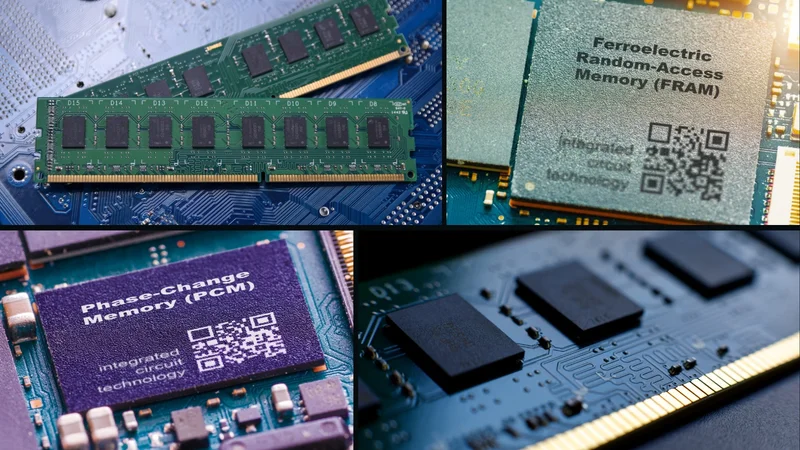
Choosing memory for a modern device is no longer a simple question of how much storage is needed. It is a question of how fast data must move, how often it must be rewritten, and how reliably it must survive.
An autonomous vehicle, factory robot, AI edge device, or connected medical monitor may contain five or more different memory types working together. Each is chosen to optimize a different requirement, whether that is nanosecond access time, millions of write cycles, low standby power, long-term data retention, or resistance to harsh operating environments.
As memory technologies continue to evolve, engineers must consider more than just capacity and cost. This article compares modern volatile and non-volatile memories, including SRAM, DRAM, Flash, EEPROM, MRAM, FeRAM, ReRAM, and PCM. It also explores their architectures and the trends shaping the future of memory design.
Understanding the Major Memory Technologies
Every memory technology optimizes a different set of performance characteristics. Some prioritize speed, others maximize storage density, while emerging memories focus on endurance, power efficiency, or data retention. Hence, modern electronic systems often combine multiple memory types rather than relying on a single solution.
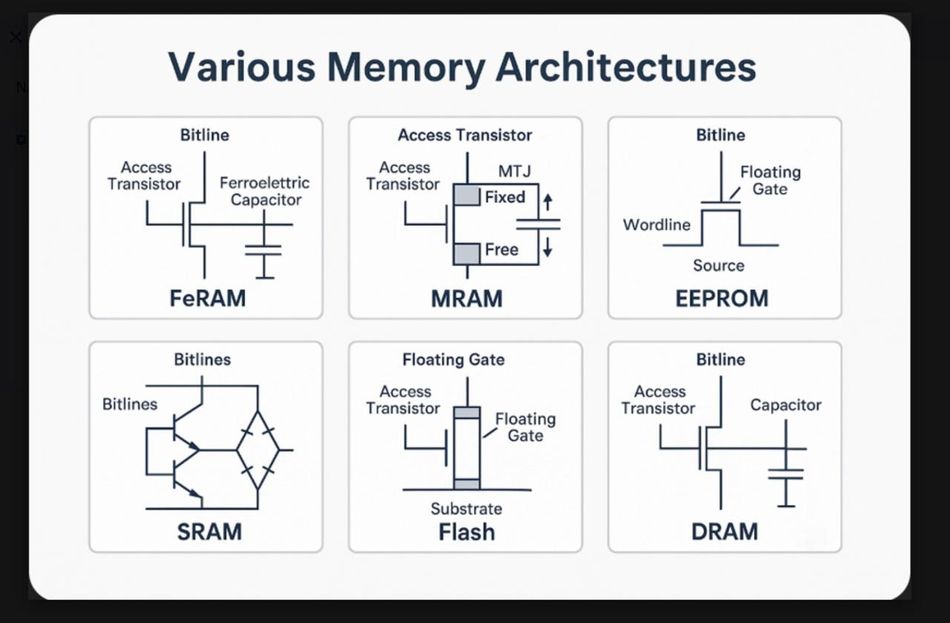
Let’s explore these in detail:
1. SRAM (Static Random Access Memory)
Architecture: Six-transistor (6T) cell that stores data using bistable latches; no refresh required.
Performance: Fastest mainstream memory with extremely low latency.
Strengths: High speed, reliable random access, virtually unlimited read cycles.
Weaknesses: Large cell size, low density, and high cost per bit.
Best applications: CPU caches (L1/L2/L3), networking equipment, and FPGA on-chip memory.
2. DRAM (Dynamic Random Access Memory)
Architecture: One-transistor, one-capacitor (1T1C) cell that requires periodic refresh.
Performance: High capacity and bandwidth with higher latency than SRAM.
Market insight: DRAM accounts for about 45% of the global memory market, driven by increasing adoption of DDR5 and High Bandwidth Memory (HBM) in AI servers and high-performance computing.
Best applications: System memory for PCs, servers, graphics processors, and AI accelerators.
3. Flash Memory (NAND vs. NOR)
Architecture: Stores data by trapping electrical charge in floating-gate or charge-trap transistors, enabling non-volatile storage.
Performance: NAND Flash provides high sequential read/write speeds, while NOR Flash offers faster random access for code execution.
NAND Flash: High-density storage with fast sequential access, making it ideal for SSDs, smartphones, and memory cards.
NOR Flash: Faster random reads with execute-in-place (XIP) capability for firmware storage.
Strengths: Non-volatile, cost-effective, and widely available.
Weaknesses: Limited write endurance and slower write speeds than RAM technologies.
4. EEPROM
Architecture: Electrically rewritable non-volatile memory with byte-level erase capability.
Performance: Slower read and write speeds than Flash and RAM, but supports precise updates to small amounts of data.
Strengths: Reliable storage for small amounts of persistent data.
Weaknesses: Slow writes and limited capacity.
Best applications: Device configuration, calibration data, and system settings.
5. FeRAM (Ferroelectric RAM)
Architecture: Uses a ferroelectric layer instead of a conventional capacitor.
Performance: Offers fast write speeds, low latency, and extremely high write endurance.
Strengths: Extremely low write power, fast writes, and very high endurance.
Weaknesses: Lower storage density than Flash.
Best applications: Smart meters, industrial automation, medical devices, and battery-powered IoT products.
6. MRAM (Magnetoresistive RAM)
Architecture: Stores data using magnetic tunnel junctions instead of electrical charge.
Performance: Provides fast read/write access comparable to SRAM while maintaining non-volatile data retention.
Strengths: Fast, non-volatile, high endurance, and radiation-resistant.
Weaknesses: Higher manufacturing cost than DRAM or Flash.
Best applications: Automotive, aerospace, industrial controllers, and embedded systems.
7. ReRAM (Resistive RAM)
Architecture: Changes the resistance of a dielectric material to represent data.
Performance: Offers low-latency operation and potential for high-density storage, although performance varies by material and implementation.
Strengths: Low operating voltage, high potential density, and promising AI capabilities.
Weaknesses: Commercial adoption is still limited.
Best applications: Edge AI, embedded non-volatile memory, and neuromorphic computing.
8. PCM (Phase Change Memory)
Architecture: Stores data by switching phase-change materials between crystalline and amorphous states.
Performance: Delivers faster access than NAND Flash but slower operation than DRAM.
Strengths: Faster writes and higher endurance than NAND Flash.
Weaknesses: Higher write energy and manufacturing complexity.
Best applications: Storage-class memory, enterprise storage, and emerging AI systems.
Memory Technologies at a Glance
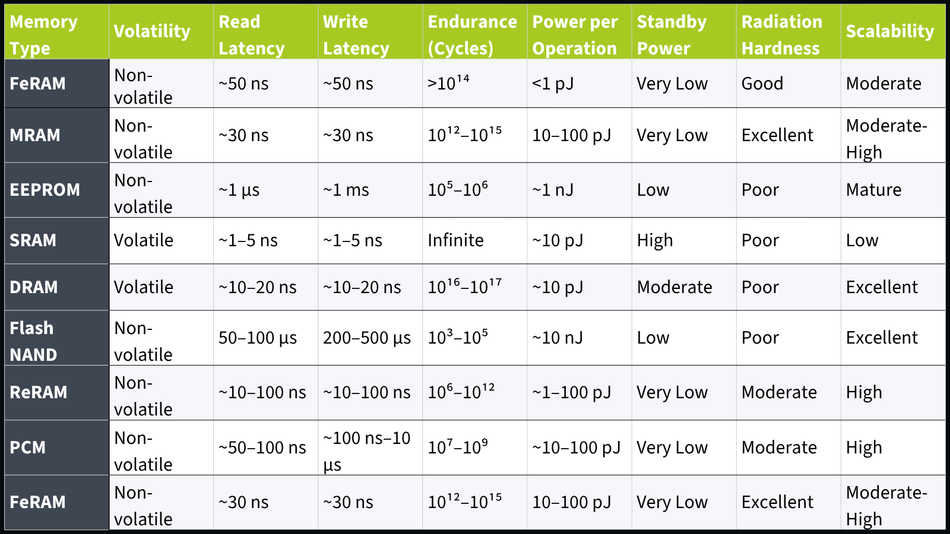
Which Memory Technology Fits Your Application?
As AI, edge computing, connected devices, and industrial automation continue to evolve, memory architectures will become application-specific. Understanding the strengths and limitations of each technology enables engineers to build systems that meet today's performance requirements while remaining adaptable to future workloads.
Here is how to choose:
If you're building… | What matters most | Recommended memory | Why it's a good fit |
Wearables | Long battery life and reliable data retention | FeRAM, MRAM, NOR Flash | Low power consumption and non-volatile storage help maximize battery life while preserving data during power loss. |
IoT sensors and smart devices | Frequent data writes with minimal power | FeRAM, MRAM, ReRAM | These technologies support repeated writes while keeping power consumption low for remote and battery-powered devices. |
Medical devices | Reliability and long operational life | FeRAM, MRAM | High endurance and low power make them suitable for devices that must operate continuously with minimal maintenance. |
Edge AI devices | Fast local inference | MRAM, ReRAM, PCM | They provide fast access and non-volatile storage for AI workloads running without constant cloud connectivity. |
Industrial robotics | Real-time responsiveness | SRAM, DRAM, MRAM | Fast memory access supports motion control, while MRAM adds persistent storage for critical data. |
Industrial controllers and data loggers | Continuous operation in demanding environments | MRAM, FeRAM | High endurance and data retention help maintain reliable operation even with frequent writes. |
AI servers and data centers | Maximum bandwidth and scalability | DRAM, HBM, PCM | High-speed memory is essential for training and serving large AI models. |
Automotive systems | Reliability and performance under demanding conditions | MRAM, DRAM, PCM | These technologies balance fast access, data persistence, and durability for safety-critical automotive applications. |
Emerging Memory Technologies and the Future of Semiconductor Design
The future of semiconductor memory is not about replacing SRAM, DRAM, or Flash with a single breakthrough technology. Instead, the industry is moving toward specialized memories that reduce power consumption, improve endurance, and better support AI and data-intensive applications.
The Rise of Ferroelectric Materials
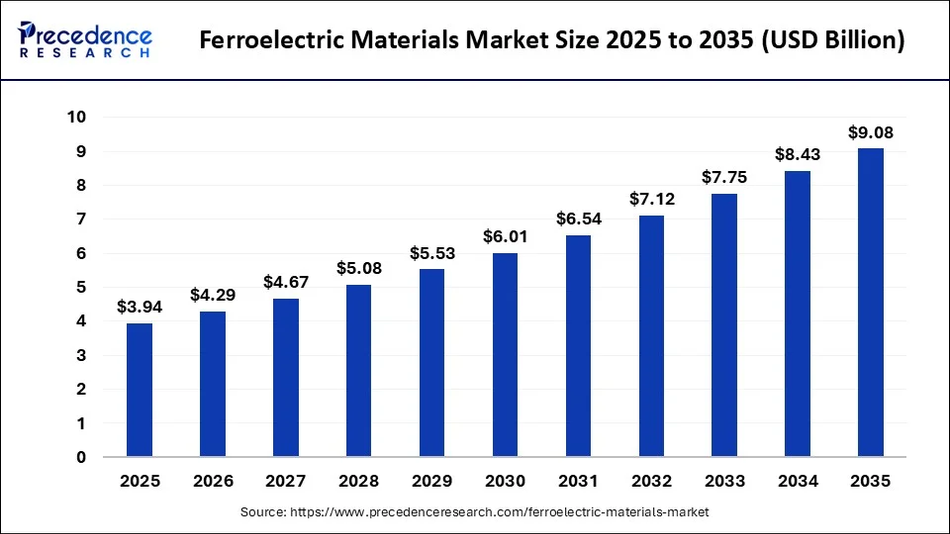
Ferroelectric memory is entering a new growth phase. The global ferroelectric materials market is expected to grow from $4.29 billion in 2026 to around $9.08 billion by 2035.
This growth is largely driven by hafnium oxide (HfO₂), which has overcome the limitations of older ferroelectric materials such as PZT. Since HfO₂ is compatible with standard CMOS fabrication, manufacturers can scale it to sub-10nm nodes without the integration challenges that limited earlier ferroelectric technologies.
2D Ferroelectric Materials
Building on that momentum, researchers are also combining ultra-thin HfO₂ films, just a few nanometers thick, with 2D semiconductors such as MoS₂. Stacking these materials into van der Waals heterostructures yields ferroelectric field-effect transistors (FeFETs) that integrate memory and logic into a single device. The result is non-destructive reads, steep-slope switching, and a real path toward in-memory computing at nanoscale dimensions.
Storage-Class Memory
Storage-class memory (SCM) aims to bridge the performance gap between DRAM and NAND Flash by combining near-memory speeds with persistent data storage. Instead, the industry is solving the problem architecturally, through standards like JEDEC's NVDIMM-P and CXL Type-3 memory pooling.
The Role of Emerging Memories in AI Hardware
As AI models become larger, memory bandwidth and energy efficiency are becoming key design challenges. Emerging memories such as MRAM, ReRAM, and PCM are being explored for AI accelerators and compute-in-memory architectures. These technologies help reduce data movement and improve overall system efficiency.
Questions to Ask Before Selecting a Memory Technology
The right memory choice depends on the specific demands of the system. Use the following checklist to evaluate key design considerations before selecting a memory technology:
Does the application require data retention during power loss?
How frequently will data be written, and what endurance level is required?
Is faster access speed or higher storage capacity more important?
Are power efficiency and battery life critical design factors?
Will the device operate in harsh, high-temperature, or radiation-prone environments?
What are the cost, availability, and scalability requirements over the product lifecycle?
This checklist helps translate memory specifications into practical design decisions based on real application requirements.
Conclusion
The right memory technology depends on the specific requirements of each system, including speed, endurance, power consumption, cost, density, and reliability. Since no single memory type meets every requirement, modern systems combine different memory technologies to support specific workloads. SRAM, DRAM, Flash, and emerging memories such as MRAM, FeRAM, ReRAM, and PCM each have their own strengths and limitations.
Engineers can build memory architectures that improve performance, reduce energy consumption, and support demanding workloads by understanding these trade-offs. The key is not choosing the fastest or newest memory, but choosing the right balance of capabilities for your system’s needs.