What are FPGAs used for? A Deep Dive Into Architecture, Advantages, and Modern Applications
Discover how Field Programmable Gate Arrays (FPGAs) work, why they matter, and where they are used today. It covers core architectural concepts, compares FPGAs to ASICs and CPUs, and explores applications across communications, finance, aerospace, automotive, AI, medical

09 Dec, 2025. 15 minutes read
Key Takeaways
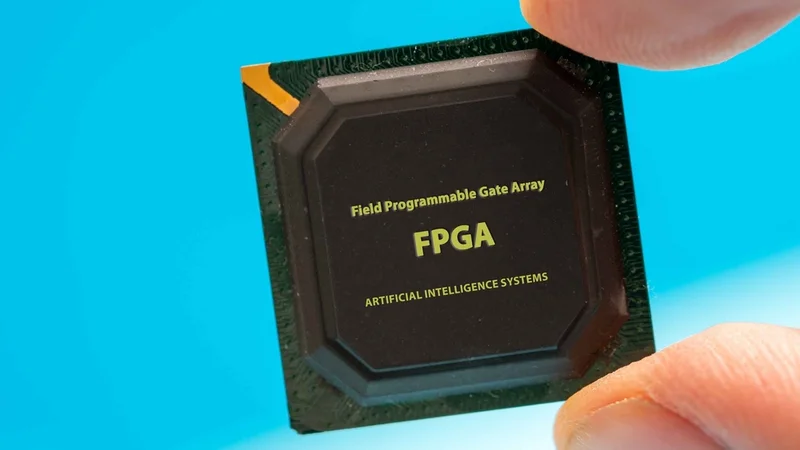
- FPGAs provide reconfigurable hardware: A Field-Programmable Gate Array consists of arrays of configurable logic blocks (CLBs) such as LUT-based combinational logic functions, flip-flops, and hardware multipliers, connected by programmable interconnects. Because both the logic and routing can be electrically reprogrammed after manufacturing, an FPGA can implement a wide range of digital circuitry without changing the physical device. This reconfigurability is what distinguishes FPGAs from fixed-function application-specific integrated circuits (ASICs).
- Time‑to‑market advantage: Unlike ASICs, which require custom masks and lengthy fabrication, an FPGA design can be configured in hours or days rather than months [1]. This makes them well-suited for prototyping, low- to medium-volume deployments, rapid iteration, and projects with evolving requirements.
- Parallelism and deterministic timing: FPGA fabric allows true hardware-level concurrency, enabling many operations to execute at once. This architecture supports deterministic, low-latency timing, which is critical for communications, latency-sensitive finance, real-time vision systems, and safety-critical control applications. In contrast, CPUs and GPUs operate through instruction pipelines, drivers, and OS schedulers, which introduce variability and limit deterministic performance.
- Wide range of applications: FPGAs accelerate workloads across telecommunications (5G networks), finance (high‑frequency trading), image processing, aerospace and defense, automotive ADAS, data centers, medical imaging, consumer electronics, and industrial control [2].
- Growing market and future outlook: The FPGA market was valued at USD 12.72 billion in 2024 and is projected to grow to USD 27.51 billion by 2032 [3]. This growth is driven by AI adoption, edge-computing demand, 5G expansion, and the need for customizable hardware acceleration.
Introduction
Field‑Programmable Gate Arrays (FPGAs) have transformed digital design by offering hardware that can be reprogrammed after deployment and throughout a product’s lifecycle. Unlike a microcontroller or graphics processing unit (GPU) with a fixed instruction set, an FPGA can be configured to implement nearly any digital logic. It achieves this flexibility through an array of programmable logic blocks and interconnects [4]. These devices first appeared in the 1980s and have since evolved into high-density platforms with millions of logic elements, hardened DSP blocks, memory, and high-speed I/O. Today, their unique combination of flexibility, parallelism, and deterministic timing positions them at the heart of many modern systems.
This guide is written for digital design engineers, hardware architects, and electronics engineering students who want a holistic understanding of what FPGAs are used for. It begins by explaining FPGA architecture and design flow, followed by a comparison with ASICs and CPUs to clarify when FPGAs offer an advantage. It then compares FPGAs to other technologies like ASICs and CPUs. The article primarily explores real-world applications—spanning signal processing, communications, high-frequency trading, aerospace, automotive systems, AI acceleration, and edge computing, helping readers clearly understand what FPGAs are used for in practice, from high-performance computing acceleration to FPGA-based machine learning deployment. Finally, we look at system‑on‑chip (SoC) variants, market trends, and frequently asked questions.
Understanding FPGA Architecture and Theory
Basic Architecture: Configurable Logic, Routing, and I/O
At the core of every FPGA is an array of programmable logic blocks interconnected by a network of programmable routing. A standard FPGA comprises three main components:
Programmable logic blocks (CLBs): Each CLB contains lookup tables (LUTs), flip‑flops, and multiplexers. LUTs implement logic functions, flip-flops store sequential state, and multipliers support numeric pipelines such as DSP or machine learning inference modules. By programming the LUT contents and routing, engineers can create arbitrary combinational and sequential logic, enabling FPGAs to replicate everything from simple glue logic to full custom pipelines.
Programmable routing: Metal interconnect lines with programmable switches and switch matrices connect logic blocks and I/O. Routing occupies the majority of an FPGA’s silicon area and is a major contributor to both flexibility and configuration overhead [4].
I/O blocks: I/O blocks interface the FPGA fabric with external pins and support various electrical standards (e.g., LVCMOS, LVDS, PCIe, MIPI, and transceiver-based high-speed SERDES). They connect to the logic blocks through the routing network.
A generalized FPGA arranges CLBs in a two‑dimensional grid with I/O blocks positioned around the perimeter [4]. Programming an FPGA modifies the state of configuration bits (implemented with SRAM, flash, or antifuse cells) to define each LUT’s behavior and all routing connections.
Programming Technologies
FPGAs are reprogrammable because their behavior is defined by configuration memory, and this memory is built using one of three widely used technologies [4].
The characteristics of the technologies are discussed in the table below:
Configuration technology | Characteristics | Typical use |
SRAM‑based | Uses static memory cells to store configuration bits [4]. Offers full reprogramming and uses standard CMOS processes, enabling high integration and speed. Drawbacks include volatility (configuration is lost when power is removed) and relatively large area per cell (six-transistor SRAM).large area because each SRAM cell uses six transistors [4]. | Dominant technology in commercial FPGAs from AMD (Xilinx) and Intel (Altera) |
Flash‑based | Stores configuration in non‑volatile flash. Lower power and non‑volatile. Drawbacks include slower writing speeds and limited reprogramming cycles. | Mid‑range devices and some low‑power FPGAs |
Antifuse‑based | One‑time programmable. Creates permanent connections when programmed. Offers radiation tolerance and security. | Aerospace, defense, and high‑security applications |
Design Flow
An FPGA design process begins by describing the desired functionality using a hardware description language (HDL) such as VHDL or Verilog. The design flow typically involves the following steps:
Design capture: Write VHDL/Verilog code, use high‑level synthesis (HLS) tools, or assemble block-diagram designs from IP cores.
Synthesis: Convert the HDL into a netlist of logic gates and registers.
Technology mapping: Map the logic onto the available LUTs, flip‑flops, and other resources of the target FPGA.
Place and route: Determine where to place each logic block on the device and how to connect them through the programmable routing.
Bitstream generation: Create a configuration file (bitstream) that programs the FPGA’s configuration memory.
Programming and testing: Load the bitstream into the FPGA and verify the design using simulation and hardware debugging tools.
High‑level synthesis is gaining popularity: it allows designers to write in C/C++ or Python and automatically generate HDL [7]. Vendor ecosystems such as AMD Vivado and Vitis, and Intel Quartus and oneAPI, provide integrated design flows, reusable IP cores, hardware/software co-design tools, and optimized compilers to streamline development [6].
FPGAs vs ASICs vs CPUs/GPUs
Feature / Metric | FPGAs | ASICs | CPUs/GPUs |
Time-to-Market | Very fast — hours to days; ideal for prototyping | Slow — months due to custom masks & fabrication | Fast for software development, but hardware acceleration is limited |
Non-Recurring Engineering (NRE) Cost | Negligible | Very high — millions for masks & design | Low for software; hardware fixed |
Unit Cost | Higher per unit (low/medium volume) | Low per unit at high volume | Varies; generally affordable |
Performance & Power | Moderate; overhead due to routing & config memory | High; optimized for task | CPU: lower parallelism, higher latency. GPU: high parallelism but fixed architecture |
Flexibility / Upgradability | Can be reprogrammed post-deployment | Cannot be modified | CPU: flexible software, GPU: flexible for compatible workloads, but fixed hardware |
Parallelism | Custom, task-specific pipelines; deterministic | Only what is designed | CPU: sequential GPU: massive, homogeneous parallelism |
Best Use Cases | Prototyping, AI inference, real-time control, communications | High-volume, fixed-function devices | General-purpose computing, graphics, and some AI workloads |
Recommended Reading: ASIC vs FPGA: A Comprehensive Comparison
FPGA History and Market Trends
The FPGA market has grown significantly over the past decade. In 2024, the global FPGA market was valued at USD 12.72 billion and is projected to grow to USD 27.51 billion by 2032 with a compound annual growth rate (CAGR) of 10.2 % [3]. This growth is driven by the rise of AI and IoT, the expansion of data centers and 5G infrastructure, and demand for high‑performance, customizable solutions in automotive, aerospace, and consumer electronics [3]. Major vendors include AMD (formerly Xilinx), Intel, Lattice Semiconductor, and Achronix [3]. In short, the combination of technological advancements and rising demand for adaptable, high-performance hardware is fueling sustained growth in the FPGA market.
Core FPGA Use Cases
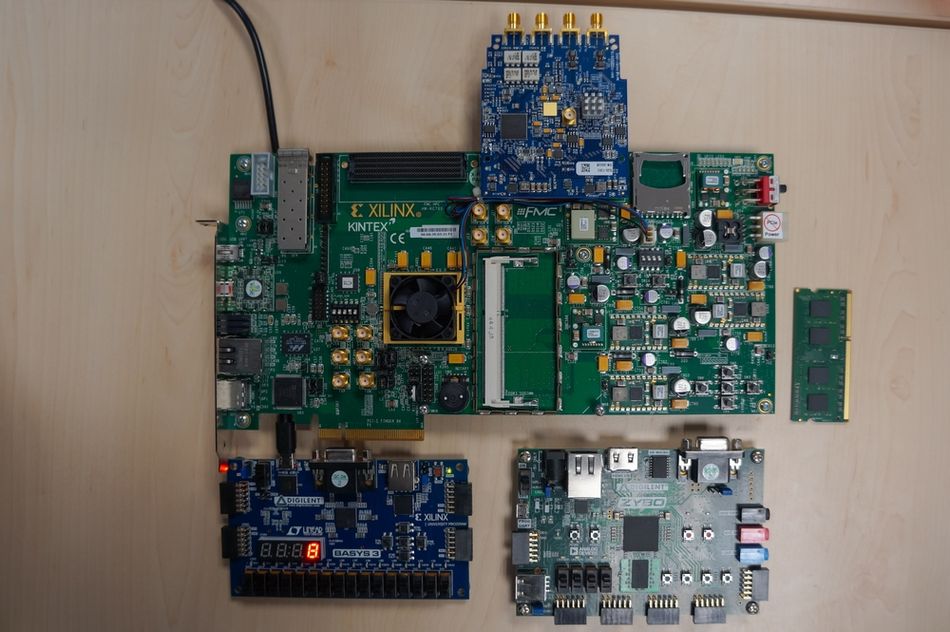
FPGAs excel in applications requiring high-throughput parallel processing, deterministic timing, low latency, and customizable hardware. This section provides a high-level overview of the major domains in which FPGAs are currently deployed.
Telecommunications and 5G Infrastructure
Rolling out 5G networks demands very high signal processing bandwidth and extremely low latency. Base stations must perform digital up‑conversion, down‑conversion, channel filtering, beamforming, and MIMO (multiple‑input, multiple‑output) processing in real time. FPGAs often form the backbone of radio access networks because they execute these computation‑heavy tasks while supporting rapidly evolving standards [2]. Their programmability allows operators to deploy updated configurations as 5G evolves, helping protect expensive infrastructure investments [2].
Key telecom FPGA functions:
Digital up‑conversion and down‑conversion of baseband signals [2].
Channel filtering and modulation/demodulation.
Massive MIMO support and beamforming for high‑capacity links.
Real‑time network optimization using AI acceleration [7].
FPGAs in 5G infrastructure enable high-throughput data processing and real‑time signal processing for massive MIMO and beamforming. Their reconfigurability helps network operators adapt to evolving standards [7]
High-Frequency Trading and Finance
In financial markets, microseconds decide profit or loss. Traditional trading systems can suffer from latency introduced by operating systems, network stacks, and context switching. FPGA‑based trading platforms process market data feeds and trading algorithms directly in hardware, bypassing software bottlenecks [2]. The deterministic timing of FPGA pipelines allows firms to react to market events in microseconds or even nanoseconds, significantly outperforming CPU-or GPU-only systems.
FPGAs also enable rapid on‑the‑fly reconfiguration; trading strategies and risk controls can be updated without replacing hardware [2]. This adaptability is especially vital as regulations and market conditions change. Consequently, FPGAs are widely deployed in low‑latency feed handlers, order book engines, pre-trade risk checkers, and network interface cards for finance.
Image Processing and Computer Vision
Computer vision tasks—object detection, edge detection, and feature extraction—require processing large pixel streams with strict timing. FPGAs excel because they process pixels in parallel pipelines rather than sequentially like CPUs. In FPGA‑based image processing, pixel streams move through dedicated hardware performing filtering, edge detection, and feature extraction simultaneously [2]. This parallelism is invaluable for autonomous vehicle perception, industrial inspection, and medical imaging.
The FPGAs handle high‑resolution video with low latency. Their architecture allows multiple regions of an image to be processed simultaneously, a requirement for real‑time object recognition in self‑driving cars or drones. FPGAs are also widely used in broadcast and professional audio‑visual systems; AMD notes that cost‑optimized FPGAs support real-time high‑bandwidth video capture, processing, and 4K playout with low power consumption [6].
Aerospace and Defense
Aerospace and defense systems demand deterministic timing and high reliability. FPGAs provide predictable response times without any unpredictable operating system delays [2]. They are deployed in avionics for flight control, navigation, radar, and electronic warfare. Programmable logic allows the incorporation of redundant logic and fault‑tolerant paths to meet stringent safety standards like DO‑254. In electronic warfare and signals intelligence, FPGAs execute complex signal processing and adaptive countermeasures in real time [2].
Space-Grade FPGA Applications
Space applications benefit from radiation‑tolerant antifuse or flash‑based FPGAs, which maintain configuration in harsh environments. The ability to update algorithms after launch is invaluable for satellites and deep‑space probes, where physical access is impossible.
Automotive Electronics and ADAS
Modern vehicles integrate dozens of sensors—cameras, LiDAR, radar—to support advanced driver assistance systems (ADAS) and autonomous driving. FPGAs enable real‑time sensor fusion by assigning dedicated pipelines to each sensor within a single device [2]. Their deterministic latency ensures reliable perception and control under strict power and temperature constraints.
In automotive AI inference, FPGAs use built-in digital signal processing (DSP) blocks to accelerate convolutional neural networks while consuming less power than GPUs [2]. Manufacturers can update AI models and add features throughout a vehicle’s service life. AMD highlights the use of its cost‑optimized FPGAs for night‑vision cameras, pedestrian detection, and automatic emergency braking, emphasizing energy‑efficient real‑time image processing for long‑wave infrared cameras. Automotive safety‑critical compliance (ISO 26262) is achieved through redundant processing and continuous error detection.
Data Centers and Cloud Acceleration
While GPUs dominate AI training in data centers, FPGAs are gaining traction for low-latency AI inference and specialized acceleration. The FPGAs’ energy efficiency and customizability make them ideal for search ranking, recommendation engines, and natural language processing in cloud workloads [7]. They offload specific operators such as convolution, encryption, data compression, and database query filtering.
Microsoft famously deployed FPGAs in its data centers to accelerate Bing search algorithms. FPGAs can be reconfigured to support new algorithms or repurposed to run various modeling or simulation routines [1]. Major cloud providers like Amazon Web Services (AWS) and Microsoft Azure now offer FPGA‑accelerated instances (e.g., AWS F1) that let developers prototype, test, and deploy FPGA-based acceleration without purchasing hardware.
Medical Electronics and Healthcare
FPGAs process large sensor datasets in medical imaging (MRI, CT), diagnostics, and surgical robotics. Their ability to perform real‑time analysis helps accelerate MRI and CT reconstruction, leading to faster diagnoses. In surgical robotics, FPGAs provide precise control loops and low‑latency feedback. They are also used in implantable devices, patient monitoring, and wearable health sensors, where low power and deterministic real‑time response are critical.
Scientific Instruments and Industrial Control
FPGAs are common in test and measurement instruments, oscilloscopes, spectrum analyzers, and data acquisition systems. They implement high‑speed converter interfacing, digital filtering, and protocol handling. In industrial automation, FPGAs provide deterministic control for robotics, motion controllers, and factory automation systems. AMD notes that FPGAs enable efficient actuator control, high‑speed data acquisition, and low‑power image processing in industrial equipment. Their real‑time performance ensures reliable closed‑loop control and supports emerging industrial Ethernet standards.
Consumer Electronics and IoT
Consumer devices such as smartphones, cameras, drones, and smart TVs increasingly incorporate FPGAs for specific tasks. These consumer applications leverage FPGAs for real‑time image processing, sensor interfacing, cryptography, and power‑efficient AI inference. Small low‑power FPGAs or SoC FPGAs are also used in wearables and IoT gateways, where customizable hardware accelerators extend battery life and reduce latency.
Prototyping, Emulation, and System Validation
Even when the final product will use an ASIC, engineers often employ FPGAs for prototyping and emulation. FPGAs allow pre‑silicon and post‑silicon validation of designs and firmware [1]. They enable concurrent hardware/software co-developmenthardware/software co‑development and accelerate time to market by identifying bugs early. Emulation platforms built from arrays of large FPGAs can accurately mimic entire SoCs for software development before tape‑out.
System‑on‑Chip (SoC) and Adaptive FPGA Solutions
What is an FPGA‑Based SoC?
Traditional FPGAs consist solely of programmable logic, requiring an external microprocessor for software tasks. An FPGA‑based System on Chip (SoC) integrates an FPGA fabric with one or more processor cores (often ARM or RISC‑V) on a single chip. This architecture provides both hardware and software programmability. Popular SoC platforms include Xilinx Zynq, Intel (Altera) SoC FPGAs, and Lattice ECP5, which combine FPGA fabric with ARM‑based or RISC‑V cores [9].
Benefits of SoC Design
The advantages of FPGA‑based SoCs are:
Hardware–software co-design flexibility: Engineers can partition an application between custom hardware acceleration in the FPGA fabric and software running on the integrated processor. For example, encoding/decoding high‑definition video can be implemented in the FPGA while control algorithms run on the CPU.
High performance and low latency: By offloading time‑critical tasks to the FPGA fabric, SoCs reduce latency and increase throughput. This is particularly vital in automotive and aerospace systems, where milliseconds can make a significant difference.
Energy efficiency: The ability to optimize hardware for specific tasks means SoCs achieve required performance with less power than general‑purpose processors.
Customizability and scalability: SoC FPGAs are reprogrammable and allow feature updates or algorithm changes throughout a product’s lifecycle. Designs scale from small, power‑efficient devices to high‑performance systems without changing the underlying architecture.
SoC FPGAs are used in industrial control, telecommunications, robotics, automotive ADAS, and IoT gateways. They simplify board design because fewer discrete components are needed and reduce latency by bringing processors and accelerators on‑chip.
Adaptive Computing and Heterogeneous Integration
Beyond SoC FPGAs, vendors are integrating FPGAs with CPUs and GPUs in heterogeneous computing platforms. Intel’s Agilex and AMD’s Versal families include AI engines and high‑speed network interfaces. Adaptive SoCs support dynamic partial reconfiguration, where parts of the FPGA are reprogrammed while other logic continues running. This feature enables multitasking and allows systems to adapt dynamically to different workloads at runtime.
Advantages of Using FPGAs
Parallelism and Deterministic Latency
FPGAs excel at parallel processing. Because separate tasks run simultaneously in dedicated parts of the chip without interference, an FPGA can implement deeply pipelined data paths or instantiate multiple identical processing blocks. This spatial parallelism eliminates the unpredictability of operating systems and caches, yielding deterministic timing. For safety‑critical applications—flight control, industrial automation, medical devices—deterministic response ensures predictable behavior.
Reconfigurable Flexibility
Users can download new bitstreams to change functionality even after deployment. This flexibility enables updates to support new protocols, bug fixes, or added features without replacing hardware [1]. Partial reconfiguration allows updating a portion of the FPGA while the rest of the system operates, minimizing downtime.
Lower Development Risk and Cost for Small Volumes
Because FPGAs do not require expensive masks, they significantly reduce non‑recurring engineering costs. Designs can be rapidly iterated and validated, reducing risk before investing in ASIC fabrication. For products with low‑to-medium volume production or uncertain requirements, FPGAs provide a cost‑effective solution.
Hardware Acceleration and Energy Efficiency
Custom hardware accelerators implemented in FPGAs can provide significant performance and energy advantages over CPUs and sometimes GPUs. By tailoring datapaths precisely to the algorithm, eliminating instruction fetch and OS overhead, FPGAs achieve high throughput with lower power. This is especially advantageous for AI inference, cryptography, compression, and real‑time signal processing.
Hardware-in-the-Loop Testing and Validation
FPGAs enable hardware‑in‑the‑loop (HIL) simulation for control systems. Engineers can connect physical plant models to FPGA‑based controllers, allowing real-time validation of embedded software and hardware. FPGAs' ability to emulate complete systems facilitates early integration testing and accelerates development.
Challenges and Considerations
While FPGAs offer many benefits, they also pose challenges:
Development Complexity
Programming FPGAs traditionally requires expertise in HDLs like VHDL or Verilog, which have a steep learning curve. The Utmel AI guide notes that development complexity is a significant barrier. HLS tools mitigate this, but may not always produce fully optimized designs.
Longer Development Cycles
Compared to software, designing, synthesizing, verifying, and testing hardware can be time-consuming. Meeting timing closure often involves iterative place‑and‑route cycles.
Resource Constraints
FPGAs have finite logic blocks, memory, and DSP slices. Large AI models or complex designs may not fit within a single device. Careful architecture and resource optimization are essential.
Higher Power Consumption Compared to ASICs
Flexible routing and configuration memory increase static and dynamic power consumption [5]. However, modern devices and advanced process nodes are reducing this gap.
Cost of Tools and Talent
The software tools required for FPGA development can be expensive, and engineers with digital design expertise are in high demand.
Mitigating these challenges often involves using high‑level synthesis, vendor‑supplied IP cores, and design suites, as well as cloud‑based FPGA platforms for scalable experimentation.
Future Trends and Emerging Applications
The FPGA landscape is evolving quickly. Several trends are shaping its future:
Edge AI and neural network acceleration: As AI moves from cloud servers to edge devices, FPGAs provide efficient inference engines with low latency and power consumption. Vendors are integrating AI engines into adaptive SoCs and offering frameworks like Vitis AI.
Dynamic partial reconfiguration and adaptive computing: Next‑generation devices allow reconfiguring parts of the logic on the fly, enabling task swapping and multi‑tenant operation.
Integration with RISC‑V and open hardware: Many SoC FPGAs now include RISC‑V processors. The open instruction set architecture encourages innovation and reduces licensing costs.
Advanced packaging and chiplets: Vendors are exploring chiplet‑based FPGAs where different dies (logic, memory, analog) are integrated on a package substrate. This modularity offers better scalability and heterogeneity.
Quantum and neuromorphic acceleration: Research prototypes use FPGAs to interface with quantum processors and implement neuromorphic algorithms. The flexibility of FPGAs makes them a versatile testbed for emerging computing paradigms.
Conclusion
FPGAs represent a unique blend of flexibility, performance, and determinism. Their reconfigurable architecture—built from programmable logic blocks, routing, and I/O—allows designers to craft custom hardware without fabricating new silicon. Compared to ASICs, FPGAs offer faster time to market, lower upfront cost, and the ability to fix bugs or add features after deployment. While they may consume more power and achieve lower maximum performance than fixed ASICs [5], their parallelism and determinism make them indispensable in signal processing, communications, finance, aerospace, automotive, data centers, healthcare, and beyond.
The FPGA market is poised for robust growth—projected to reach USD 27.51 billion by 2032—driven by AI, 5G, and the demand for adaptable hardware [3]. As adaptive SoCs and heterogeneous computing platforms evolve, FPGAs will continue to bridge the gap between custom silicon and general‑purpose processors. For engineers and students, mastering FPGA technology unlocks opportunities to build high‑performance systems tailored to the rapidly changing digital landscape.
Frequently Asked Questions
Why choose an FPGA over a microcontroller or CPU?
An FPGA provides custom, parallel hardware that can execute multiple operations simultaneously with deterministic timing. This makes it ideal for high‑speed signal processing, control loops, and workloads requiring low latency. CPUs execute instructions sequentially and rely on software, which introduces overhead and unpredictability. Microcontrollers are best for simple control tasks, whereas FPGAs excel when hardware customization and parallelism are needed.
What programming languages are used for FPGAs?
Traditional FPGA development uses hardware description languages like VHDL and Verilog. High‑level synthesis tools enable designers to write in C/C++ or Python and automatically generate HDL. Vendor toolchains such as AMD’s Vivado/Vitis and Intel’s Quartus/oneAPI provide integrated environments for design, simulation, and implementation.
Are FPGAs replacing GPUs for AI workloads?
Not entirely. GPUs remain dominant for training large neural networks due to their massive parallelism and mature software ecosystems. FPGAs, however, offer lower latency, reconfigurable pipelines, and better energy efficiency for inference and specialized workloads. Many data centers use FPGAs alongside CPUs and GPUs to accelerate specific operations such as convolution, encryption, and search ranking.
How long does it take to develop an FPGA design?
Development time depends on complexity and experience. Because there are no fabrication delays, prototype designs can be tested in hours or days. However, achieving timing closure and optimizing resource usage can lengthen development cycles, especially for large designs. Using IP cores and high‑level synthesis tools can accelerate the process.
What are the main resource limitations of an FPGA?
Each FPGA has a finite number of logic cells, flip‑flops, block RAM, and DSP slices. Complex designs may exceed available resources, requiring optimization or partitioning across multiple devices. Resource scarcity can also restrict the precision of arithmetic operations or the size of on‑chip buffers. Selecting an appropriately sized device and optimizing the design are critical.
Can FPGAs be used in space or radiation‑heavy environments?
Yes. Antifuse and flash‑based FPGAs offer radiation tolerance because their configuration data is non‑volatile and not susceptible to bit flips. These devices are used in satellites, spacecraft, and military equipment where reliability under radiation is essential.
How do SoC FPGAs differ from discrete FPGAs?
SoC FPGAs integrate processing cores and peripheral controllers with the FPGA fabric on a single chip. This allows hardware–software co‑design, reduced PCB footprint, and lower latency between the CPU and programmable logic. Discrete FPGAs lack integrated CPUs and require external processors for software tasks.
References
[1] Arrow Electronics, “FPGA Basics: Architecture, Applications, and Uses,” [Online]. Available: Link. [Accessed: 06-Dec-2025].
[2] Magmio, “FPGA Use Cases,” [Online]. Available: Link. [Accessed: 05-Dec-2025].
[3] Fortune Business Insights, “Field-Programmable Gate Array Market,” [Online]. Available: Link. [Accessed: 08-Dec-2025].
[4] H. Zheng, “FPGA Architecture Overview,” University of South Florida, [Online]. Available: Link. [Accessed: 08-Dec-2025].
[5] Total Phase, “Differences Between FPGA and ASIC: Advantages and Disadvantages,” [Online]. Available: Link. [Accessed: 05-Dec-2025].
[6] AMD, “Cost-Optimized FPGAs: Performance and Power Efficiency,” [Online]. Available: Link. [Accessed: 08-Dec-2025].
[7] Utmel, “Applications of FPGAs in Artificial Intelligence: A Comprehensive Guide,” [Online]. Available: Link. [Accessed: 08-Dec-2025].
[8] Digilent, “What Is an FPGA?” [Online]. Available: Link. [Accessed: 07-Dec-2025].
[9] RunTimeRec, “Exploring FPGA-Based System-on-Chip (SoC) Design,” [Online]. Available: Link. [Accessed: 07-Dec-2025].
.
in this article
1. Introduction2. Understanding FPGA Architecture and Theory3. Core FPGA Use Cases4. System‑on‑Chip (SoC) and Adaptive FPGA Solutions5. Advantages of Using FPGAs6. Challenges and Considerations7. Future Trends and Emerging Applications8. Conclusion9. Frequently Asked Questions10. References