What Is Swiss Machining? Swiss-Type CNC Lathes Explained
What is Swiss machining? This guide explains how Swiss-type lathes work, how they differ from conventional lathes, and when to use them.

28 Jul, 2026. 10 minutes read
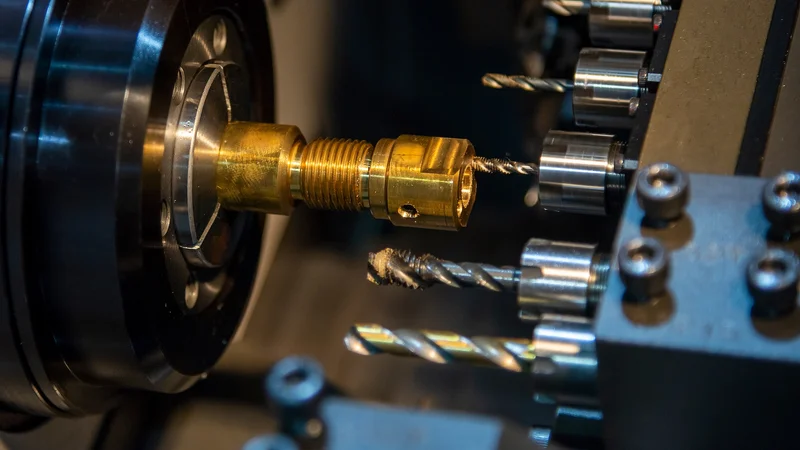
Swiss machining excels at small, complex parts
Key Takeaways
Swiss machining feeds bar stock through a guide bushing while the sliding headstock moves the material past fixed tools, so cutting always happens next to the point of support and workpiece deflection stays minimal.
The process excels at small, complex parts: diameters of roughly 2 mm to 38 mm, length-to-diameter ratios above 3:1, and production tolerances down to around plus or minus 0.005 mm.
Modern Swiss CNC machining centers combine a main spindle, sub spindle, and live tooling to turn, mill, drill, and thread a part complete in one cycle, which cuts secondary operations.
Compared with conventional lathes, Swiss-type machines cost more and take longer to set up, so they pay off on precision parts and higher volumes rather than large diameters or one-off jobs.
Medical bone screws, aerospace fasteners, electronic connectors, and automotive fuel injectors are typical Swiss-machined parts.
Swiss machining, also called Swiss turning, Swiss-style machining, or Swiss CNC machining, was invented for the Swiss watchmaking industry in the 1870s and has since become the default process for high-volume precision manufacturing of small cylindrical components. This article covers the working principle of Swiss machining, a comparison with conventional CNC turning, part selection criteria, materials, applications, the machine landscape, and the practical pitfalls that catch new users.
How Swiss Machining Works
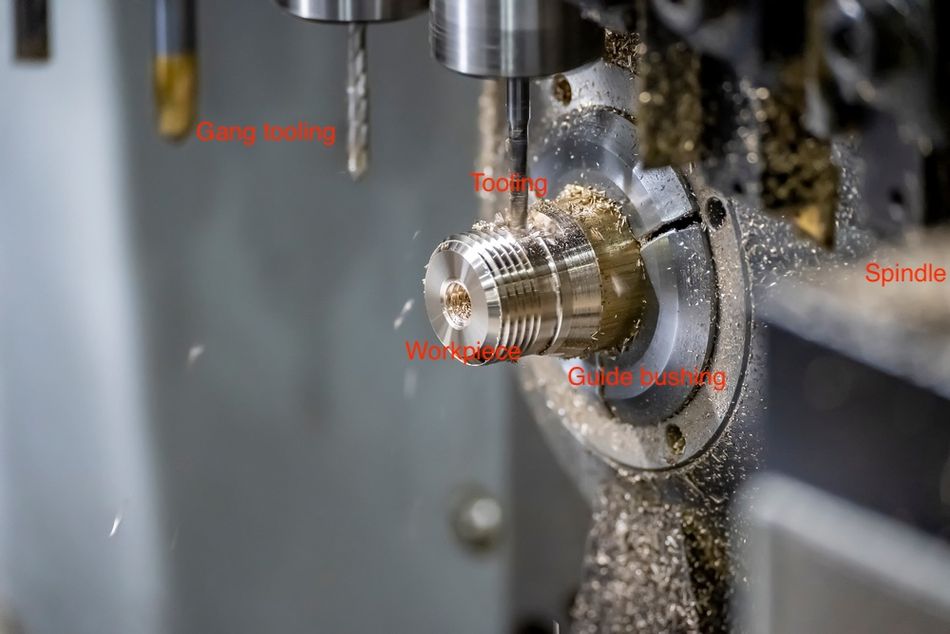
A CNC Swiss-type lathe is an automatic lathe with a sliding headstock and a guide bushing that supports the workpiece at the point of cut.[1] The machine produces small, complex, cylindrical parts in one cycle with minimal operator intervention.
The Sliding Headstock
On a conventional lathe, the headstock is fixed: the workpiece rotates in place while cutting tools travel along it. On a Swiss-type lathe the logic is inverted. The headstock itself slides along the Z axis, pushing or pulling the bar through the guide bushing while the cutting tool sits just in front of the bushing face.[2] The collet in the headstock grips the bar and provides both rotation and feed motion.
The Guide Bushing
The guide bushing is the other defining component of the process. It supports the rotating bar within a very short distance of the cutting tool, so the section being machined behaves like a short stiff stub rather than a long flexible rod. That support suppresses deflection, vibration, and tool chatter, which is exactly what long thin parts need.
Guide bushings come in two main types:
Rotary guide bushings rotate with the workpiece and are the standard choice for most work.[3]
Fixed guide bushings stay stationary while the bar spins inside them; they are less common because they can mark the material.[3]
Because the bar runs through the bushing with only a small clearance, Swiss turning is sensitive to material quality. Shops typically buy centerless-ground bar stock with restricted diameter tolerance and good straightness.
Main Spindle, Sub Spindle, and Live Tooling
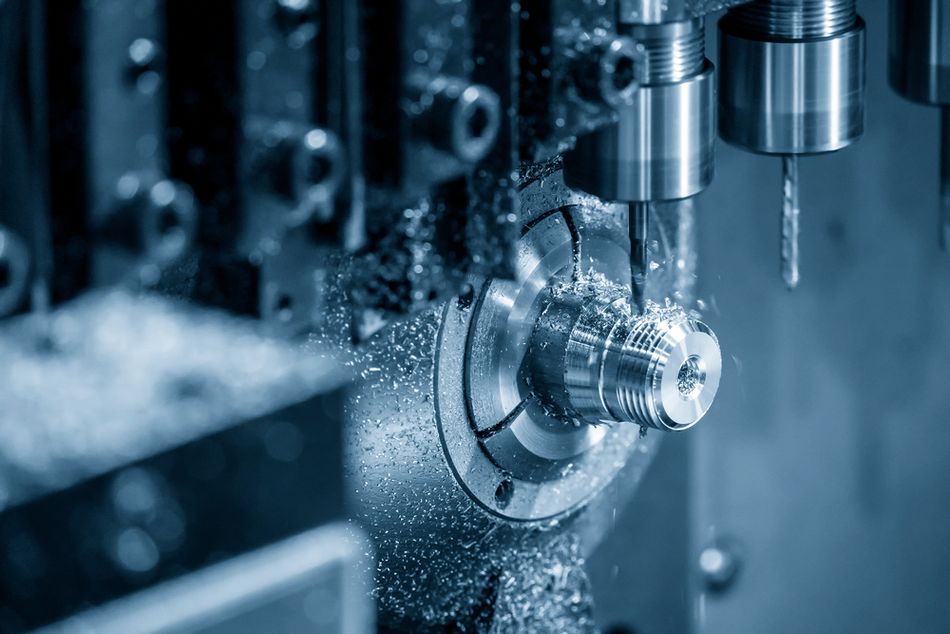
Modern Swiss CNC machines are far more than lathes. A typical configuration adds:
A sub spindle (back spindle) that picks the part off the main spindle in a synchronized handoff, then performs back-working operations while the main spindle starts the next part.
Live tooling (powered, rotating cutting tool) stations for cross drilling, cross milling, polygon turning, and thread whirling.
Gang tool posts (multiple tools arranged in sequence) above the guide bushing, opposite tool posts, and back-working tool posts near the sub spindle.
Swiss machines can control up to 13 axes,[4] versus 2 to 5 on traditional CNC lathes,[5] and can take deeper cuts in a single pass because the guide bushing absorbs the cutting forces. The most advanced Swiss machines with live tooling can handle turning, milling, drilling, and threading in one setup, so secondary operations and their fixturing errors largely disappear.
Why Is It Called Swiss Machining? A Brief History
The name refers to the place of origin. The Swiss lathe was invented in 1872 by Jakob Schweizer in the Swiss Jura region to make tiny, accurate screws for the watchmaking industry, and industrialist Nicolas Junker brought mass-produced automatic lathes to market from Moutier, Switzerland shortly after.[6] Conventional lathes of the era could not hold the accuracy that watch components demanded; supporting the workpiece at the cut solved the problem.
The technology stayed cam-driven for nearly a century. Tornos presented the first numerically controlled sliding-headstock automatic lathe, the Elector 16, in 1978, and CNC control has defined the category since.[6] Today the historic Swiss builders share the market with Japanese manufacturers like Citizen Machinery and Tsugami Corporation.
Swiss Lathe vs Conventional Lathe
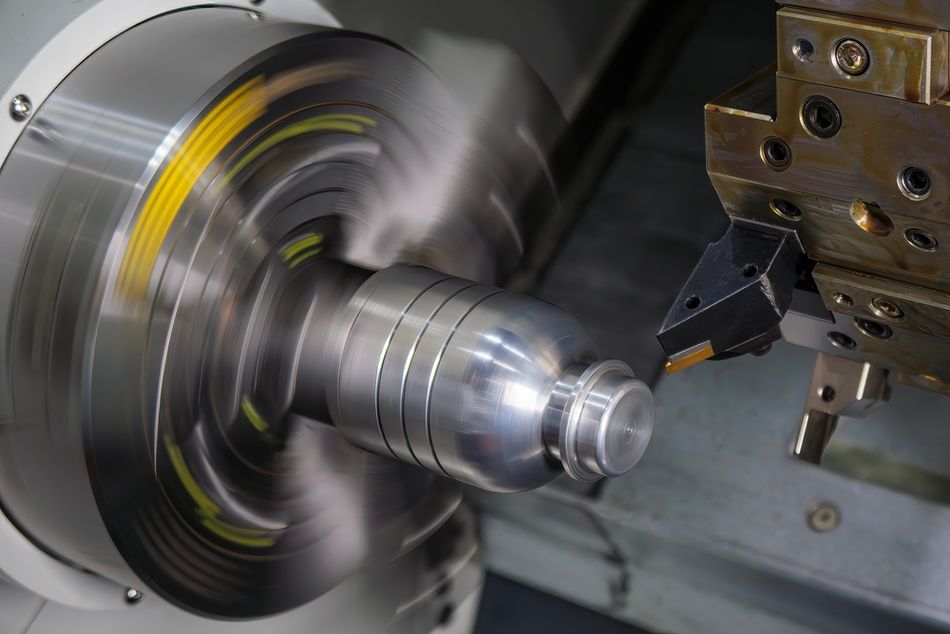
The two machine types overlap in capability but are optimized for different work. Conventional lathes are better suited to larger-diameter parts, heavy cutting, and flexible one-off or low-volume jobs, while Swiss-type lathes excel at long, slender, high-precision components produced in medium-to-high volumes. The comparison below summarizes the differences that matter in practice.
Criterion | Swiss-type lathe | Conventional CNC lathe |
Headstock | Sliding, feeds the bar in Z | Fixed |
Workpiece support | Guide bushing at the point of cut | Chuck or collet at one end, optional tailstock |
Maximum bar capacity | Roughly 38 mm[7] | Roughly 180 mm on large machines[8] |
Long slender parts | Excellent, deflection controlled | Poor beyond about 3:1 length-to-diameter without support |
Axes | 7 to 13 typical | 2 to 5 typical |
Production tolerances | Plus or minus 0.005 mm routinely[9] | Wider on comparable slender geometry |
Setup and changeover | Hours, more complex | Faster, suits frequent job changes |
Ideal volume | High-volume repeat work | Job-shop mix, larger parts, prototypes |
Three differences drive part-level decisions:
Support at the cut: On a conventional lathe, cutting force bends an unsupported slender workpiece away from the tool, which has an adverse effect on tolerance and surface finish. The guide bushing removes that lever arm, so a Swiss machine holds concentricity and diameter on geometry a conventional lathe cannot.
Cycle strategy: A Swiss machine turns each section of the part to finished size as the bar advances (segmented turning), instead of roughing and finishing the whole profile in separate passes. Combined with simultaneous front and back working, this shortens cycle times on complex small parts.
Economics: Swiss equipment costs more (typically upward of about 150,000 USD for new machines) and setups take several times longer than conventional lathes, so the process rewards volume. Conventional lathes remain the better choice for large diameters, short slender-free parts, and fast changeovers.
If your part is under about 32 mm in diameter, longer than three times its diameter, and toleranced tighter than about 0.025 mm, a Swiss lathe is usually the right machine. If it is big, short, or a one-off, it usually is not.
Recommended reading: What is CNC Turning? Process, Advantages, Applications
When to Use Swiss Machining
Use these criteria when deciding whether to make or order a part using a Swiss machine:
Diameter: Most Swiss-type lathes top out at 20 mm to 32 mm bar capacity, with some models reaching 38 mm and larger. Bar stock generally runs 2 mm to 38 mm.
Length-to-diameter ratio: Ratios above 3:1 favor Swiss; ratios above 10:1 practically require it.
Tolerances: Production tolerances down to about plus or minus 0.005 mm are routine on good machines with stable thermals. Micro machining work on small diameters can go tighter still.
Complexity: Cross holes, flats, polygons, threads, and back-side features that would need multiple setups elsewhere are done in one cycle with live tooling.
Volume: Continuous bar feeding and unattended automation suit runs from a few hundred parts to well beyond 10,000. Prototypes are possible but carry the setup cost, so many shops run prototypes on conventional machines and move to Swiss for production.
Materials for Swiss Machining
Swiss machines cut most bar-fed materials. Machinability, chip control, and bar quality matter more than on conventional machines because the material must run through the guide bushing.
Material group | Common grades | Notes for Swiss turning |
Free-cutting and carbon steel | 12L14, 1215, 4140 | Free-cutting steels are the benchmark for chip control |
Stainless steel | 303, 304, 316LVM, 17-4 PH | 303 machines easily; 316LVM used for implants |
Titanium | Grade 5 (Ti-6Al-4V), Grade 23 ELI | Implant-grade; lower speeds, sharp tools, watch tool wear |
Brass and copper | C360 brass, C110 copper | Fast cycles, excellent surface finishes |
Aluminum | 6061, 7075 | High spindle speeds, gummy chips need high-pressure coolant |
Cobalt and nickel alloys | MP35N, L605, Elgiloy, Nitinol | Implant-grade |
Plastics | PEEK, nylon, acetal | Stable engineering plastics run well; watch heat |
Recommended reading: CNC Machining Aluminum: A Guide for Digital Design and Hardware Engineers
Applications: Where Swiss Machining Is Used

Swiss machining dominates industries that need small precision parts in volume:
Medical devices: Bone screws, surgical anchors, and dental implants are classic Swiss parts.[10]
Aerospace and defense: Fasteners, pins, valve components, and fittings where traceability, repeatability, and tight tolerances are mandatory.
Electronics: Contact pins and coaxial connectors with high length-to-diameter ratios and fine surface finish requirements.
Automotive: Fuel injectors and sensor components produced in the millions, where cycle time and unattended automation decide unit cost.
Watchmaking: Still the spiritual home of the process: arbors, pinions, and screws for mechanical movements.
Recommended reading: CNC vs 3D Printing: How to Choose the Right Process
What Is Swiss Screw Machining?
Swiss screw machining refers to the same process and equipment but in terms of what it is typically used to make. As the list above shows, many industries use Swiss lathes to produce fasteners like screws, and the terms “Swiss screw machining” and “Swiss machining” are therefore often used interchangeably.
However, not all screw machines are Swiss-style lathes. For example, turret-type screw machines used a fixed headstock. Some screw machines use CNC, while others are cam-operated.
Shops may describe themselves as “Swiss screw machine shops” even when they operate modern multi-axis CNC Swiss lathes capable of producing complex medical implants, aerospace fittings, and hydraulic components rather than just screws.
The Swiss-Type Machine Landscape
Four builders anchor the market, and each offers a broad range of machines varying by factors like bar capacity, number of axes, tool arrangement, and secondary machining operations. The table below shows these manufacturers and the basic capabilities of one of their most notable high-end machines:
Builder | Example high-end machine | Bar capacity | Number of axes |
Tornos (Switzerland) | SwissDECO 36 | 36 mm | 11 |
Citizen (Japan) | Cincom M32 VIII | 32 mm | 12 |
Star CNC (Japan) | SR-38 | 38 mm | 10 |
Tsugami (Japan) | B0386-III | 38 mm | 6 |
Since the main Swiss lathe manufacturers offer several machine options, the best solution may be the company offering the best level of support in a particular region. Other important factors to consider when investing in a Swiss lathe include axis configuration (not only the number of axes), tooling capability, and spindle performance.
Practical Considerations, Limitations, and Common Mistakes
Swiss machining offers unique benefits but also has some unique constraints that should be taken into account before manufacturing:
Setup time and cost: Guide bushing configuration, collet selection, tool arrangement across multiple posts, and spindle synchronization make setups run several hours.
Oil-based coolant and heat: Swiss machines typically run cutting oil rather than water-based coolant. Oil lubricates better at the bushing interface but has lower heat capacity than water, so thermal management matters on long runs and gummy materials.
Bar stock quality: An out-of-tolerance or bent bar will chatter in the bushing, scrap parts, and accelerate tool wear. Specify centerless-ground stock for guide-bushing work.
Guide bushing adjustment: Clearance must let the bar slide freely yet still support it near the cut. Too tight galls the bar; too loose gives up the deflection control the machine exists for. Symptoms like sudden taper, chatter marks, or drifting concentricity usually trace back to bushing clearance or worn bushing surfaces.
Remnant waste: Each bar leaves an unusable remnant; parts made in chucker-capable geometries can be redesigned slightly shorter to reduce material cost on big runs.
Tool wear monitoring: With many small tools cutting continuously and unattended, a single worn or chipped cutting tool can lead to thousands of bad parts. Use tool life counters, in-process gauging, or periodic sampling.
Diameter ceiling: Above roughly 38 mm, conventional CNC turning takes over. Do not force large parts onto a Swiss platform.
Recommended reading: CNC Programming: Mastering Precision and Efficiency in Engineering
Conclusion
Swiss machining exists because supporting the workpiece at the point of cut changes what a lathe can do. The sliding headstock and guide bushing let Swiss-type CNC lathes hold micrometer-level tolerances on long, slender, complex parts, and the main-spindle plus sub-spindle architecture with live tooling finishes those parts in one cycle. The trade-offs are equally clear: higher machine cost, longer setups, oil-based thermal management, strict bar stock requirements, and a hard diameter ceiling.
If your part is small, slender, tightly toleranced, and needed in volume, Swiss CNC machining is very likely the most economical way to make it. If not, a conventional lathe remains the better tool.
Frequently Asked Questions
What is Swiss machining in simple terms?
It is CNC turning in which the bar stock slides through a guide bushing that supports it right at the cutting tool. Because the material is supported where it is cut, the machine can hold very tight tolerances on small and slender parts.
Why is it called a Swiss lathe?
The design was invented in Switzerland in 1872 by Jakob Schweizer to produce precision screws for Swiss watchmaking, and Swiss companies around Moutier industrialized it. The name stuck even though many machines are now built by Japanese manufacturers.
What is the difference between a Swiss lathe and a regular lathe?
A regular lathe holds the workpiece in a chuck with a fixed headstock and moves the tools. A Swiss lathe moves the bar through a guide bushing with a sliding headstock while tools cut next to the bushing. That gives the Swiss lathe superior deflection control on long thin parts, at the cost of more complex setup and a smaller diameter range.
What tolerances can Swiss machining hold?
Production tolerances of plus or minus 0.005 mm to 0.025 mm are routine. Tighter figures are achievable on specific features with stable thermal conditions and fresh tooling.
What size parts suit Swiss machining?
Parts made from bar stock roughly 2 mm to 38 mm in diameter, especially with length-to-diameter ratios above 3:1. Larger diameters belong on conventional CNC lathes.
Is Swiss machining good for prototypes?
It can be, but long setups make single prototypes expensive. Many teams prototype on conventional machines and move to Swiss machining for production volumes, or batch prototype variants into one setup.
Is Swiss machining the same as Swiss screw machining?
Yes, the processes are effectively the same, both referring to the turning of parts using a sliding headstock and guide bushing. Swiss machining or Swiss turning is the more common name, as the process can produce parts besides fasteners.
References
[1] Tooling U-SME. Basics of the CNC Swiss-Type Lathe 215 [Internet]. Cleveland (OH): Tooling U-SME; [cited 2026 Jul 28].
[2] Korn D. Recognizing the Swiss advantage [Internet]. Modern Machine Shop. 2010 Nov 12 [cited 2026 Jul 28].
[3] Absolute Machine Tools. Guide bushings for Swiss lathes: everything you need to know [Internet]. Lorain (OH): Absolute Machine Tools; 2022 Jul 12 [cited 2026 Jul 28].
[4] Rodgers A. The remarkable edge of 13-axis Swiss screw machining [Internet]. KMM Group. 2025 Sep 4 [cited 2026 Jul 28].
[5] Yamazaki Mazak Corporation. Products: CNC machine tools [Internet]. Florence (KY): Yamazaki Mazak Corporation; [cited 2026 Jul 28].
[6] Smith C. An epic industrial story [Internet]. Moutier (Switzerland): Tornos SA; 2022 [cited 2026 Jul 28].
[7] Tornos SA. Swiss-type lathes | Sliding headstock lathes [Internet]. Moutier (Switzerland): Tornos SA; [cited 2026 Jul 28].
[8] Haas Automation Inc. ST-45: Large, big bore CNC lathe [Internet]. Oxnard (CA): Haas Automation Inc.; [cited 2026 Jul 28].
[9] Citizen Machinery UK. Turned parts subcontractor progresses with modern sliding-head technology [Internet]. Bushey (UK): Citizen Machinery UK Ltd.; 2022 [cited 2026 Jul 28].
[10] Robinette R. Swiss small parts machining of bone screws and anchors [Internet]. Warren (NJ): Metal Cutting Corporation; 2020 Jun 17 [cited 2026 Jul 28].
in this article
1. How Swiss Machining Works2. Why Is It Called Swiss Machining? A Brief History3. Swiss Lathe vs Conventional Lathe4. When to Use Swiss Machining5. Materials for Swiss Machining6. Applications: Where Swiss Machining Is Used7. What Is Swiss Screw Machining?8. The Swiss-Type Machine Landscape9. Practical Considerations, Limitations, and Common Mistakes10. Conclusion11. Frequently Asked Questions12. References