Nordic Semiconductor Makes the Case for Cat 1 bis in IoT
A Cat 1 bis platform that provides engineers with a practical path for long-term Global connectivity.

21 Jul, 2026. 4 minutes read

Europe and other regions have begun sunsetting 2G networks, and large-scale IoT deployments need a replacement connectivity solution before 2G goes dark. But replacing 2G fallback is not as simple as swapping in LTE-M (LTE for Machines) or NB-IoT (Narrowband IoT) with NTN (Non-Terrestrial Network) satellite fallback, because those standards don’t work for all applications and use cases.
Cat 1 bis is a 4G standard that sits squarely between narrowband IoT and full LTE options. With a single-antenna design, global availability, and lower cost than original Cat 1, Cat 1 bis is a powerful solution to replace legacy 2G fallback solutions used today. Fortunately, Nordic Semiconductor offers a Cat 1 bis platform that can take engineers from simple evaluation all the way through to a certified product.
2G Devices Are Leaving A Gap
When most IoT devices are designed for field lifetimes of 10 years or longer, obsolete connectivity or lack of supplier support can be a threat to service life. Unfortunately, upgrading to a new network is not as simple as flashing new firmware to the board. Instead, designers need new cellular hardware, new certifications, and a connectivity roadmap that holds up for the next decade.
The two most common replacements for 2G are LTE-M and NB-IoT, but both standards are meant for low-power, low-data-rate IoT applications. While many networks exist globally, LTE-M or NB-IoT are not currently available in all markets with 2G solutions. LTE-M tops out at 1 Mbps downlink, and NB-IoT has even less bandwidth, trading data rate for range and deeper indoor penetration. While many sensor or metering applications can work within those constraints, more sophisticated asset trackers or security cameras, for example, may need sustained multi-megabit throughput that exceeds those specifications. When application requirements outgrow LTE-M or NB-IoT, engineers have fewer options.
One alternative is LTE Cat 1. While the original standard delivered up to 10 Mbps over existing 4G infrastructure, it required dual-antenna MIMO (Multiple-Input Multiple-Output), which added complexity and costs that rendered it impractical for IoT deployments. Additionally, Cat 1 and higher LTE categories are optimized for downlink-centric use cases versus the typical uplink-centric data flow needed in most IoT deployments.
As a result, IoT engineers often face a trade-off between too little bandwidth or too much hardware.
Cat 1 bis Offers a Better Option
One powerful option for designers is Cat 1 bis, a 3GPP (3rd Generation Partnership Project) amendment to the original LTE Cat 1 standard. By dropping the MIMO requirement, Cat 1 bis unlocks single-antenna designs that reduce module size and bill of materials (BOM) costs compared to the original. And, with up to 10 Mbps downlink and 5 Mbps uplink rates, that reduced footprint still provides enough headroom for video streaming and responsive data exchange.
Another meaningful benefit of Cat 1 bis is its compatibility with existing global 4G infrastructure. As a result, engineers can leverage the standard to build a single hardware configuration that supports global deployment rather than maintaining separate regional variants for different network environments.
Even so, Cat 1 bis does not suit every application. For example, Cat 1 bis draws higher peak power than LTE-M and NB-IoT due to its inherent full-duplex radio configuration and complexity. Standards bodies and mobile network operators have also extended LTE-M and NB-IoT with NTN satellite options that extend beyond traditional terrestrial network footprints, providing those standards with better coverage in remote areas also as part of 5G.
Where deep indoor coverage or sub-1 Mbps data rates are sufficient, LTE-M or NB-IoT may deliver adequate performance at lower power consumption. But, for applications that genuinely require multi-megabit throughput, global 4G availability, and a compact single-antenna form factor, Cat 1 bis fills a gap that narrowband standards simply can’t match.
Nordic Semiconductor's Cat 1 bis Platform
To support Cat 1 bis deployments, Nordic Semiconductor offers its nRF93M1 Smart Modem module. A dedicated Cat 1 bis solution, the module simplifies hardware design and extends the bandwidth ceiling beyond their existing nRF9151 LTE-M / NB-IoT / NB-NTN offering.
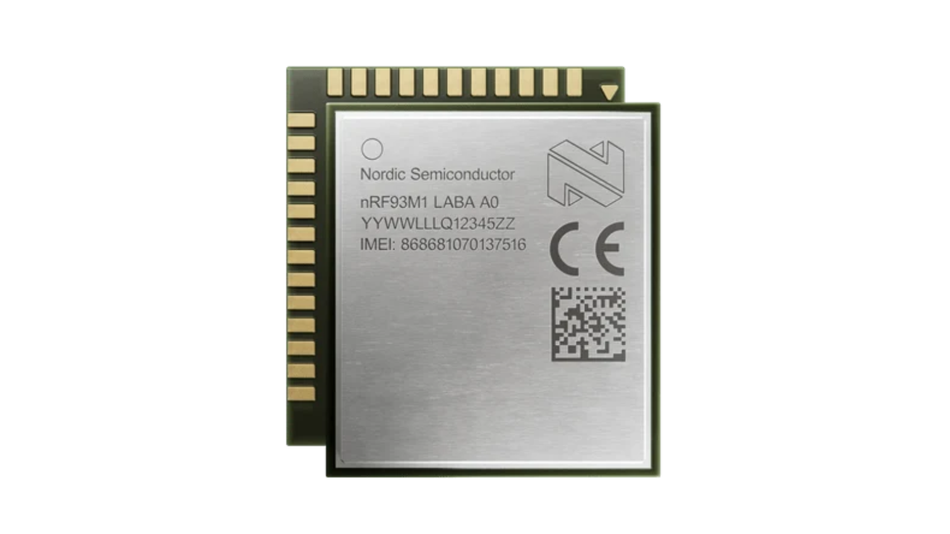
In an effort to simplify Cat 1 bis adoption, Nordic built the nRF93M1 around a single-antenna architecture, where the modem, RF front-end, and power management are all integrated into a single module with a feature set enabling optimized and robust designs. Nordic also built the nRF93M1 to support flexible SIM options, letting teams quickly choose and swap the best connectivity model for their specific deployment.
Thanks to this flexible and highly integrated architecture, the nRF93M1 offers low cost of ownership and a simplified solution for Cat 1 bis deployments with pin-compatible multi-regional and global SKU options.
Beyond connectivity, Nordic integrates nRF Cloud location services into the nRF93M1 to support asset tracking, covering low-power Wi-Fi positioning and cellular-based location. Fleet management, remote monitoring, and security teams can use these services to deliver location context and theft alerts alongside the connectivity payload. The nRF93M1 also features integrated observability features that let teams remotely monitor device and network parameters to identify performance issues without requiring a site visit. Long-term support is available through a CRA-certified firmware update solution, providing the compliance audit trail required to maintain IoT devices in the field.
And, to support development, Nordic offers the nRF93M1 Development Kit with pre-provisioned connectivity from Onomondo. The kit features Nordic’s BLE nRF54L device as a host platform. Onomondo's non-steered SIM technology pairs with the nRF93M1 to ensure devices connect to the strongest available 4G network at each location, rather than being locked to a predetermined operator by roaming agreements, maximizing the power efficiency gains Cat 1 bis is designed for. This pre-provisioned connectivity approach is a true enabler for single-SKU global deployment: one hardware design, one SIM, and consistent coverage wherever LTE exists.
Backed with the open-source nRF Connect SDK, including reference designs, host application examples and pre-built support for standard IoT security protocols, Nordic’s AI-assisted development flow significantly reduces deployment risk and speeds up time to market. Teams get ongoing lifecycle support through maintained firmware, updated certifications, and security patches, so products shipped today can stay compliant without needing updated hardware.
A Practical Path for Long-Term Global Connectivity
As 2G networks sunset throughout Europe and other regions, IoT product teams should consider Cat 1 bis as the connectivity solution for their next generation of hardware. With Nordic’s nRF93M1, designers can easily integrate Cat 1 bis into their next generation IoT deployments to keep them running today and be supported for decades to come.