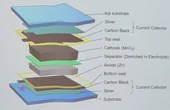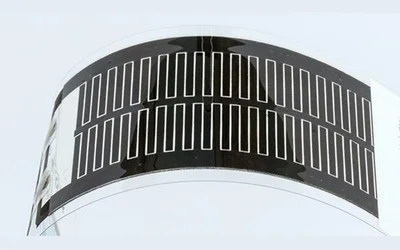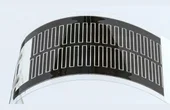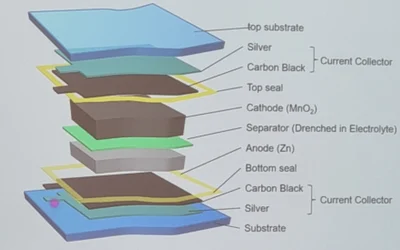
Printed batteries offer thinness and flexibility, enabling new applications, but their production is deceivingly complex. Gunter Hübner from Stuttgart Media University offered some insights at the e-Swiss conference last week.

Tagged with
Printed batteries offer thinness and flexibility, enabling new applications, but their production is deceivingly complex. Gunter Hübner from Stuttgart Media University offered some insights at the e-Swiss conference last week.
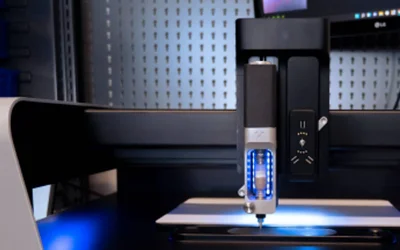
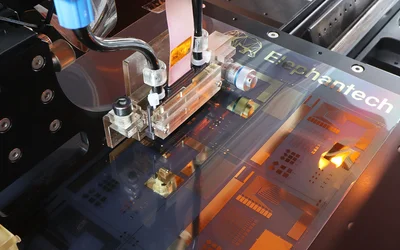
Experimenting in the world of Flexible Hybrid Electronics (FHE) comes with a variety of hurdles. Printing technologies are vastly different in terms of materials compatibility and have pros and cons that make them suitable for particular applications. Choosing materials that match the printing technology you intend to use is the most important decision you’re going to make. But what if one could print, digitally, using any paste and ink on any substrate? Read more
3 minutes read
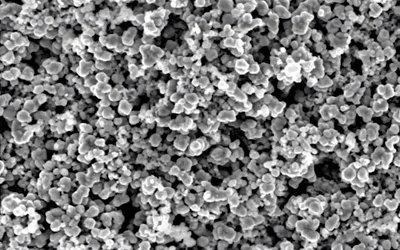
Cost of production has been a major barrier despite the fact that Cu raw material prices are far lower than Ag. This is because this large raw material cost difference does not often get translated into equally large nanoparticle dispersion or ink costs. Can this be overcome?
Warp knitting is an excellent candidate. It combines weaving and weft knitting, allowing the warp knitted fabrics to have the stability of woven fabrics and the elasticity of knitted ones.
Conformal EMI shielding is a megatrend on its way to become ubiquitous in electronics. The incumbent process is based on sputtering a tri-layer structure consisting of SUS on the EMC of the package. In these slides, you can see performance analysis and detailed cost analysis/projections.
2 minutes read
This article describes the TAeTTOOz printable battery technology developed by Evonik and acquired by InnovationLab for upscaling and mass production. In this article, you can learn about the operating principles, the key working characteristics, the material set, production techniques, and emerging applications of this technology
7 minutes read
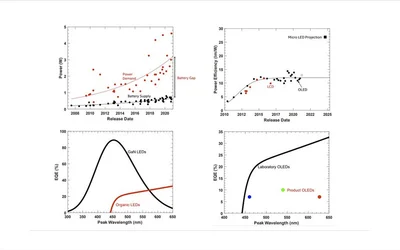
Why can microLED technology can help narrow the energy gap in electronic devices? The first slide shows the battery gap- Ahmed (Intel) has collected data by year showing that power demand of phones far exceeds the power supply level of batteries, creating a "battery gap" which ...
Phosphors or QDs for color conversion in LCD and microLED ? Which will win? This is an evolving technology space to watch. Here, it is shown that phosphor technology is evolving, enabling not just red but also green narrowband color conversation with small particle sizes compatible with microLEDs
2 minutes read
Molecular particle free inks can offer extreme formability and stretchability, allowing the design and production of 3D shaped and/or in-mold electronics parts with extreme curvatures and complex shapes.
How to overcome the traditional limits of LDS (laser direct structuring) to metallize 2D and 3D objects made from all kinds of surfaces?
It is incredible to see the progress that organic semiconductors (OSC) have made over the past 15-20 years. Ian Jenks explains in this short 5-min presentation how they are removing the long-existing barriers to adoption of OTFT technology.
Gallium-Indium-Tin is an interesting material for stretchable electronics. It can be formed into a non-toxic RoHS-compliant gel and applied to almost any substrate to form stretchable conductive metallizations and circuits.
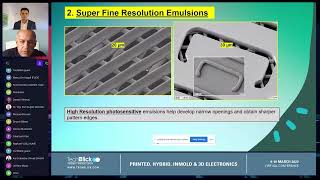
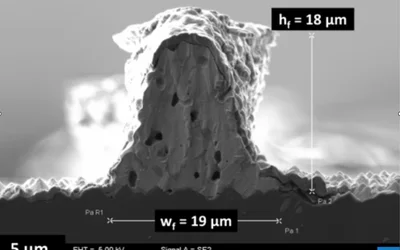
Screen printing never ceases to advance and is entering into ultrafine line printing territory. FERNANDO ZICARELLI explains in this short 5-min talks important considerations to achieve fineline printing and further push the resolution down:
Here, the additive nature of the process means that the production process is environmentally friendlier and does not involve etching chemicals. Furthermore, the digital nature of the patterning (inkjet printing) means that designs can be changed faster.
We first discuss emerging and existing applications for ultra fineline screen printing, outlining how evolution of screen printing can unlock various electronic applications. Next, it will review other printing technologies extending the linewidth resolution to sub-micron range