Ultra-Subminiature Sealed Switches for Space-Constrained Systems: D2EW and D2EW-R by Aratas
By rethinking switching at the structural level, Aratas has developed switches that offer multi-directional actuation, environmental sealing, and integrated fault detection in compact, high-density systems.

02 Mar, 2026. 5 minutes read
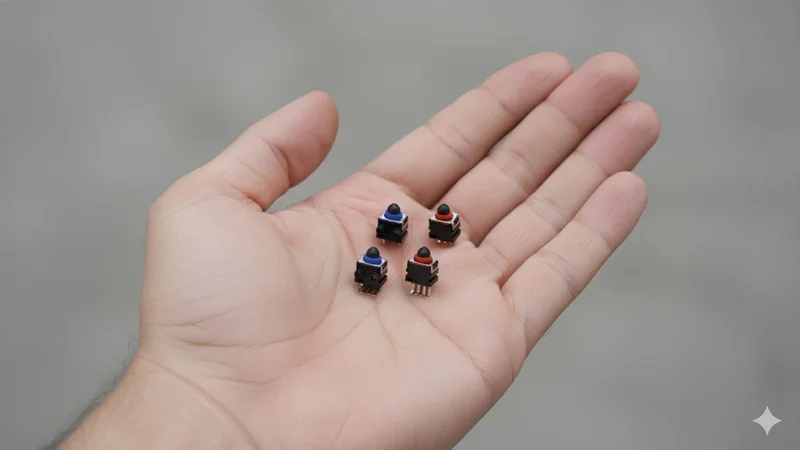
As the trend of miniaturization continues across industries, designers are under constant pressure to deliver more capabilities within shrinking physical envelopes. While most of the attention is given to electronics and software optimization, mechanical components such as switches and relays are often overlooked.
Yet switches affect packaging efficiency, design freedom, reliability, and ultimately, the overall product cost. Their actuation method influences the surrounding mechanisms, stroke characteristics affect control and durability, and sealing determines environmental robustness. As a consequence, traditional miniaturization often introduces new trade-offs, solving one problem while creating others elsewhere.
This article examines why conventional switches struggle in space-constrained systems and how Aratas is addressing these challenges with a fundamentally different approach to switch design.
Challenges in Switch Designs in Space-Constrained Systems
As available space inside products decreases, integrating switches without compromising the surrounding mechanisms and overall system reliability becomes a challenge.
Space Constraints: The first constraint is limited space. Actuation components like cams, levers, guides, and mechanical stops occupy more volume than the electrical contact, turning the actuation method into a primary deciding factor for the enclosure size.
High Force: High mechanical forces further restrict design options. In applications like automotive door latches, switches are subjected to repeated impact and load, leaving little tolerance for ultra-short stroke designs or uncontrolled overtravel.
Harsh Environments: Environmental exposure adds further complexity. Moisture, condensation, dust, and temperature cycles all demand sealed construction, which gets more difficult to implement as the switch size decreases and geometries become more complex.
Diagnostics: Finally, growing diagnostic expectations require switches to have increasingly predictable behavior and offer visibility into faults, placing extra pressure on compact designs.
These constraints make switch selection a system-level design challenge rather than a simple component choice.
Where Traditional Switch Designs Fall Short
Designers typically make use of a limited set of established switch actuation approaches, which are well understood but bring compromises that become more apparent as systems get smaller and more demanding.
Vertical push-button switches, for example, suffer when exposed to high forces due to their very short stroke lengths. Their limited travel leaves little margin for error, requiring external mechanical stops to prevent the switch from getting damaged.
Lever-based horizontal switches allow side actuation but increase the occupied envelope of the switch. The lever extends cam travel, adds parts, and introduces additional assembly steps, all of which work against the goal of miniaturization.
Cam switches manage to reduce stress on the actuator by changing the angle of force application, but they require longer travel distances to achieve full actuation, which again increases enclosure size.
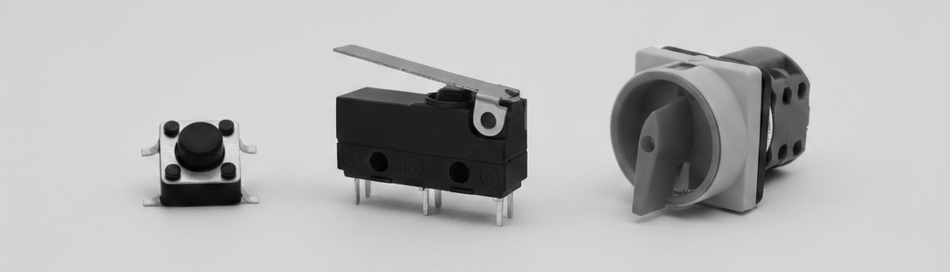
All these approaches have one limitation in common: they try to adapt force direction to conventional switch structures. Overcoming the challenges requires rethinking how force is transmitted into the switch itself, rather than reshaping external mechanisms around it.
Aratas D2EW Sealed Ultra Subminiature Basic Switch: Rethinking the Switching Architecture
Aratas approached the problem with a clean-sheet redesign of the internal actuation motion, with a focus on managing the force within a very small volume.
The core shift in the design was to build the actuator in such a way that it could accept force from multiple directions without any external mechanisms to redirect the motion. By internalizing this behavior, Aratas developed the D2EW family of sealed ultra-subminiature switches that reduced dependence on levers, cams, and large actuation hardware that typically drive up the size and complexity of traditional switches.
This was not just about scaling down the conventional pushbutton structure but a fundamentally different switching architecture that addressed space, force, and reliability constraints together, rather than trading one off for another.
Table 1: Key specifications of Aratas D2EW and D2EW-R
| Specification | Details |
| Dimensions and Weight | 8.3 x 7.0 x 5.3 mm, 0.5 g |
| Operating Speeds | 30-500 mm/s |
| Operating Frequency | Up to 30 operations/min |
| Protection | IEC IP67 (excluding terminals), vibration resistance, shock resistance |
| Operating Temperature | -40 to +85°C (at 60% RH max.) |
Multi-Angle Operation Without a Lever
Even in tightly constrained spaces, D2EW switches support multi-angle actuation without a lever. This is enabled by a uniquely shaped triangular actuator geometry that looks like a rice ball. Unlike circular pushbuttons with a flat head, D2EW switches channel applied force efficiently into the internal mechanism.
Whether the force gets applied vertically or from the sides, the shape guides the motion in a controlled way to reduce stress concentration on the actuator and the surrounding parts. As a result, D2EW switches can be operated from angles up to 90° without requiring any external mechanisms like levers or sloped cams.
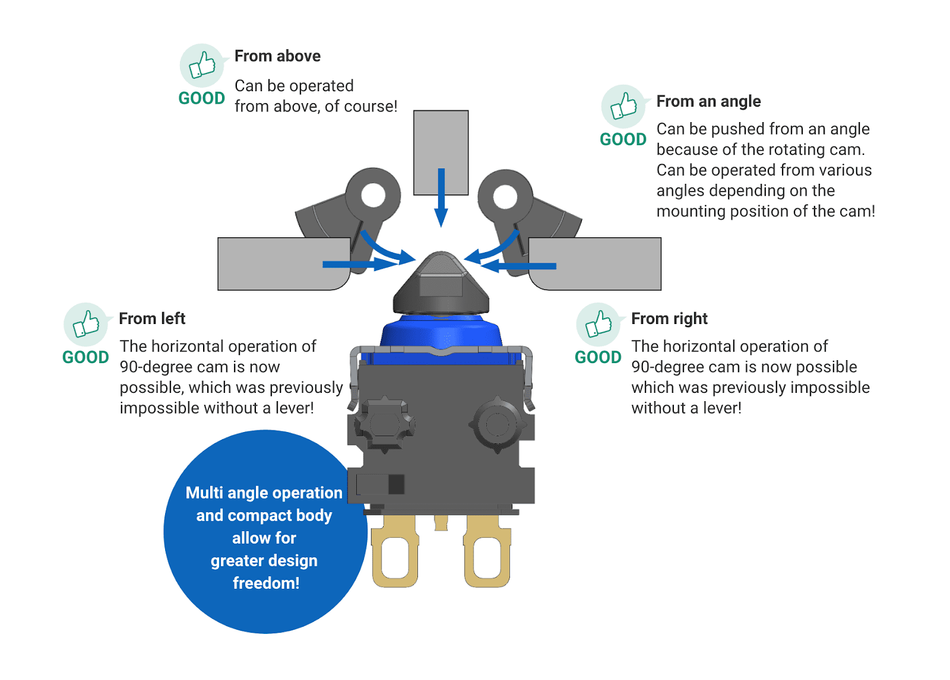
Internally, a sliding contact mechanism converts this external motion into stable electrical switching, which supports reliable operation with short as well as long strokes while maintaining durability. D2EW carries out the switching operation quietly and with great efficiency.
Sealing, Assembly, and Durability in Ultra-Compact Forms
Designing a sealed switch at such a small scale introduces challenges that go beyond actuation. Non-circular actuator geometry makes it difficult to apply uniform sealing pressure, and conventional heat-caulking methods used for circular push buttons no longer remain suitable for D2EW switches.
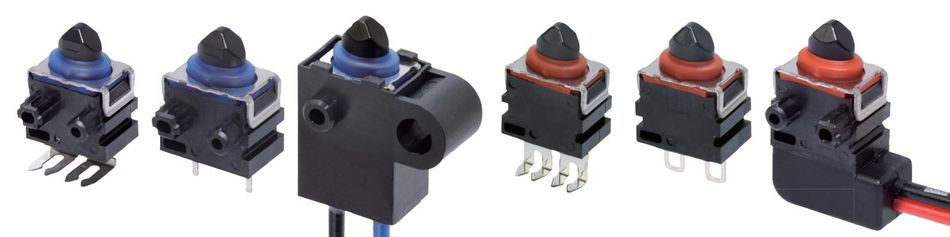
To address this, Aratas developed a snap-fit sealing structure in which the rubber cap is sandwiched between the case and cover, achieving IP67 protection despite the super compact size. The rubber cap’s shape and thickness were carefully optimized to equalize sealing pressure and maintain performance under temperature cycling and vibrations.
Aratas D2EW’s assembly also required a bathtub-shaped enclosure that enabled top-down assembly, accommodating the larger actuator while keeping the overall switch footprint small. This design simplified assembly without compromising sealing or durability.
These design choices balanced size, robustness, and manufacturability, the key requirements for space-constrained systems.
Suggested Reading: Enhancing Assembly Efficiency with Aratas's XW4M/XW4N Push-In Terminal Block PCB Connectors
Fault Detection with Aratas D2EW-R
The D2EW-R is a variant based on the same mechanical platform, sharing identical form factor, actuation behavior, sealing, and durability, but it goes a step beyond by offering internal resistors integrated into the switch circuit to help identify ON and OFF positions as well as fault conditions. It can detect open-circuit (broken wire or disconnected connector) and short-circuit events.
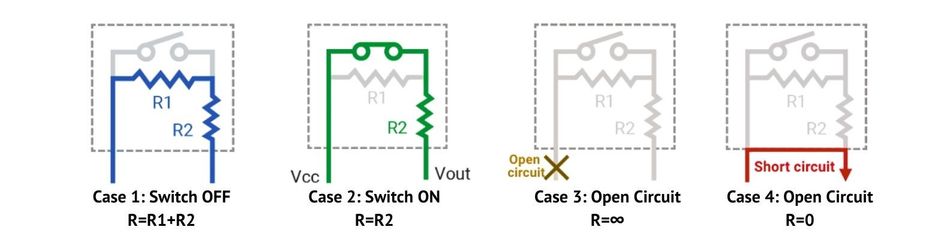
Monitoring the voltage across or current through the switch can clearly pinpoint abnormalities in the circuit without additional external components. This built-in resistor network eliminates the need for an external fault-detection circuit, further reducing the overall product size.
Advancing Switching for Next-Generation Applications
Aratas’s D2EW switches were developed initially for automotive door latch systems, where switches had to be operated in extremely tight packaging constraints while withstanding high mechanical loads and harsh conditions. Slim profiles, tolerance to misalignment, and sealed construction were critical for long-term reliability. The same characteristics translate well for other space-constrained systems such as HVAC equipment, mobile robots, industrial automation systems, and consumer electronics.
Visit Aratas’s D2EW and D2EW-R landing page to discover how a fundamentally reengineered switching architecture can unlock new space, simplify your mechanism, and elevate system reliability in your next design.