Securing the Supply Chain – Authenticity vs. Reliability
Rethinking Supply Chain Security for Multi-Decade Industrial Lifecycles

05 Mar, 2026. 4 minutes read
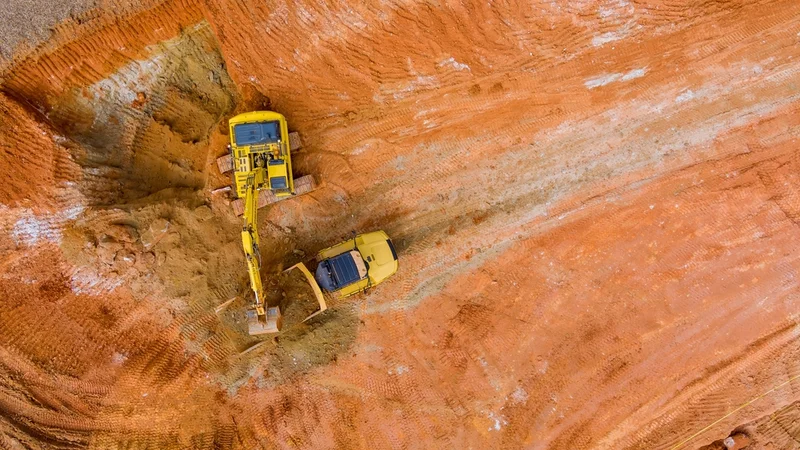
For manufacturers in the industrial and heavy equipment sectors, supply chain security is a responsibility that spans decades. A single semiconductor often dictates whether a production line or an excavator remains operational after thirty years in the field. However, many organizations incorrectly equate supply chain security solely with counterfeit prevention.
While ensuring a part is genuine is important, the reality of long-term support encompasses much more. True security requires a holistic approach that guarantees the integrity of component storage, transparent traceability, and rigorous environmental control throughout the device's entire lifespan.
Why Supply Chain Security Extends Beyond Counterfeits?
The electronics industry has long focused on counterfeit detection as its primary mechanism of defense, but this approach addresses only the surface of the problem. Physics dictates that even 100% genuine components degrade if suppliers fail to store or handle them correctly (1).
Plastic-encapsulated semiconductors, for example, naturally absorb moisture from the atmosphere. If a technician reflows these components years later without proper preparation, the trapped moisture expands rapidly, causing the package to crack ("popcorn effect") or delaminate internal wire bonds.
For industrial equipment builders, such failures carry consequences that far exceed the cost of a replacement board. A degraded control chip can freeze an assembly line or disable heavy machinery that has otherwise operated flawlessly for decades. In contrast to engineers in consumer electronics, industrial OEMs rarely design systems with plug-and-play redundancy. When the part fails, the system fails. Therefore, the true test of supply chain security lies in maintaining the physical integrity of components across decades of storage, handling, and logistics.
The Lifecycle Mismatch
The industrial and heavy equipment markets operate on timelines that the rest of the semiconductor industry views as glacial. A control module designed for a mining truck or a power plant may remain in service for forty years or more. During that span, the industry retires entire generations of process technology and packaging standards. Even if the original parts stay in stock, their mechanical and metallurgical properties can change (2).
Time alters materials! Tin whiskers can grow on plated leads and cause short circuits. Bond wire adhesion can weaken under humidity cycling. Surface oxidation can degrade thermal performance and solderability. Each of these degradation modes turns an otherwise authentic component into a latent point of failure.
A secure supply chain must therefore extend its oversight from the initial wafer lot to the point of use. Designers need absolute visibility over how and where suppliers store every unit.
Rochester’s Secure Supply Chain Framework
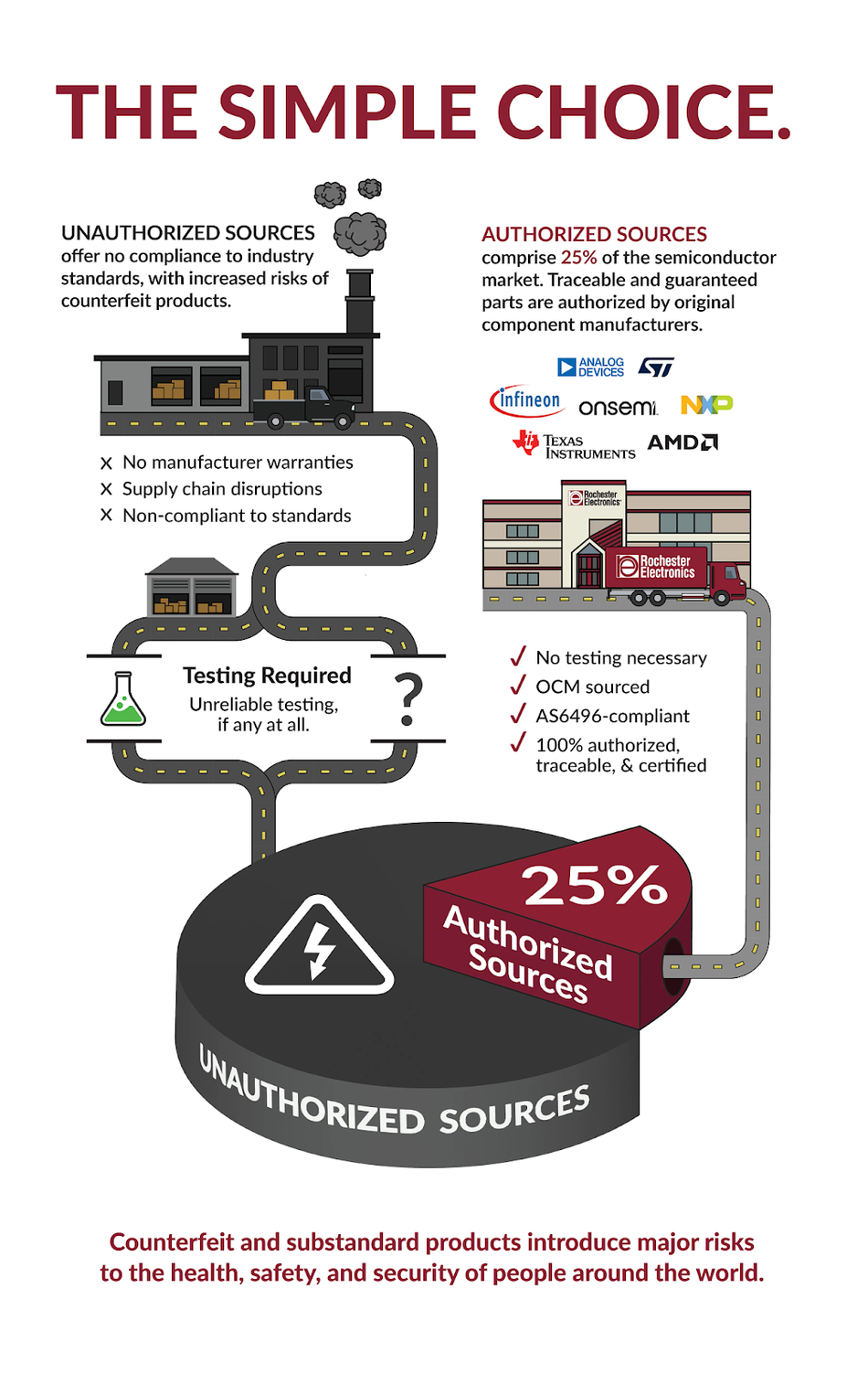
Rochester’s supply chain security model begins with traceability and controlled storage. Every component that enters our inventory remains within the authorized distribution channel from the OCM. Additionally, our operations comply with SAE AS6496, which outlines the practices required to maintain an unbroken chain of custody (3). Whereas hybrid distributors maintain both authorized and broker divisions, Rochester operates within a single channel. With no open-market sourcing, mixed inventory, or ambiguity about origin, Rochester eliminates uncertainty. Every unit originates from the original manufacturer and is stored under controlled conditions.
Inside the facilities, Rochester continuously monitors environmental parameters. For example, we control temperature, humidity, and electrostatic discharge levels to meet or exceed OCM specifications. We also seal moisture-sensitive devices in barrier packaging with desiccant and humidity indicators, and re-bake before shipment if needed. These measures mean that when a component leaves storage, whether after one year or twenty, it performs according to its original specifications.
Traceability is the second pillar of Rochester’s framework. Customers can trace each component lot back to its wafer source, manufacturing date, and test program data. A complete pedigree helps customers demonstrate compliance during audits and supports root-cause analysis when systems approach end-of-life. Industrial customers rely on that traceability to verify that replacement components match the electrical and mechanical characteristics of their original builds. Broker-sourced material simply can't guarantee the same level of assurance.
By maintaining the physical and informational integrity of each device, Rochester creates a supply chain where authenticity and reliability reinforce one another. A genuine part is of little value if it fails under stress. A reliable part cannot exist without confidence in its origin. Rochester makes sure both conditions remain inseparable.
Extending Life Through Die Banking
Even the most sophisticated storage protocols can’t preserve a finished semiconductor indefinitely. Eventually, original manufacturing ceases, and finished goods inventory dwindles. For long-lifecycle markets, this inevitability is a vulnerability. To solve this, Rochester practices die banking.
Specifically, Rochester keeps extensive stocks of known-good die (silicon wafers) under tightly controlled environmental conditions. When an OCM ends production, Rochester will acquire the remaining wafer stock, along with the test programs and intellectual property required to continue manufacturing under license. This capability allows the company to produce components that are electrically and mechanically identical to the originals and fully authorized by the OCM.
Enabling Reliability Across Decades
Ultimately, industrial supply chain security is a function of physical control and long-term accountability. Industrial environments leave no margin for error. A supply chain that merely delivers "genuine" parts fails if those parts have aged or degraded due to neglect. Reliability is, therefore, the cumulative result of unbroken traceability, active environmental preservation, and authorized reassembly.
Rochester’s integrated model provides that assurance. Our AS6496-certified storage infrastructure preserves the physical integrity of components. Our traceability systems maintain full visibility into every lot, wafer, and test record. Our licensed manufacturing programs extend availability long after OCMs have transitioned to new technologies.
References
1. https://www.rocelec.com/news/long-term-storage-solutions
2. https://www.rocelec.com/news/are-you-overthinking-date-codes
3. https://www.rocelec.com/news/authorized-supply-chain