Humanoids of the Future
Explore Alternative Form Factors, such as Compact, Tracked, and Torso-Only Robots.

20 Nov, 2026. 8 minutes read
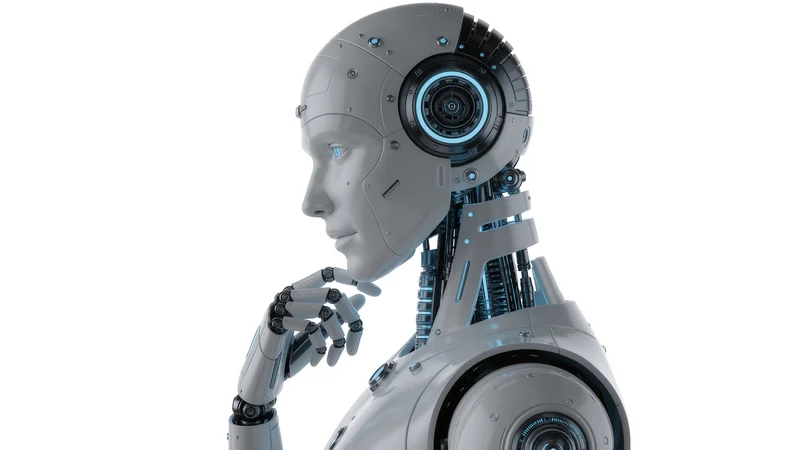
Humanoids Could Scale to 3 Billion by 2060
Humanoids are the new favorites for modern industries. These general-purpose robots can learn and adapt to industrial environments and are designed to boost productivity in manufacturing plants, assembly lines, etc. So far, they seem to be on the right track.
A report suggests that, by 2060, up to 3 billion humanoid robots will be deployed in the industrial landscape, potentially transforming factories, warehouses, homes, healthcare, and other human-centered environments.
These humanoids are expected to make up:
20% of the workforce in the industrial sector, replacing 2.5 human workers.
50% of the workforce in the service sector, replacing 1.5 human workers.
But when we define a Humanoid, most of us picture a full-sized bipedal machine like the Tesla Optimus or Atlas, which are designed to walk, manipulate objects, and operate alongside people.
However, not every application needs a human-like two-legged robot. There can be varying demands based on mobility, payload, stability, reach, energy consumption, and cost.
So, it raises a fundamental question: will the humanoid robots of 2060 all look like today’s bipedal machines?
Suggested Reading: Why Industrial Robotics is Experiencing Steady Growth
What Counts as a Humanoid
Humanoid is a generic term that describes robots with a typical human form factor. But they are more than just two-legged robots and are capable of understanding, learning, and adapting to their environments.
Ideally, a humanoid should replicate human motion, as its anthropomorphism is much more human-like and different from other robots. For instance, a humanoid may perform tasks like picking an object and placing it upstairs, or collaborating with a human to assemble parts on an assembly line. However, these seemingly simple operations require complex dynamics, which are often difficult to achieve with accuracy, let alone safety.
In Humanoid robotic systems, it’s not about how closely a robot resembles a human, but how well it is compatible with human environments and tasks. A humanoid may use two arms to manipulate objects and may walk, run, or jump when required.
But not every application needs these capabilities. Instead, the application should determine the robot’s form, particularly because bipedal humanoids introduce significant penalties:
Balance and control complexity
High energy consumption
Cost and maintenance
Mechanical complexity
Payload limitations
This distinction separates human-like function from human-like appearance. A robot may closely resemble a human yet offer limited practical compatibility with human tasks. Likewise, a distinctly non-human robot can provide the reach, dexterity, mobility, and sensing needed to work effectively alongside people. Humanoid design, therefore, is better defined by function than appearance.
Recommended Reading: Design Considerations for Humanoid Robots
Alternative Humanoid Form Factors
The future of humanoid applications suggests that robots that retain certain human features can be equally productive for specific assembly lines. Here, we introduce three promising humanoid forms: compact humanoids, tracked humanoids, and torso-only humanoids
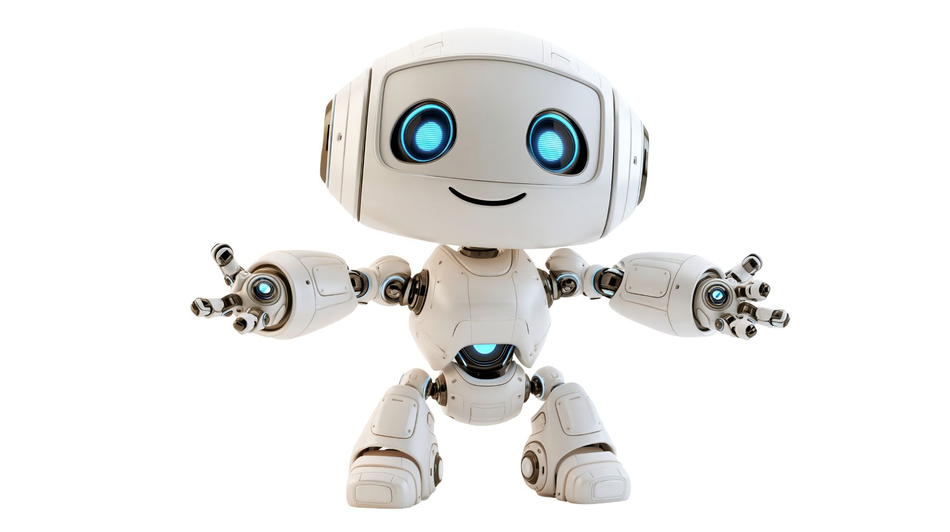
Compact Humanoids
Compact humanoid robots are smaller versions of the conventional humanoid form. They have reduced height, weight, and power requirements. So, instead of matching the size and strength of an adult human, their design is focused on:
Portability
Smarter Energy Management
Ease of deployment.
Moreover, their smaller footprint can reduce material and manufacturing costs while making transportation, charging, and storage easier. Also, lower mass improves safety when operating near people, particularly in homes, schools, offices, and healthcare environments.
Compact Humanoid Applications
Because of their compact form factor, these robots are more useful for interaction and accessibility than strength-based applications. Their potential applications include:
Household assistance: Carrying lightweight objects, providing reminders, monitoring environments, and assisting with simple daily tasks.
Retail and hospitality: Greeting customers, providing information, guiding visitors, and delivering lightweight items.
Inspection: Accessing confined or cluttered spaces that may be difficult for larger humanoids to navigate.
Healthcare and assisted living: Providing basic assistance, reminders, communication, and object delivery for older adults or people with disabilities.
Education: Serving as interactive platforms for teaching robotics, programming, and human–robot interaction.
Real-Life Compact Humanoids
The following examples illustrate how different compact humanoids have been adopted for different applications.
NAO from SoftBank Robotics, at approximately 58cm tall, is a small humanoid designed primarily around interaction, education, entertainment, nursing, and research.
Unitree G1, at roughly 1.3m tall, moves closer to human scale while retaining a relatively compact and lightweight design, making it suitable for research, mobility, and manipulation experiments.
The following table shows some more popular compact humanoid robots and their applications.
Robot | Height | Applications |
ROBOTIS OP3 | 50cm | Education and research; AI and human–robot interaction |
ROBOTIS DARwIn-OP | 45.4cm | Robotics research; education and programming |
KHR-3 HUBO | 125cm | Humanoid robotics research; walking and manipulation |
ICub | 104cm | Cognitive robotics research; manipulation and human–robot interaction |
NimbRo-OP2X | ~90cm | Robotics research; autonomous walking and manipulation |
Wheeled and Tracked Humanoids
Tracked humanoid robots replace conventional human-like legs with continuous tracks or articulated track units, while retaining a human-compatible upper body with a torso, arms, hands, and sensors.
This creates a hybrid form factor, combining human-oriented manipulation with the stability and traction of tracked mobility. Tracks distribute the robot's weight over a larger contact area, providing greater stability and improved traction on loose, uneven, wet, or hazardous terrain.
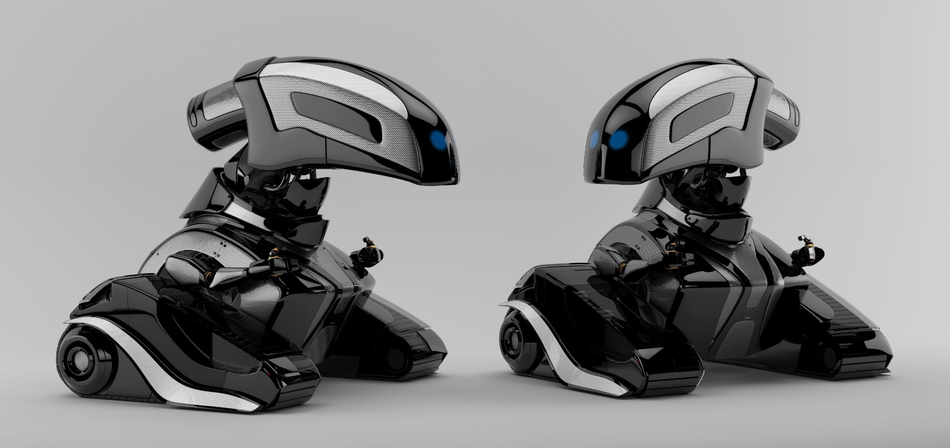
They can also support heavier payloads and simplify locomotion because the robot does not need to maintain the complex balance and gait control required by a bipedal system. Fewer highly articulated leg joints can also potentially simplify maintenance and improve mechanical robustness.
Tracked Humanoid Applications
The combination of a torso and a stable lower body makes these robots particularly attractive for environments where terrain is more challenging than the task itself. Because these robots can move on uneven terrain, one useful application for tracked humanoids is in search and rescue operations.
For instance, BIT-DMR features a dual-arm upper body placed onto a tracked mobile platform, which allows it to manage versatile payloads, remove obstacles, and perform casualty evacuation.
Moreover, Tracked Humanoids can be very useful in the following application areas:
Warehouses and factories: Transporting materials while using human-oriented workstations, shelves, tools, and machinery.
Construction and infrastructure inspection: Operating on rough floors, debris, slopes, or unfinished surfaces while manipulating inspection equipment and tools.
Disaster response: Entering unstable or hazardous environments to inspect damage, move objects, or perform remote manipulation without exposing human workers.
Mining and agriculture: Working outdoors on loose soil, rocks, mud, or uneven terrain where wheeled or bipedal systems may struggle.
Tracked Humanoid Examples
Tracked humanoids occupy an interesting position between conventional mobile robots and fully legged humanoids.
CHIMP from Carnegie Mellon University is a tracked humanoid built for disaster response in degraded and human-engineered environments. It’s a unique tracked humanoid because all four of its limbs carry motorized tracks. It rests on the tracks of its legs, which gives it a wide, steady base. On rough ground, it lowers itself and drives on all four tracks like a tank.
JPL Surrogate is another tracked robot built at NASA’s Jet Propulsion Laboratory. The robot was designed to reach hazardous places to perform tasks like testing, accessing closed compartments, closing valves, etc.
The following table shows the list of some notable tracked robots:
Robot | Base | Applications |
RoboForce TITAN | Tracked/wheeled | Manufacturing and assembly; mining and logistics |
SuperDroid Humanoid Robot | Tracked/6-wheel | Research and education; industrial manipulation |
Rollin' Justin — DLR | 4-wheel mobile base | Space robotics research; household/service manipulation |
Musashi-W | Wheeled | Household manipulation; autonomous mobile manipulation |
TWENDY-ONE | Omnidirectional wheels | Household assistance; human–robot interaction |
Torso-Only Humanoids
Torso-only humanoid robots focus on the upper-body portion of the human form. Typical robots combine a torso, one or two arms, dexterous hands, sensors, and sometimes a head or vision system. These platforms may be stationary or mounted on a mobile base, but they do not require full-body legs or bipedal locomotion.
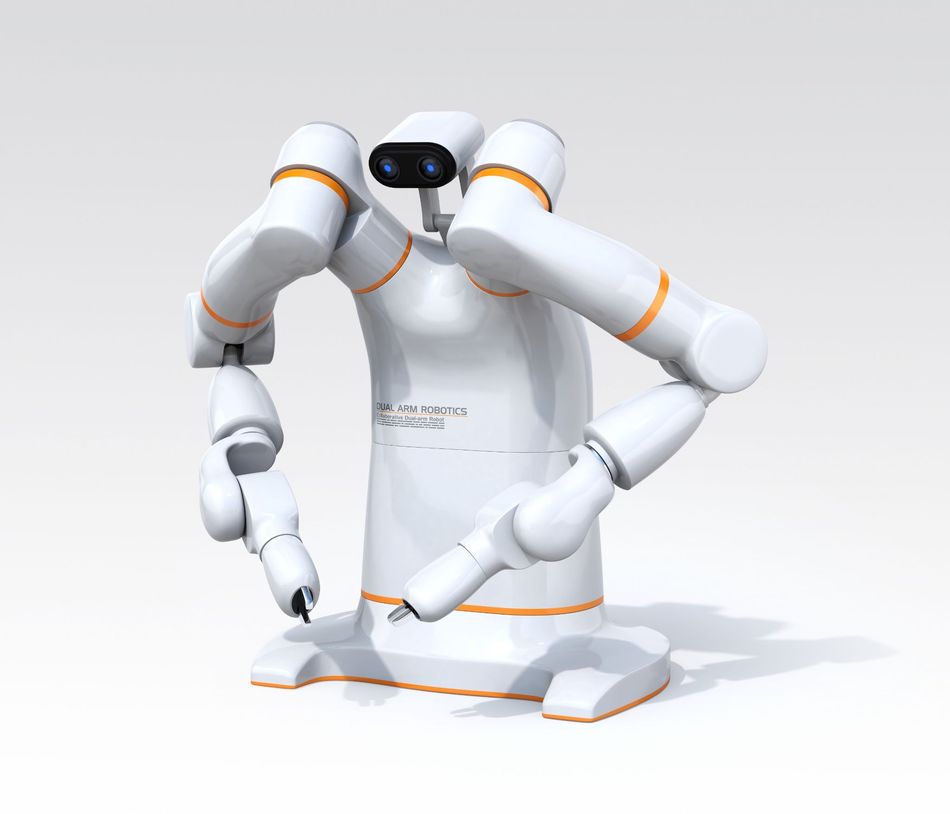
By concentrating on the body components most important for manipulation, they can interact with tools, components, containers, instruments, and other objects designed for human workers while remaining mechanically simpler than a complete humanoid.
A Torso-only design is simpler, and lighter to build and control, and it lets designers focus on manipulation. Torso-Only Humanoid Applications
Since these robots don’t need to move much, they are excellent options for stationary applications on assembly lines and in laboratories.
Here are some common applications of Torso-only humanoids:
Assembly lines: manipulating components, fastening parts, handling tools, and performing repetitive assembly operations.
Laboratory automation: handling samples, instruments, containers, and equipment designed around human laboratory workflows.
Food preparation: grasping ingredients, operating utensils, and performing repetitive preparation tasks.
Surgical and medical support: manipulating instruments or assisting with controlled procedures in environments requiring precision and repeatability.
Real-Life Torso-Only Humanoid Examples
Robonaut 2 (R2) was initially launched by NASA as a Torso-only robot, restricted to a stanchion. It was the first human-like robot launched in space. It was developed as a human assistant. Later, Robonaut was upgraded with legs to enhance locomotion.
DLR Table Justin by the Institute of Robotics and Mechatronics, German Aerospace Center. It was motivated by the DLR Lightweight Robot III and DLR Hand II. It features a 3 DOF torso, combined with a pair of arms and dexterous hands. It can handle tasks like emptying bins and unscrewing cans.
Robot | Height | Applications |
Kawada NEXTAGE | 84 cm (without pedestal) |
|
Baxter — Rethink Robotics | 190cm | Industrial assembly, collaborative manipulation |
A Quick Comparison of Humanoids
The following table summarizes the comparison of humanoids discussed in this article.
Form factor | Primary strengths | Potential applications | Main limitations |
Full-size bipedal | Often has human-like reach and mobility closer, which suits spaces built for people. | General-purpose work, logistics, maintenance | High complexity, balance demands, cost, and safety concerns |
Compact humanoid | Tends to be cheaper, easier to move, and safer to use around people | Homes, offices, retail, education, care support | Limited reach, payload, and battery capacity |
Tracked humanoid | Often steadier on rough or uneven ground, and some designs can carry heavier loads. | Disaster response, construction, inspection, industrial work | Poorer stair and obstacle navigation |
Torso-only | Puts design effort into manipulation, and can use tools made for people. | Manufacturing, laboratories, food service, hazardous remote work | Limited independent mobility |
These are general tendencies. Actual performance depends on the specific robot’s design, not on its form factor alone. The robotic categories cover several application areas and advantages tend to overlap. Therefore, it primarily depends on cost and the nature of the applications whether one robot is preferred over another.
Moreover, the future of robotic applications may demand hybrid humanoids where the capabilities of different humanoids are integrated in a single unit.
Recommended Reading: A quick engineering comparison of cutting-edge humanoid robots
Is there a Clear Winner in Humanoid Form Factors?
The comparisons and characteristics discussed in this article indicate that humanoids can be quite versatile in their form factors and applications. There is no clear winner among these form factors. Each offers something unique where other form factors might fail.
Moreover, further hybrid forms can be created out of these systems. For instance, a specialized torso mounted on a compact robot with specialized tools can be used for highly specific industrial applications. It also indicates that the future of humanoids can be extremely versatile.
Primarily, the choice of a humanoid type comes down to user requirements such as payload, cost per task, speed, reliability, human acceptance, and regulatory requirements.
Suggested Reading: 7 Challenges In Industrial Robotics
Conclusion
The future of humanoids can hardly be assumed as one-dimensional. As three billion humanoids are projected to be deployed by 2060, it’s hard to imagine a single humanoid form taking up every task. Moreover, the economic and practical considerations will demand more application-specific robots. So, the focus would be on the capabilities of a robot, rather than how it looks.
For the future industries, the question may not be whether humanoid robots will look like humans, but how much of the human form is actually necessary for a given task. The 2060 robot workforce could therefore look less like an army of Atlas or Optimus robots and more like an ecosystem of specialized machines that borrow only the human characteristics they need.