Why Heat Management Is the Foundation of Reliable Soldering
JBC Soldering addresses the challenges and key factors of heat management in modern electronics manufacturing.

23 Jul, 2026. 5 minutes read
Who Is JBC Soldering Tools and Why Heat Management Matters
Reliable soldering depends on much more than simply melting solder, as every solder joint requires the correct amount of heat delivered at the right duration and location. When heat is not properly controlled, even experienced operators can encounter inconsistent joints, damaged components, shortened tip life, and reduced production efficiency. Therefore, effective heat management is a defining factor in achieving consistent manufacturing results.
In this regard, JBC Soldering Tools is a company that has a history of more than 95 years developing soldering technology for electronics manufacturing. The company has built its reputation around one core principle: that reliable soldering depends on precise heat control, as it is a key factor affecting quality, productivity, and reliability. This article discusses the role of heat management in achieving reliable solder joints and examines how JBC's soldering technologies are designed to maintain consistent thermal performance throughout the soldering process.
Why Heat Management Determines Solder Joint Quality
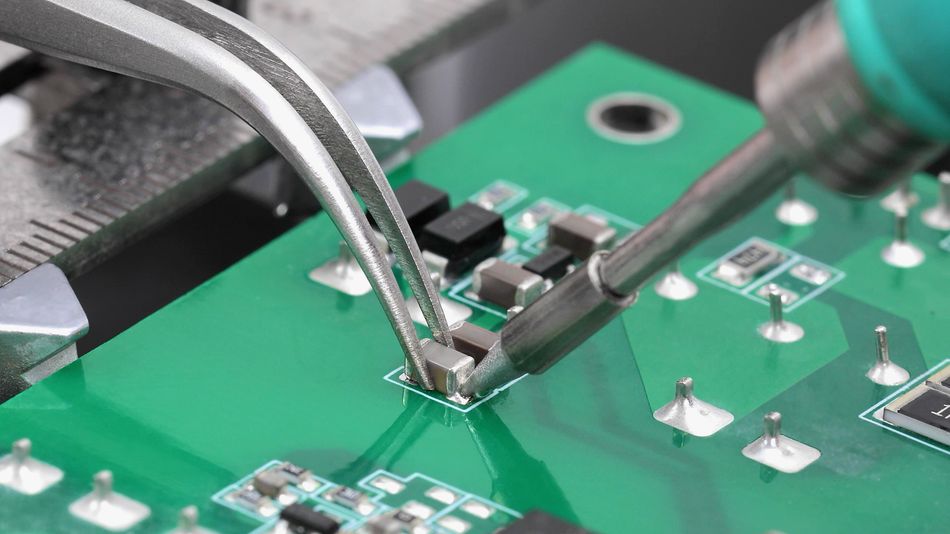
During soldering, heat should flow from the soldering tip into both the component lead and the PCB pad before the solder can properly melt and wet the surfaces. When sufficient heat reaches both surfaces simultaneously, the solder flows evenly, creating a strong metallurgical bond with good electrical and mechanical properties.
If too little heat is transferred, solder may not fully wet the surfaces before solidifying. This can result in cold solder joints, poor electrical connections, increased contact resistance, and joints that are more susceptible to failure during vibration or thermal cycling. These defects are often difficult to identify visually, yet can significantly affect long-term product reliability. Similarly, applying excessive heat or exposing components to elevated temperatures for too long can damage sensitive devices, lift PCB pads, accelerate flux degradation, or shorten component life.
Therefore, the challenge is not simply achieving the desired temperature once. Every solder joint presents different thermal demands depending on factors such as copper thickness, component size, ground planes, and PCB design. Maintaining stable heat transfer despite these changing conditions helps produce consistent solder joints across an entire assembly.
This consistency becomes more important in high-reliability industries such as aerospace, medical device manufacturing, and automotive electronics. In these sectors, electronics usually operate under demanding environmental conditions involving vibration, temperature cycling, humidity, and extended service life. A solder joint that performs adequately during initial testing may still fail prematurely if the soldering process introduces hidden weaknesses caused by improper thermal control. Consistent heat management helps minimize these variations, supporting manufacturing processes that produce repeatable, reliable joints capable of meeting the stringent quality requirements of these industries.
The Challenge of Controlling Heat in Modern Electronics Manufacturing
Maintaining stable heat delivery has become harder as electronics have advanced. Miniaturized components, multilayer PCBs, fine-pitch packages, and larger copper areas all influence how heat flows during soldering. Some joints absorb heat rapidly because they are connected to large copper planes, while nearby components may require less thermal energy.
These varying thermal loads make it difficult to maintain a consistent tip temperature during continuous production. Each time the soldering tip contacts a joint, heat flows from the tip into the workpiece. The amount of heat differs from one joint to the next, causing the tip temperature to fluctuate if the soldering system cannot compensate quickly enough.
Maintaining a stable operating temperature despite changing heat requirements is one challenge. Recovering from those temperature drops is another. Heat recovery refers to how quickly a soldering system restores the tip to its work temperature after heat has been transferred into the joint.
Consistent tip temperature focuses on minimizing temperature fluctuations while soldering different joints, whereas heat recovery describes how effectively the system restores thermal energy after each soldering operation.
Key Elements of Effective Heat Management
Temperature Stability and Heat Recovery
When the tip is close to its target temperature throughout production, each solder joint experiences similar thermal conditions, which improves process consistency.
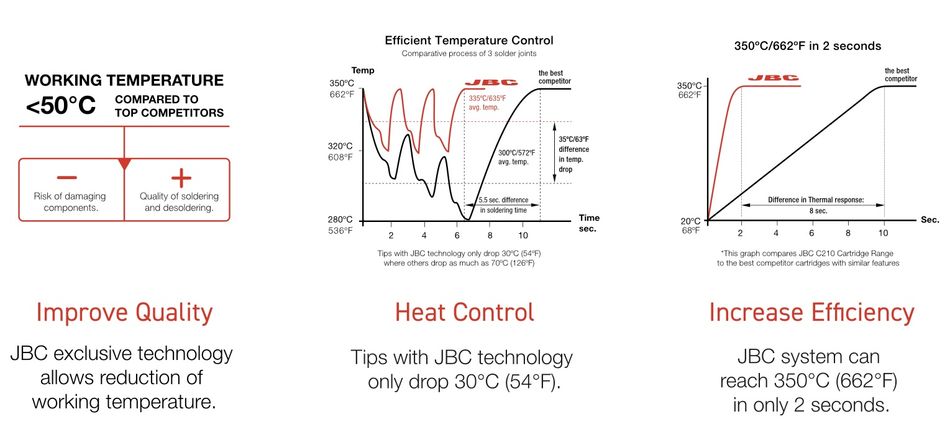
Achieving stable temperatures depends not only on the heating element but also on how quickly the system responds to changing thermal requirements. During continuous production, every solder joint removes heat from the tip. A soldering system with fast heat recovery replaces that lost energy quickly to solder subsequent joints under nearly identical conditions. Therefore, heat recovery speed is usually more important than initial heat-up time. Although rapid startup improves convenience, production efficiency depends primarily on maintaining stable performance throughout repeated soldering cycles.
Intelligent Heat Management
During idle periods, continuously maintaining maximum operating temperature can accelerate tip oxidation, shorten cartridge life, and consume unnecessary energy.
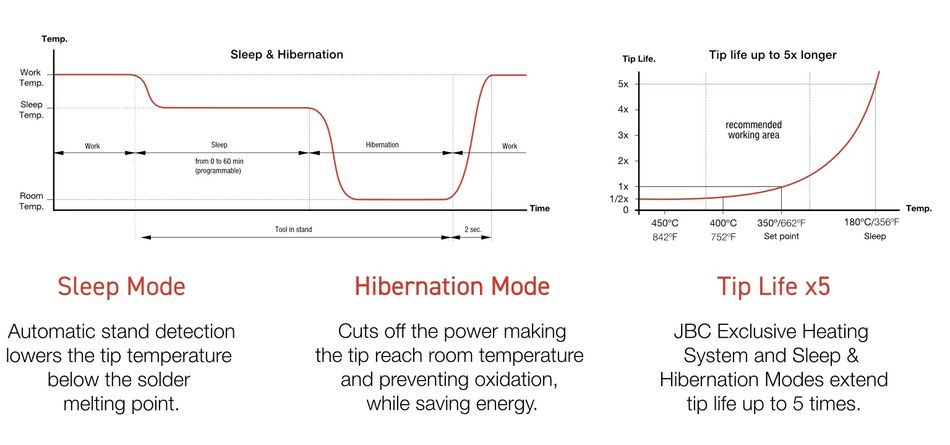
Advanced soldering systems address this through intelligent heat management features that automatically reduce the tool temperature when idle and quickly restore the working temperature when soldering resumes. This automated approach improves efficiency without requiring additional intervention from the operator, providing equipment longevity and lower costs.
Process Efficiency and Reliability
Consistent thermal control contributes to overall manufacturing efficiency. When solder joints are produced under stable thermal conditions, manufacturers can reduce defects associated with inconsistent heating, including insufficient wetting, rework, and unnecessary process interruptions. Operators spend less time compensating for fluctuating temperatures, and production teams benefit from improved repeatability across multiple assemblies.
How JBC Approaches Heat Management
JBC's approach to heat management is based on maintaining consistent thermal performance and minimizing unnecessary heat exposure that can reduce cartridge lifespan. The company's engineering philosophy emphasizes precise temperature control, rapid response to thermal changes, and automatic heat management during periods of inactivity. These capabilities are integrated into JBC's soldering systems through a combination of hardware design and intelligent control features.
JBC's short-distance tip-to-sensor architecture is central to this approach. The system measures the actual tip temperature by placing the temperature sensor as close as possible to the soldering tip. This allows it to detect temperature drops almost immediately when the tip comes into contact with a solder joint and quickly restore the selected working temperature. The rapid thermal response helps maintain stable operating conditions throughout continuous soldering tasks.
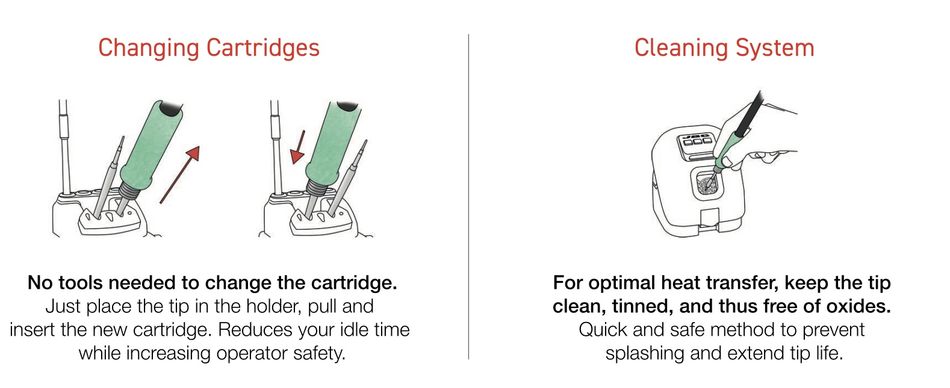
Through JBC's Intelligent Heat Management System, when the tool is placed in its stand, Sleep Mode automatically lowers the tip temperature below the solder melting point, allowing the remaining solder to solidify, creating a protective layer against oxidation. If the tool remains idle for a longer period, Hibernation Mode switches off the power supply, allowing the tip to cool to room temperature. These transitions occur automatically through stand detection, requiring no additional action from the operator.
The short-distance tip-to-sensor design and Intelligent Heat Management System help maintain soldering performance and reduce thermal stress on the tip. Rapid temperature recovery minimizes interruptions during soldering, and automatic temperature reduction during idle periods helps limit oxidation and wear. This combination provides consistent soldering performance over time and contributes to longer cartridge life and lower replacement frequency.
Conclusion
Heat management is central to reliable soldering because it influences every stage of solder joint formation. Maintaining stable temperatures, recovering quickly from changing thermal loads, and managing heat intelligently are imperative for manufacturing quality and efficiency, especially for compact and thermally demanding electronic assemblies.
JBC's engineering approach reflects this broader view of thermal control by combining rapid thermal response, accurate temperature regulation, and intelligent heat management to support consistent soldering performance and extend tool life. Learn more about JBC's approach to soldering technology and heat management by visiting their website.