Solid-State Relays: Bringing Robustness to High-Cycle Switching Applications
Solid-state relays deliver high-cycle reliability for industrial switching, enabling precise PID control, silent operation, and long service life in demanding systems.

08 Jan, 2026. 6 minutes read
Introduction
In many applications that involve frequent on/off switching, such as temperature control systems or industrial automation, traditional mechanical relays face limitations due to mechanical wear and contact degradation. These relays rely on moving parts that can wear out over time, resulting in reduced reliability and a shorter lifespan. In contrast, solid-state relays (SSRs) offer a significant advantage as they operate using semiconductor-based switching and have no moving parts. This design eliminates the issues of contact bounce and mechanical failure, which are common in electromechanical relays [1]. The inherent durability and ability to withstand high-cycle applications make SSRs ideal for precise, reliable switching in systems that require frequent operation. This article will examine the operational advantages of SSRs, their applications across various fields, and how they enhance the longevity and robustness of switching processes.
Inside SSRs and Their Operation
At their core, solid-state relays (SSRs) replace the mechanical contacts of traditional relays with semiconductor devices such as TRIACs, SCRs, or transistors, and provide opto-isolation between the control input and the output power path. This design enables SSRs to maintain electrical isolation between the input and output, with high resistance when not conducting and low resistance when conducting, similar to the operation of conventional switches. This arrangement eliminates the wear-related issues of contact erosion, bounce, and arcing found in mechanical relays [1].
In practical terms, an SSR input receives a low-voltage control signal (typically 3–32 V DC), which activates an LED inside an opto-coupler. The LED light triggers a photo-sensitive device (e.g., a photo-triac), which in turn activates the power semiconductor. The opto-coupler provides high-voltage isolation between the input and output, often allowing handling of several thousand volts [1]. Depending on the design, SSRs may perform zero-cross switching for AC loads or instantaneous switching for inductive loads, thereby reducing electrical noise and switching transients [2].
Due to the absence of moving parts, SSRs offer quicker switching times, quieter operation (no audible click), and a longer operational lifespan under high-cycle conditions compared to mechanical relays [1]. However, it is essential to note that SSRs require proper thermal management and appropriate derating. Despite the absence of mechanical wear, semiconductor components still generate heat and must be appropriately managed to ensure reliable, long-term performance.
PID Control and SSRs
In feedback control systems, such as those using a proportional-integral-derivative (PID) controller, the control logic continuously compares the actual value of a process (e.g., temperature) with a desired setpoint. It adjusts the actuation accordingly [3]. In heating systems, the PID algorithm controls the heating element by turning it on or off, or modulating its duty cycle, based on the error signal to maintain the set temperature while minimising overshoot and steady-state error.
Due to the frequent switching required by a PID loop, especially when maintaining a tight control band around the set point, the choice of switching device becomes crucial. Solid-state relays (SSRs) are well-suited for such applications due to their high cycle life, lack of mechanical components, and fast switching. SSRs are commonly used in PID-controlled heating systems, where their ability to switch frequently ensures precise control [2]. Since SSRs operate silently and without mechanical contact, they minimise disturbances caused by mechanical wear and contact failures, which can impact system performance.
Additionally, SSRs are available in zero-cross and instantaneous (random turn-on) switching variants, and the correct choice depends on the load and control needs. These are generally different models/SKUs within a product family, rather than a single SSR that changes behavior based on the load.. [2]. Thus, pairing SSRs with PID systems helps ensure the reliability and stability of the system, supporting the high uptime and precision required in many industrial applications.
SSR Applications
SSRs are particularly beneficial in applications where switching occurs frequently, loads are cyclic, and reliability is essential. Several key application areas for SSRs include:
Industrial Heating and Process Control
Systems such as plastic molding machines, packaging equipment using hot glue, industrial ovens, and heated chambers rely on SSRs for precise control of heating elements. These systems require rapid cycling of the heating elements to maintain accurate temperature setpoints. SSRs provide the reliability and fast switching necessary for such operations, where consistent performance is critical [2].
Food and Beverage Equipment
In commercial food ovens, hot drink machines, warming cabinets, and other food-service appliances, SSRs ensure precise temperature regulation. The ability to handle frequent switching, combined with silent operation, is instrumental in these environments, where high reliability and minimal maintenance are needed. SSRs support the consistent results required in food service operations, making them a practical choice for applications with high-duty cycles [4].
HVAC Systems and Environmental Control
Heating, ventilation, and air conditioning (HVAC) systems often involve the cycling of heaters or blowers to regulate temperature and airflow. SSRs are well-suited for these systems due to their silent operation, longevity, and reduced maintenance requirements. Their use in HVAC systems helps ensure reliable, consistent performance over time [5].
In these applications, the advantages of SSRs are clear: they eliminate mechanical wear, offer faster switching, and provide cleaner electrical operation. To ensure optimal performance, system designers must carefully select the appropriate SSR type (e.g., zero-cross or instantaneous switching), considering factors such as load type, heat dissipation, and system requirements.
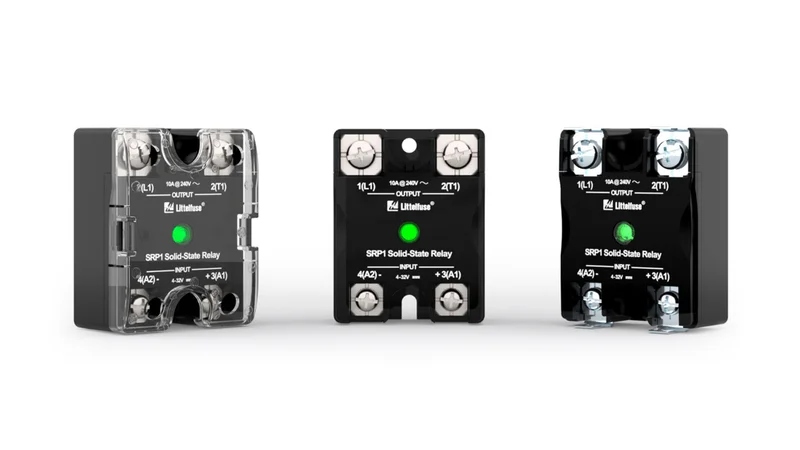
Industrial-Grade SSRs: The Case of Littelfuse SRP1 Series
In demanding industrial environments, factors such as quality, reliability, and lifecycle performance are essential when selecting SSRs. Littelfuse has documented the performance of its SRP1 series SSRs, which are designed to operate consistently under high-stress conditions. According to the Littelfuse technology brief, the SRP1 series has been tested to achieve up to 750,000 operational cycles under life-stress testing. The devices incorporate direct-bonding technology and robust power semiconductors to enhance mechanical and thermal stability [2]. The same document outlines key design elements, including transient-voltage-suppression (TVS) protection, IP20 finger-safe housing, thermal pad interfaces for efficient heatsink mounting, and LED input indicators for operational feedback [2].
A separate quality test report from Littelfuse highlights the risks associated with using low-cost or counterfeit SSRs. It notes that such products may rely on inferior materials, have inadequate isolation, omit protective components, and consequently experience premature failure. The report advises purchasing components from authorised distributors and reviewing derating curves carefully to ensure proper operation under real-world thermal and load conditions [6].
The SRP1 product line consists of two main families: the High-Endurance series and the Essentials series. The High-Endurance models are designed for applications that require frequent switching and high durability. At the same time, the Essentials series offers a balance between performance and cost for general-purpose industrial use. Both variants conform to recognised certifications, including cURus, VDE, CE, and UKCA [7].
By matching the appropriate Littelfuse SRP1 model to the specific switching load profile, designers can optimise reliability, reduce maintenance requirements, and maintain consistent performance in high-cycle applications.
Considerations for Implementation
While SSRs offer significant advantages, careful implementation is crucial to ensure reliable performance. Key considerations include:
Thermal Management and Derating
Despite having no moving parts, SSRs still dissipate power due to voltage drop across the internal semiconductor and leakage current when off, which generates heat. To prevent premature failure, it is vital to review derating curves based on ambient temperature and continuous current. Proper thermal management helps maintain SSR performance over its operational lifetime [6].
Switching Type Selection
For AC loads, zero-cross switching is beneficial, as it reduces electromagnetic interference (EMI) and transient stress by triggering the SSR at the AC waveform’s zero crossing. Inductive loads, however, may require instantaneous switching to avoid extended turn-on delays. Both switching types are highlighted in the SSR technology brief [3].
Isolation and Protection
Adequate input-to-output isolation and compliance with safety standards are crucial for minimising risks, such as electric shock, fire, or equipment damage. The quality test report emphasises that lower-quality SSRs may fail to meet these protection requirements, potentially compromising insulation and safety [6].
Cycle Life and Application Duty Cycle
SSRs are often selected for applications that require high switching frequencies. However, it is crucial to match the SSR’s rated cycle life and switching frequency with the actual duty cycle of the application. A relay designed for low-cycle use may fail prematurely when subjected to high cycling. For example, the SRP1 series has been stress-tested to achieve up to 750,000 cycles [2].
Cost vs Reliability Trade-off
While SSRs may have a higher upfront cost than mechanical relays, the long-term benefits — such as reduced maintenance, minimised downtime, and an extended lifecycle — often justify the investment, particularly in high-switch-count applications. It is important to carefully consider the reliability and safety of SSRs, as lower-cost options may compromise performance and longevity [6].
Conclusion
SSRs provide a reliable and durable solution for applications that require frequent switching and precise control. By replacing mechanical contacts with semiconductor devices, SSRs eliminate the wear and degradation issues associated with traditional electromechanical relays, offering faster switching speeds, quieter operation, and longer lifespans. These characteristics make SSRs ideal for high-cycle applications in industries such as heating, food processing, HVAC systems, and industrial automation.
However, to maximize the benefits of SSRs, careful implementation is necessary. Proper thermal management, appropriate selection of switching types, and ensuring adequate isolation and protection are critical to maintaining SSR performance and longevity. Matching SSRs to the specific requirements of each application—considering factors such as load type, duty cycle, and operating environment—will ensure reliable operation and minimise premature failure.
With careful selection and implementation, SSRs provide a cost-effective, long-term solution that enhances system stability, reduces maintenance, and improves overall operational efficiency, making them a crucial component for modern, high-demand systems.
References:
- Solid State Relay or Solid State Switch
- SSR-Technology-Brief-Flyer.pdf
- Control Tutorials for MATLAB and Simulink - Introduction: PID Controller Design
- Smarter Food Heating Starts with Solid State Relays | Bench Talk
- Texas Instruments — “Isolated Self-Powered AC Solid-State Relay With MOSFETs” (TI Design TIDA-01065 / TIDUC91)
- LittelfuseSolid-StateIndustrialRelaysQualityTestReport2024.pdf
- SRP1 Essentials Solid-State Relays - Littelfuse | Mouser