Reimagine Power Management with Nordic at CES
Discover how the new PMIC by Nordic revolutionizes low power design with ultra low ship mode current, seamless activation, and smarter battery management for next generation connected devices.

15 Dec, 2025. 4 minutes read
Every great connected product starts with efficient power management. Whether designing wearables or medical sensors, engineers constantly balance tradeoffs between energy use, battery size, and device functionality. Nordic Semiconductor has long been a leader in low-power wireless design, building the radios and SoCs that make these devices practical and energy-efficient. Now, they are applying that same philosophy to power control itself.
At CES, Nordic Semiconductor will showcase its Power Management IC (PMIC) that extends its reputation for energy efficiency into smarter battery behavior and startup control. They are tackling the longstanding challenge of shipping battery-powered products that remain sealed, dormant, and safe until their very first use. The live demonstration at CES will show their solution in action and how their patented PMIC function reimagines the moment when a device first wakes from ship mode.
Challenges Shipping Battery-Powered Devices
For engineers building compact, battery-integrated electronics, preparing a product for shipment is often more complicated than powering it up. OEMs normally ship devices in a deactivated state to prevent the battery from draining before use. The traditional approach relies on physical pull-tabs (i.e., small strips of plastic placed between a coin cell and its terminal) or shipping the battery separately for later installation. Both methods work, but they’re far from ideal.
Mechanical pull-tabs create constraints around sealing and assembly. In hermetically sealed medical devices or wearables, introducing a removable part can compromise enclosure integrity. Similarly, shipping batteries separately forces users or factory technicians to perform extra assembly steps that increase handling time and error risk.
These workarounds stand in the way of truly seamless manufacturing and activation. As devices become smaller, more integrated, and increasingly buttonless, the industry needs a smarter, more automated solution to shipping-state power control.
A Patented Function That Changes the Game
Nordic designed its new PMIC with a patented function that eliminates mechanical activation altogether. The IC lets engineers ship fully assembled, sealed products with the battery already connected, without any significant current drain during storage. In this state, known as ship mode, the PMIC maintains an internal electronic disconnect between the battery and most of the system’s circuitry. The PMIC reduces the current in ship mode to around 65 nA.
In contrast to conventional pull-tab systems or button-triggered wake-up methods, the PMIC performs this transition entirely in silicon. Devices don’t require external switches, relays, or mechanical intervention. Once activated, the PMIC automatically reestablishes the normal power path, and the device powers up as if it were freshly unboxed.
The Nordic Semiconductor approach makes everything easier across the entire supply chain. Manufacturers can ship devices with batteries already installed, which streamlines the assembly process. Warehouses don't have to worry about batteries slowly draining while products sit in storage. And when customers open the box, everything just works with no setup hassles.
Inside the PMIC
From a system design perspective, the PMIC acts as both a power distribution hub and a supervisory controller. It coordinates power rails, monitors battery state, and controls transitions between modes so that developers can experiment with new product architectures and embed energy awareness at every level.
Technically, Nordic engineered the PMIC with advanced rail control and on-die logic for dynamic power management across multiple domains. We developed an internal gating architecture that governs each supply rail independently, ensuring that only essential circuits remain biased in ship mode while all others are electrically isolated. Ultra-low leakage paths and precision control logic help the architecture to maintain stability at nanoamp-level quiescent currents.
The Demo at CES
The Nordic Semiconductor CES demonstration brings this concept to life.
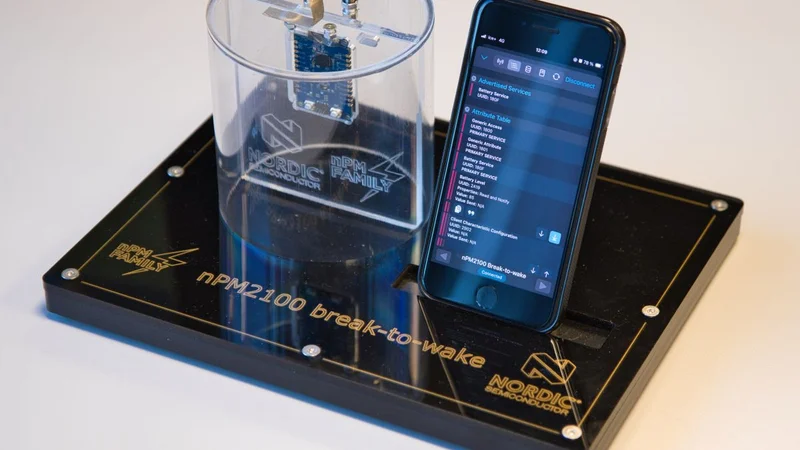
The setup features a circuit board incorporating Nordic’s nPM2100 PMIC and nRF54L15 SoC enclosed within a clear plastic shell. On the surface of the enclosure are four electrodes: two connect to Nordic’s Power Profiler Kit 2 (PPK2) for current measurement, while the other two interface with a strip of conductive tape.
When the conductive tape bridges the electrodes, the system enters ship mode and draws an imperceptible current. Removing the tape breaks the connection, and the PMIC instantly interprets the event as a wake trigger. The circuit reactivates, transitioning cleanly to regular operation.
This “break-to-wake” effect is the crux of the PMIC’s patented intelligence. It allows the device to behave as though it were physically disconnected from the battery through electronic control rather than mechanical separation. As a result, engineers have a powerful new capability for designing compact, sealed products. They can now ship buttonless or hermetically sealed devices with preinstalled batteries, confident that they will remain inert and safe throughout transport and storage.
Applications and Use Cases
In practical implementations, the concept can take several forms.
A sticker with conductive adhesive can cover two electrodes that sit flush with the device housing, maintaining the ship-mode connection until the user removes the sticker to activate the product. Alternatively, a thin exposed metal filament or string could complete the connection during packaging and break automatically when the product is lifted out of its tray or box. Both methods use the PMIC’s break-detection capability to trigger a clean, controlled wake event that requires no buttons, switches, or mechanical pull-tabs.
This technology will impact many industries. In medical wearables and disposable health patches, regulations require hermetic sealing for patient safety and hygiene. And, these devices really only require activation once they contact skin or when users remove the adhesive. Nordic’s PMIC makes that possible by electronically preserving battery charge until the moment of use.
Wearable sensors and consumer trackers necessitate long shelf life and immediate activation. With the PMIC guaranteeing dormancy during transit, OEMs can ship devices worldwide that arrive fully assembled and ready for use. Similarly, in consumer electronics such as smart trackers or earbuds, the feature lets designers improve packaging aesthetics and simplify user experience by replacing pull-tabs with an invisible electronic switch.
Regardless of application, engineers gain simplified manufacturing and a cleaner product architecture, while users enjoy reliable, instant activation.
Reimaging Low-Power Electronics
The new PMIC reimagines how engineers think about power management. By embedding intelligence at the earliest stage of a device’s lifecycle, designers can eliminate long-standing mechanical constraints and improve efficiency across design, logistics, and user experience. Now, engineers can start designing for power management before a product ever powers on.
As part of Nordic's low-power ecosystem, the PMIC offers developers everything they need to build connected devices that are simpler to assemble, run longer on a single charge, and deliver smart functionality from day one.
Want to learn more about the new PMIC solution? Check out our CES demo here.
Learn more about Nordic Semiconductor at CES 2026.