Two New Front-End Modules for 2.4 GHz IoT Connectivity
Bluetooth, Zigbee and Thread front-end modules fit a +20 dBm PA, LNA and switch into 1.8 x 1.8 mm

13 Oct, 2026. 4 minutes read
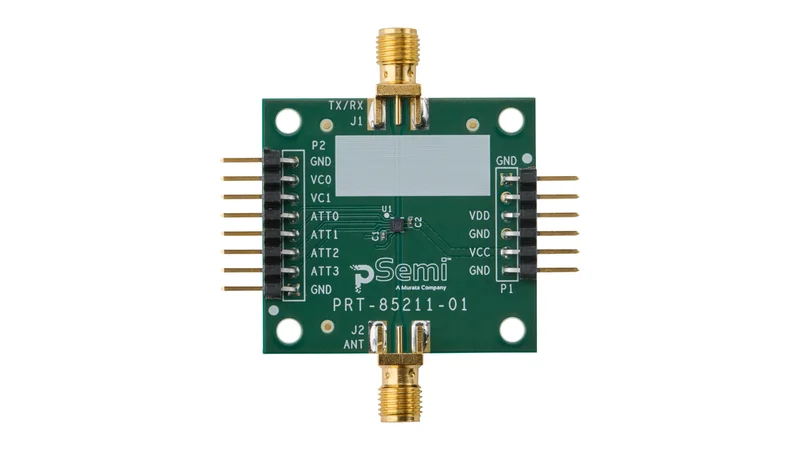
pSemi's PE566212 and PE566213
pSemi, a subsidiary of Murata, announced the PE566212 and PE566213
The PE566212 and PE566213 are two 2.4 GHz front-end modules (FEMs) for Bluetooth, Zigbee and Thread devices. Each integrates a power amplifier (PA), low-noise amplifier (LNA) and RF switch on one die in UltraCMOS+, pSemi's silicon-on-insulator (SOI) process, inside a 14-lead 1.8 × 1.8 × 0.63 mm LGA.[1][2][3][4][5]
The PE566212 and PE566213 transmit up to +20 dBm and receive with a 1.8 dB noise figure at 13 dB gain. The PE566212 covers Bluetooth Low Energy and Classic Basic Rate (BR); the PE566213 adds Classic's Enhanced Data Rate (EDR) at up to +12 dBm.[1][5]
Why it matters
The PE566212 and PE566213 join pSemi's PE562212, an earlier multi-protocol FEM in the same package that also supports EDR and Wi-Fi up to MCS7 and remains in production. Against the PE562212, the PE566212 and PE566213 list slightly lower output power and higher noise figure and bypass loss (see table), while the PE566212 widens gain control from 15 dB to 22.5 dB in coarser 1.5 dB steps.[4][5][6][7]
Bluetooth EDR's π/4-DQPSK and 8-DPSK payloads vary in amplitude and need a linear PA, and pSemi rates EDR below Basic Rate: +12 dBm against +20 dBm on the PE566213, and +15 dBm against +21 dBm on the PE562212.[5][7][8][9][10]
Against Skyworks' SKY66114-11 and SKY66403-11 FEMs and Nordic Semiconductor's nRF21540 FEM, the pSemi parts' clearest advantage is size. By our calculation from package outlines, pSemi's package takes a little over half the area of the +22 dBm SKY66114-11 (2.4 × 2.4 mm), and about a third of the SKY66403-11's (3.5 × 3.0 mm) and a fifth of the nRF21540's (4 × 4 mm), both of which add a second antenna port.[10][11][12]
What the PE566212 and PE566213 add on transmit depends on the SoC. Nordic's nRF54L15 SoC is rated at up to +8 dBm, so a +20 dBm FEM adds 12 dB of transmit power by our calculation, before the LNA's effect on sensitivity.[13] Silicon Labs' EFR32MG24 SoCs come with a +10 dBm or a +19.5 dBm PA depending on part number, so by the same calculation the FEM adds 10 dB or only 0.5 dB.[14] On transmit power and size, the PE566212 and PE566213 suit designs built on lower-output SoCs and short of board space, as does the PE562212, which adds Wi-Fi and more EDR output. pSemi describes the PE566212 and PE566213 transmit paths as power-efficient but has made no current figures public to set against the PE562212's 145 mA at +21 dBm.[1][4][5][7]
Technical specifications: pSemi 2.4 GHz SOI front-end modules
| Parameter | PE566212 | PE566213 | PE562212 (earlier sibling, for comparison) |
|---|---|---|---|
| Frequency range | 2400 to 2483.5 MHz | 2400 to 2483.5 MHz | 2400 to 2483.5 MHz |
| Integration | PA, LNA, RF switch and bypass path on one SOI die | PA, LNA, RF switch and bypass path on one SOI die | PA, LNA, RF switch and bypass path on one SOI die |
| Process | UltraCMOS+ (SOI) | UltraCMOS+ (SOI) | UltraCMOS (SOI) |
| Protocols listed | Bluetooth BR (BDR) and Low Energy, Zigbee, Thread | Bluetooth BR (BDR), EDR and Low Energy, Zigbee, Thread | Bluetooth BR (BDR), EDR and Low Energy, Zigbee, Thread, Wi-Fi up to MCS7 |
| Transmit output, Basic Rate | up to +20 dBm | up to +20 dBm | +21 dBm typ. |
| Transmit output, EDR | not listed | up to +12 dBm | +15 dBm typ. (8-DPSK) |
| Transmit gain | 21 dB | 20 dB | 23 dB typ. (small signal) |
| Transmit gain control | 22.5 dB in 1.5 dB steps | 15 dB in 1 dB steps | 15 dB in 1 dB steps |
| Receive noise figure | 1.8 dB typ., at 13 dB gain | 1.8 dB typ., at 13 dB gain | 1.6 dB typ. |
| Receive gain | 13 dB (press release) | 13 dB (press release) | 15 dB typ. |
| Bypass loss | 0.8 dB typ. | 0.8 dB typ. | 0.6 dB typ. |
| Control interface | GPIO | GPIO | GPIO (2 mode pins, 4 gain bits) |
| Supply voltage | not stated | not stated | 3.0 to 3.6 V (VCC) plus 1.6 to 2.0 V (VDD) |
| Transmit current at maximum output | not stated | not stated | 145 mA at +21 dBm, VCC 3.3 V |
| Operating temperature | not stated | not stated | -20 to +85 °C |
| Test conditions | not stated | not stated | 25 °C, VCC 3.3 V, VDD 1.8 V |
| Package | 14-lead LGA, 1.8 × 1.8 × 0.63 mm, MSL3 | 14-lead LGA, 1.8 × 1.8 × 0.63 mm, MSL3 | 14-lead LGA, 1.8 × 1.8 × 0.63 mm, MSL3 |
| Status | In production; evaluation board EK566212-01 | In production; evaluation board EK566213-01 | In production; evaluation board EK562212-01 |
Sources: [1][2][3][4][5][6][7][15][16][17]
pSemi publishes the PE566212 and PE566213 RF figures without test conditions and marks only noise figure and bypass loss as typical, so comparisons with the PE562212 (25 °C, 3.3 V) and with the Skyworks and Nordic parts (25 °C, 3.0 V PA supply) are indicative.[4][5][7][10][11][12] The figures that block a design-in decision are supply range and transmit current, which set battery life and whether the FEM can run directly from a cell, and operating temperature, which sets where it can be deployed. pSemi releases the full PE566212 and PE566213 datasheets on request, after review, to applicants with a business or accredited university (.edu) email address.[18][19]
Recommended Next Reading: Shouting and listening: Extending Bluetooth LE range. Nordic Semiconductor's explainer on how a PA/LNA front end raises a Bluetooth LE link budget, what regional power limits allow, and what the extra range costs in battery life.
References
- pSemi Announces Two UltraCMOS+ Front-End Modules for 2.4 GHz IoT Connectivity, pSemi, 9 October 2026 (press release)
- PE566212 2.4 GHz SOI IoT Front-end Module, pSemi, accessed 12 October 2026 (product page)
- PE566213 2.4 GHz SOI IoT Front-end Module, pSemi, accessed 12 October 2026 (product page)
- PE566212 Product Brief, DOC-126064-1, pSemi, September 2026 (two-page summary of the full datasheet)
- PE566213 Product Brief, DOC-127214-1, pSemi, October 2026 (two-page summary of the full datasheet)
- PE562212 2.4 GHz SOI IoT Front-end Module, pSemi, accessed 12 October 2026 (product page)
- PE562212 Product Specification, DOC-115237-7, pSemi, April 2025 (datasheet)
- Bluetooth Core Specification v6.1, Vol 2 Part A: Radio Specification, Bluetooth SIG, accessed 13 October 2026
- Bluetooth Enhanced Data Rate (EDR): The Wireless Evolution, Application Note 5989-4204EN, Keysight Technologies, 2 December 2017 (test-equipment vendor's application note)
- SKY66403-11: 2.4 GHz Front-End Module for Zigbee Technology and Thread/Bluetooth Applications, data sheet 204148J, Skyworks Solutions, 2 June 2026
- SKY66114-11: 2.4 GHz Front-End Module for Bluetooth Low Energy/802.15.4/Thread/Zigbee Technology Applications, data sheet 203678M, Skyworks Solutions, 1 December 2022
- nRF21540 Product Specification v1.2, Nordic Semiconductor, January 2022
- nRF54L15 ultra-low-power wireless SoC, Nordic Semiconductor, accessed 12 October 2026 (product page)
- EFR32MG24 Series 2 Multiprotocol Wireless SoC, Silicon Labs, accessed 13 October 2026 (product page; output power by part number in its part table)
- PE566212 listing, RFMW, accessed 12 October 2026 (distributor listing)
- PE566213 listing, RFMW, accessed 12 October 2026 (distributor listing)
- PE562212 listing, RFMW, accessed 12 October 2026 (distributor listing)
- PE566212 Datasheet Request, pSemi, accessed 13 October 2026 (request form for the full datasheet)
- PE566213 Datasheet Request, pSemi, accessed 13 October 2026 (request form for the full datasheet)