More Hands, Faster Plans: How Collaboration Speeds Electronics Development
Altium Agile Team transforms hardware development with real-time collaboration, connected workflows, and built-in visibility — helping electronics teams innovate faster and stay aligned.

13 Nov, 2025. 3 minutes read
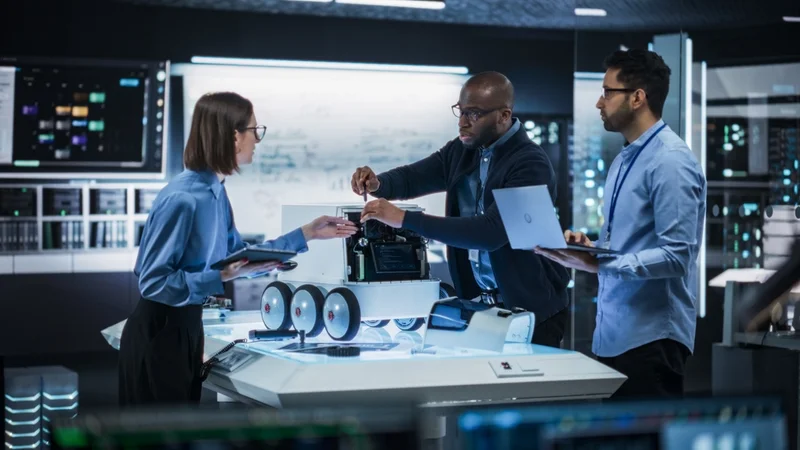
Portrait of Team of Engineers Testing a Prototype for a Delivery Robot in a High-Tech Laboratory
The Hidden Cost of Disconnection
It’s rarely the big design decisions that derail timelines; it’s the small disconnects that happen between them.
A PCB designer finalizes a layout, unaware that procurement has flagged two parts as end-of-life. The mechanical team adjusts an enclosure, not realizing that the connector footprint has changed. By the time everyone catches up, the schedule has already slipped. Great teams want to collaborate to create winning electronics products, but the tools they use don’t provide the speed, structure, or flexibility they need.
Most teams don’t fall behind because they lack talent or commitment. They fall behind because their information isn’t connected. Design files, BOMs, and reviews live in separate tools. Each update requires chasing context, and every misalignment pushes delivery further out of reach.
For industries like consumer electronics, where a single missed launch window can mean missing an entire profit cycle, keeping projects on schedule isn’t just about efficiency. It’s about business survival.
Why Collaboration So Often Fails in Practice?
Every engineering team says they collaborate. But most of what passes for “collaboration” is really coordination: file exchanges, scattered comments, and late-stage alignment.
Electrical engineers live in ECAD tools. Mechanical engineers in MCAD. Procurement in spreadsheets. Manufacturing in PLM. Each tool holds a piece of the story, but no one sees the full picture until it’s too late to shape it according to the vision for the product.
The traditional rhythm—design, handoff, review, repeat—creates dependency, not collaboration. Meetings replace progress. Updates replace innovation. Managers spend more time chasing clarity than guiding outcomes.
It’s not that teams don’t want to collaborate; it’s that their tools weren’t built to share context. When communication happens after decisions are made, alignment is always one step behind.
Collaboration That Keeps Projects Moving
What if collaboration didn’t mean waiting for the next sync call? What if PCB, mechanical, procurement, and manufacturing teams could all work within the same live, structured environment? What if that environment frees the team from repetitive work, with flexibility that allows them to push boundaries and innovate?
That’s the purpose of Altium Agile Teams—a cloud-based solution that brings structure and speed to hardware development. Agile Teams connects the people, process, and data that drive modern electronics design, giving engineering managers the visibility and control to keep projects on track—without micromanaging anyone.
With Agile Teams:
PCB, MCAD, and procurement teams see design updates in real time, without version confusion.
Structured design reviews standardize the process of collecting feedback, thereby reducing late-stage rework.
Role-based collaboration means everyone, from QA to program management, gets the right level of access without bottlenecks or stifling overhead.
Jira integration keeps hardware and software workflows aligned, removing the need for manual status updates.
When collaboration happens where the work actually happens, engineers stop wasting time resolving miscommunication — and managers stop losing time reacting to surprises.

Visibility That Drives Alignment
True collaboration requires visibility, but not the kind that clutters dashboards with noise. Agile Teams build visibility into the work itself.
Engineering managers can instantly see which designs are progressing, which are awaiting review, and where bottlenecks are forming, without pulling anyone away from work in progress.
Every change, comment, and decision lives in context, with full traceability across disciplines. Procurement sees the latest BOM status. Mechanical engineers collaborate with their electrical colleagues on ECAD/MCAD revisions in a shared workspace. Managers see progress unfold in real time.
Working together in Agile Teams, those doing the design and development operate with startup agility and enterprise discipline at once. That’s how schedules hold steady, even when complexity rises. The right structure doesn’t slow teams down—it gives them the confidence to move faster, together.
Leading Through Connection
The best engineering leaders don’t lead through control—they lead through connection. They create the conditions for great work: open communication, shared ownership, and reliable systems that keep everyone aligned.
Altium Agile Teams gives them that solution for success. It transforms disconnected updates and manual check-ins into continuous, structured collaboration. It replaces uncertainty with visibility, and version chaos with confidence.
Because keeping a project on schedule isn’t about pushing harder—it’s about working smarter, together.
Start your free trial of Altium Agile Teams and experience how structured, real-time collaboration helps teams deliver faster and stay aligned from concept to release.