Humanoid joint controller design brings 100 ps-class PWM, TSN switching and post-quantum security onto one chip
Actus, MIPS's reference platform for robot actuators, pairs two real-time RISC-V cores with a vector DSP for in-joint models.

16 Nov, 2026. 4 minutes read
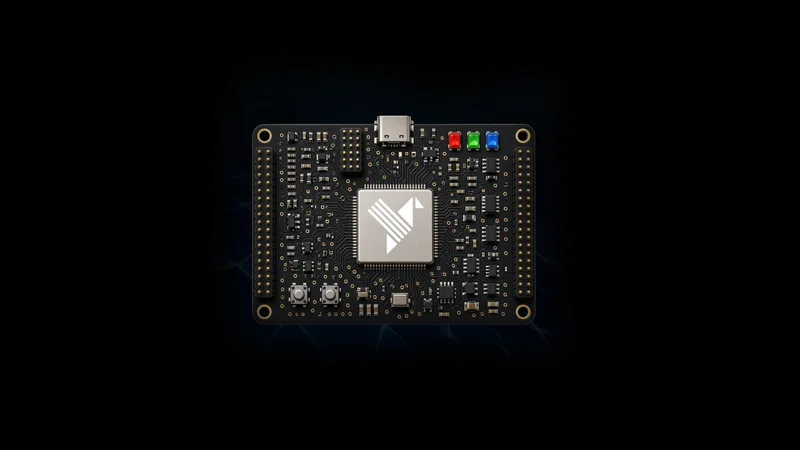
MIPS Actus Platform for Robotic Motion Control
MIPS provides details on its Actus robot-joint platform
MIPS, the RISC-V processor business of GlobalFoundries (GF), detailed its robot-joint reference platform on 9 November 2026, two months after first announcing it. The Actus chip, built on GF's FDX fully depleted silicon-on-insulator (FD-SOI) process with on-chip MRAM, combines two of MIPS's Atlas M8500 real-time RISC-V cores, a 512-bit ARC VPX vector DSP from GF's ARC processor IP line, 100-picosecond-class high-resolution PWM, sigma-delta ADCs, a three-port Gigabit Ethernet switch with Time-Sensitive Networking (TSN), CAN-FD, and a hardware security module (HSM) with post-quantum cryptography.[1][2][3]
MIPS says the chip's dedicated trigonometric hardware runs field-oriented control (FOC) algorithms more than 16 times faster than standard trigonometric libraries. Development starts on a virtual platform and moves to the Actus-1 evaluation board and SDK.[1]
Why it matters
Humanoids have up to 70 degrees of freedom, against six to 12 in an industrial arm, and need current regulation above 10 kHz, according to a Texas Instruments application brief. Their drives are commonly daisy-chained to limit cabling.[4] Actus targets the joints between elbow and fingertips, where MIPS says space, weight, power and heat are tightest, and integrates the network switch.[1]
Both M8500 cores run the control loops; MIPS says their hardware threads, up to four per core, remove context-switch penalties on interrupts. MIPS assigns the vector DSP sensor-fusion and predictive-maintenance models. The DSP comes from the ARC processor business GF bought from Synopsys in June 2026. At 512 bits it is the VPX5 tier, programmed with ARC MetaWare tools in an extended ARCv2DSP instruction set, not RISC-V.[1][3][5][6][7]
A motor-control MCU with an on-chip TSN switch is not necessarily new. Renesas' RA8T2, a 22 nm motor-control MCU, pairs a 1 GHz Arm Cortex-M85 with up to 1 MB of MRAM, a Gigabit Ethernet TSN switch and an optional EtherCAT slave controller.[8] HPMicro's HPM6E8Y, a 600 MHz dual-core RISC-V MCU launched at CES 2025 for robot joints, has a TSN switch with three external ports, an EtherCAT slave controller and 100 ps PWM.[9] Trigonometric speed-ups depend on the baseline: STMicroelectronics' cycle counts for its CORDIC unit on a Cortex-M4F put sine and cosine 5 to 26 times faster than single-precision and fixed-point library code (our calculation). MIPS's 16x sits within that range.[1][10]
Actus adds a 512-bit DSP for in-joint models and a post-quantum HSM, neither listed for the RA8T2 or HPM6E8Y. MIPS lists no EtherCAT slave controller for Actus, although TI names EtherCAT among typical humanoid interfaces.[1][3][4] Delivery differs too: Electronic Design reports the Actus boards are for evaluation and prototyping, with MIPS customers typically building its cores into their own silicon.[11] That suits robot makers with volume for custom joint controllers more than engineers needing an orderable joint MCU today.
Technical specifications: MIPS Actus chip and Actus-1 platform
| Spec | Value |
|---|---|
| Real-time CPUs | 2x MIPS Atlas M8500 (RISC-V), dual-issue, 1 to 4 hardware threads per core, trigonometric unit |
| M8500 core IP envelope | RV32IMABFD_Zce ISA; - Up to 32 KiB I-cache and 32 KiB D-cache; - Up to 3 MiB tightly coupled memory; - Functional safety up to ASIL-D / SIL 3; - MIPS positions the core for sub-10 µs control loops. |
| Vector coprocessor | ARC VPX, 512-bit vector word (VPX5 tier of the ARC VPX family) |
| Trigonometric acceleration | More than 16x standard trigonometric libraries on FOC algorithms (MIPS figure) |
| PWM | 100-ps-class high-resolution PWM; channel count not stated |
| Analog | Sigma-delta ADCs; block diagram also lists DAC and CMPSS; resolution not stated |
| Ethernet | Gigabit Ethernet, 3-port TSN switch; supported TSN standards not stated |
| Other interfaces | CAN-FD, USB, SPI, UART; I2C (reported by Electronic Design) |
| On-chip memory | SRAM, MRAM, NVM; sizes not stated |
| Security | HSM with post-quantum cryptography; algorithms not stated |
| Safety and security standards | Functional safety support stated; ISO 26262 and ISO 21434 listed for development; Actus chip safety level not stated |
| Process | GF FDX FD-SOI with AutoPro150 and on-chip MRAM. AutoPro150 is GF's automotive option for operation up to 150 °C, introduced on 22FDX+ (22 nm FD-SOI) and extended to embedded MRAM in March 2026. MIPS does not name the node for Actus. |
| Clock, power, package, temperature range | Not stated |
| Development path | Virtual platform, then Actus-1 evaluation board (single-board-computer form factor) and SDK; Green Hills Software as safety-software partner |
Sources: [1][3][7][11][12][13][14]
Clock frequency, memory sizes and power for the Actus chip are not yet public, so it cannot be compared with orderable MCUs on control-loop throughput, code space or thermal budget. The ASIL-D and SIL 3 figures describe the M8500 core IP, and MIPS's Actus page notes that safety and certification statements are subject to final product specifications and certification scope.[1][3][12] While one can now evaluate FOC and sensor-fusion code on the virtual platform; hardware sizing waits for Actus-1 measurements.
Recommended reading
- Field Oriented Control (FOC) for AC Motors. Walks through the Clarke and Park transforms whose per-cycle trigonometry Actus accelerates.
- Precision Current Sensing in Humanoid Robots. Covers the shunt, delta-sigma and Hall-effect current sensing that feeds each joint's FOC loop.
References
- MIPS Unveils Actus Platform for Precise, Secure Robotic Motion Control, MIPS, 9 November 2026 (company press release)
- MIPS Launches Workload-Native Platforms for Physical AI, MIPS, 2 September 2026 (company press release)
- MIPS Actus Platforms, MIPS, accessed 13 November 2026 (product page with Actus-1 block diagram)
- Motor Control in Humanoid Robots (SLLA659A), Texas Instruments, January 2025, revised June 2026 (vendor application brief)
- GlobalFoundries completes acquisition of Synopsys' Processor IP Solutions Business, delivering a holistic technology platform for Physical AI, GlobalFoundries via MIPS, 2 June 2026
- Synopsys Launches New ARC VPX DSP Processor IP for High-performance Signal Processing SoC Designs, Synopsys, 22 October 2019
- MIPS ARC VPX2, VPX3, VPX5 and VPX6 DSP Processors, MIPS, accessed 13 November 2026 (product family page)
- RA8T2: 1GHz Arm Cortex-M85 Microcontroller Optimized for Motor Control Applications, Renesas Electronics, accessed 13 November 2026 (product page)
- HPMicro Introduces RISC-V MCU HPM6E8Y at CES 2025: Redefining Robotics Motion Control, HPMicro, 9 January 2025 (company news release)
- How to use the CORDIC to perform mathematical functions on STM32 MCUs (AN5325, Rev 9), STMicroelectronics, October 2026 (vendor application note with measured cycle counts)
- RISC-V SoCs Zero in on Physical AI Applications, Electronic Design, 12 November 2026 (trade-press coverage)
- MIPS Atlas M8500, MIPS, accessed 13 November 2026 (product page; the datasheet is available on request only)
- GlobalFoundries Announces Availability of AutoPro150 eMRAM Technology on Enhanced FDX Platform for Advanced Automotive Applications, GlobalFoundries, 9 March 2026 (company press release)
- GlobalFoundries Unveils Power-Efficient Advancements to 22FDX Platform at Annual Tech Summit, GlobalFoundries, 27 September 2023 (company press release)