The Decisions That Get Lost — and How They Slow Hardware Teams Down
Learn how hardware projects slip not from big mistakes, but from lost decision context—and how connected workflows preserve intent to keep teams aligned.

01 Dec, 2025. 5 minutes read

Electronics engineering teams make thousands of decisions over the course of a hardware project. Some are obvious turning points, like selecting a component family, adjusting an enclosure, or changing a layout strategy. Others are tiny but essential: nudging a footprint to clear a mounting boss, tightening a tolerance, choosing a fallback supplier, or adjusting a copper pour because of an unexpected thermal hotspot. For more about copper, check out this other Wevolver article on “3D Copper: The Missing Link for Accurate Thermal Analysis.”
These small decisions shape the product just as much as the big ones. But the reality inside most hardware teams is that the decisions themselves–or records of them–rarely have a permanent home. They are scattered inside emails, meeting notes, screenshots, hallway conversations, Slack threads, even only in someone’s memory. Weeks later, the team remembers what changed — but not why, how, when, or by whom.
Products don’t slip because someone made one cataclysmically bad decision. They slip because of the gradual accumulation of many slightly misaligned small decisions that nobody noticed much at the time.
Where Projects Really Fall Apart
When engineers talk about why schedules drift, they often point to the big moments: a late design review, an unexpected component shortage, a mechanical change that forces an electrical adjustment. But the truth is that most delays begin long before anyone notices that anything is wrong.
The early cracks appear when project collaborators can’t see the full context of their decisions.
For example, when a mechanical engineer can’t easily see why the PCB outline shifted, she may revert it without realizing she’s undone an agreed-upon change. A PCB designer forgets a sourcing constraint buried in a Slack thread. Procurement replaces a part without knowing it breaks a thermal assumption. A reviewer flags an issue that was resolved last month, but the explanation lies undiscovered in someone’s inbox.
These aren’t dramatic failures. They’re the accumulation inevitable from small disconnects and points of subtle friction that force teams back into rework, clarification meetings, and slow, careful retracing of steps. The momentum that could come from a great idea fades away while everyone pieces the story together.
Even audits, internal reviews, and post-mortems become harder than necessary. Teams spend more time reconstructing historical reasoning than moving ahead to design the next thing, or doubling back to improve the product they just released.
The misalignment feels particularly frustrating because failures rarely arise from the technical difficulty of the work. They come when the context for decisions slips.
Hardware Teams Need “Decision Memory”
Software teams enjoy something hardware teams often lack: built-in traceability. Code reviews capture intent. Versioning systems record moments and preserve historical context. Discussions live next to the actual work. Decisions have an automatic, persistent memory.
Hardware development has never had that luxury.
Electrical, mechanical, procurement, and manufacturing professionals work in different tools, each with their own paradigms and constraints. Decisions ripple outward from one domain to another, but the reasoning behind those decisions vanishes instantly unless someone goes out of their way to document it.
The result is a fragile sort of alignment. Designers slow down not because the engineering is hard, but because reconstructing the reasoning behind each change becomes its own parallel process.
Hardware teams need something they rarely articulate: a shared, durable “decision memory.” Not a static document, not a file dump, but a living record that travels with the design as it evolves.
Connected Workflows Capture Intent — Not Just Data
Better collaboration doesn’t come from more meetings or more documentation. It comes from environments that automatically record the decisions engineers make as they make them.
When engineers in a design review leave their comments directly in the design, the feedback and context attach to the object they reference. Anyone who later views that object sees the decision when and where it was made. When BOM updates carry traceability, sourcing constraints don’t vanish into email history. When ECAD and MCAD updates flow between domains in real time, teams don’t lose the thread of why engineers changed the design. When workflows capture steps, assignments, and approvals, the team never has to wonder who made a change — or why.
Alignment becomes easier when context is preserved in the platform where decisions occur. Engineers move quickly because they’re not chasing explanations. Reviewers focus on what matters because earlier decisions are visible. Small changes stay small instead of growing into costly surprises downstream. The work accelerates because the friction disappears.
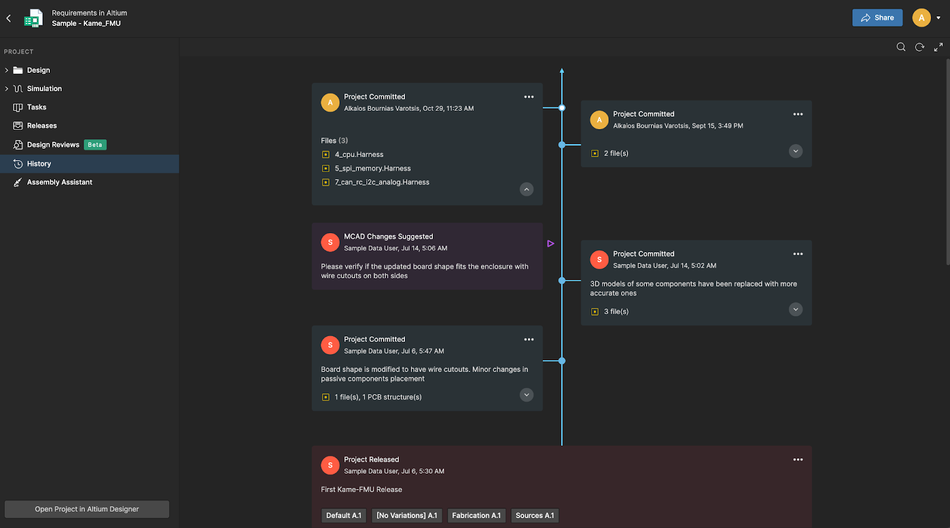
Bringing Context Into the Development Process
Altium Agile Teams introduces the kind of structured decision memory that hardware teams have always needed but rarely enjoyed. We’re not talking about heavy process overhead — this is just enough agile structure to hold decisions in place while allowing teams to move quickly and to flex their process for minor variations.
Through structured workflows, teams gain predictable, shared understanding:
part requests capture reasoning instead of handing off guesswork;
design reviews preserve in-browser comments and contextual threads; and
process-based projects standardize how to capture intent from the start.
Through context-rich collaboration, decisions don’t drift away from the design:
comments anchor to specific objects in the schematic or PCB;
threaded discussions remain inside the review, not scattered across tools; and
event logs capture actions naturally as the team works, rather than requiring a separate documentation workstream.
My connected decision data to design data, teams stop losing information at boundaries:
ECAD and MCAD updates align in one shared environment;
centralized part libraries provide lifecycle and sourcing visibility to all projects; and
Jira and PLM syncs prevent version drift across engineering and ops.
This isn’t about heavy compliance or formal documentation. It’s about preserving context automatically so engineers don’t have to think about it.
In Agile Teams, decisions don’t get lost. They stay connected to the work — and to the people who need to defend those decisions internally, or to regulators, partners, or executives.
Fast Teams Stay Fast Because They Don’t Lose Track of Themselves
Hardware development will always involve iteration, trade-offs, and change. That part isn’t going away. What slows teams down isn’t the technical challenge of the design — it’s the challenge of collaboration as dozens of small decisions accumulate. When context disappears, even simple updates become impossible to remember and difficult to navigate.
Teams that can maintain their pace are those that don’t spend time rebuilding context or revisiting past decisions. They trust in the platform to make that easy for them. They’re not forced to track down the reasoning behind a choice from weeks earlier just to move forward today. When the history is always visible, teams move forward and the project keeps its momentum.
If your team can benefit from this decision memory, start your free trial of Altium Agile Teams today. See how connected workflows keep decisions visible, align teams, and guide hardware projects towards what matters most: delivering excellent products.