Terahertz, Bringing the "Final Frontier" to the Field: ROHM's Resonant Tunneling Diode Enables Compact, Low-Power Sensing
ROHM's RTD enables the generation and detection of terahertz frequencies in a highly compact form factor at low power. It supports non-destructive, non-ionizing imaging and spectroscopy applications like security screening, medical sensing, and high-speed wireless communication.

26 May, 2026. 6 minutes read

AI-generated image by Google Gemini 3 Pro
Electromagnetic waves have regions that remain largely untapped, with terahertz (THz) waves being a prime example. With frequencies ranging from 300 GHz to 3 THz, they occupy the middle ground between millimeter waves and far-infrared radiation. As millimeter wave technologies advance in applications like 5G communications, autonomous driving radar, and contactless sensors, terahertz waves are gaining attention as the next frontier. Frequencies higher than terahertz are treated as light, making this the final unexplored territory for radio waves, hence its moniker, the "last frontier."
This article examines terahertz waves, the problems that have kept them from being used widely, and how ROHM’s Resonant Tunneling Diodes (RTDs) help create and detect terahertz waves to enable a number of different use cases.
Terahertz Waves and the Challenges to Adoption
Terahertz waves possess characteristics of both radio waves and light, holding significant potential for applications like ultra-high-speed communication exceeding 100 Gbps utilizing their wide bandwidth. Furthermore, their ability to easily penetrate clothing, paper, and resin while being absorbed by metals and water makes them promising for enhancing airport baggage screening and industrial non-destructive testing.
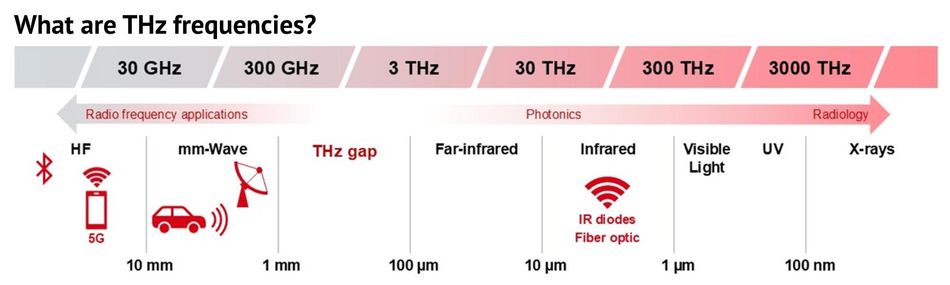
Notably, unlike X-rays, their impact on the human body is minimal. Unlike high-energy X-rays, they pose almost no risk of cellular damage, making them a highly safe imaging technology with anticipated applications in healthcare, welfare, and public infrastructure.
Moreover, many substances exhibit unique absorption spectra in the terahertz band, making it a promising sensing technology for non-destructive analysis of pharmaceuticals, food, materials, and more. Accumulated research and development focusing on these characteristics has led to significant recent advances in practical terahertz technology, finally opening the last frontier of electromagnetic waves.
However, practical applications have been limited due to challenges with existing terahertz wave oscillators and detectors, including large size, high power consumption, and extremely high cost. These longstanding barriers meant that despite awareness of terahertz waves' potential, widespread application had not been achieved.
ROHM’s Resonant Tunneling Diode (RTD): A Practical Breakthrough in Terahertz Devices
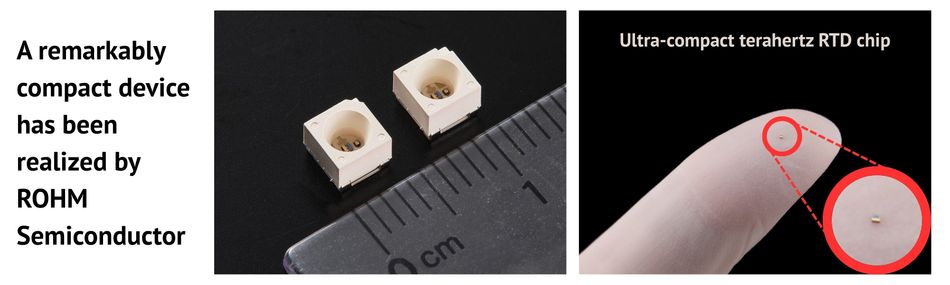
Amidst this situation, ROHM has developed a semiconductor device, the RTD, which simultaneously resolves these challenges (Figure 2). The RTD is housed in a compact Plastic Leaded Chip Carrier (PLCC) package, commonly used for LEDs, and consumes a mere 10 mW of power. This represents a significant improvement over the traditional issues of large size, high power consumption, and high cost. As mass production progresses, the price is expected to drop to levels comparable to standard optical devices.
Paid R&D samples of the RTD are already available, and terahertz wave technology has entered a full-scale verification phase toward practical application. Terahertz applications, long stagnant, are finally moving into a realistic phase of widespread adoption.
A Compact Chip for Terahertz Oscillation and Detection
Until now, frequency multiplication and photomixing methods have been the mainstream transmission/reception devices used in developing terahertz band applications. The frequency multiplication method involves raising microwave signals generated by CMOS or similar technologies to the terahertz band through multiple stages of frequency multiplication.
However, this approach faced challenges: the more multiplication stages required, the greater the cumulative conversion loss, leading to larger devices and increased power consumption. In contrast, the photomixing method extracts the difference frequency component generated by the interference of laser beams at different frequencies using a photodiode. While this method achieves high frequency accuracy, it requires multiple laser light sources and optical systems, resulting in a larger overall size and higher power consumption.
Compared to these conventional methods, ROHM's newly developed Resonant Tunneling Diode (RTD) features the ability to realize both terahertz wave oscillation and detection on a single, compact semiconductor chip. The RTD possesses a negative differential resistance (NDR) region due to the quantum tunneling effect in its double-barrier structure. This NDR enables self-oscillation in the terahertz band. Furthermore, its strong nonlinearity allows rectification and detection of incident terahertz waves.
The package dimensions are 4.0 mm × 4.3 mm × 3.25 mm, and it features a low power consumption of 10 mW. Compared to frequency multiplication methods, its volume is approximately 1/1000th, and power consumption is significantly reduced. The device operates at 320 GHz with an output of 10-20 µW and functions at room temperature. The short wavelength of 320 GHz (approximately 0.94 mm) facilitates antenna miniaturization. This device integrates a dipole antenna directly onto the chip. This eliminates the need for an external antenna, enhancing ease of module integration while retaining the flexibility to add an external antenna as required for specific applications.
ROHM’s RTD Terahertz Wave Device Evaluation Kit: Broad Application Potential and Future
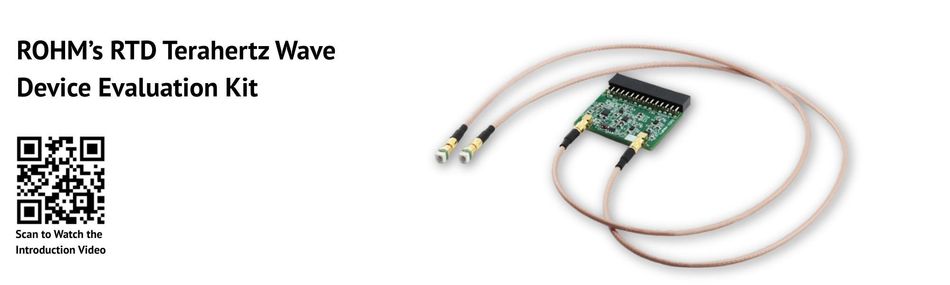
ROHM offers an evaluation kit (Figure 3) for easy testing of the developed RTD. Simply combining it with Digilent's "Analog Discovery 3" measurement tool or a PC allows simple operation of both "oscillation" and "detection" of terahertz waves on a single board.
While terahertz technology has been discussed for many applications, the company emphasizes whether it can be realized as a practical device usable in the field. Compared to conventional methods, which tended to be large and expensive, the RTD offers strengths in compact size, low power consumption, and mass-production suitability, making it a key to bringing terahertz technology closer to "portable devices."
"We hope users will challenge themselves to develop new applications using this evaluation kit," stated Kazuisao Tsuruda of the Research and Development Center, ROHM Semiconductor.
RTD's initial value lies in miniaturizing and reducing the cost of non-destructive inspection equipment. If RTD can miniaturize the transmitter and receiver, it enables bringing equipment previously requiring fixed installation directly to the field, lowering the barrier to adoption.
Suggested reading: ROHM Offers the Industry’s Smallest Terahertz Wave Oscillation and Detection Devices
Security Screening and Imaging
The first candidate application is security-oriented sensing devices. Combining an oscillator with a terahertz-sensitive image sensor enables inspection for metallic objects inside luggage (Figure 4).
"While conventional methods are possible, the equipment is large and expensive, hindering widespread adoption. RTD brings us closer to compact, affordable devices," Tsuruda stated.
The goal is not a few high-performance devices, but practical equipment that can be deployed in more locations and in greater numbers.

Moisture and Material Sensing
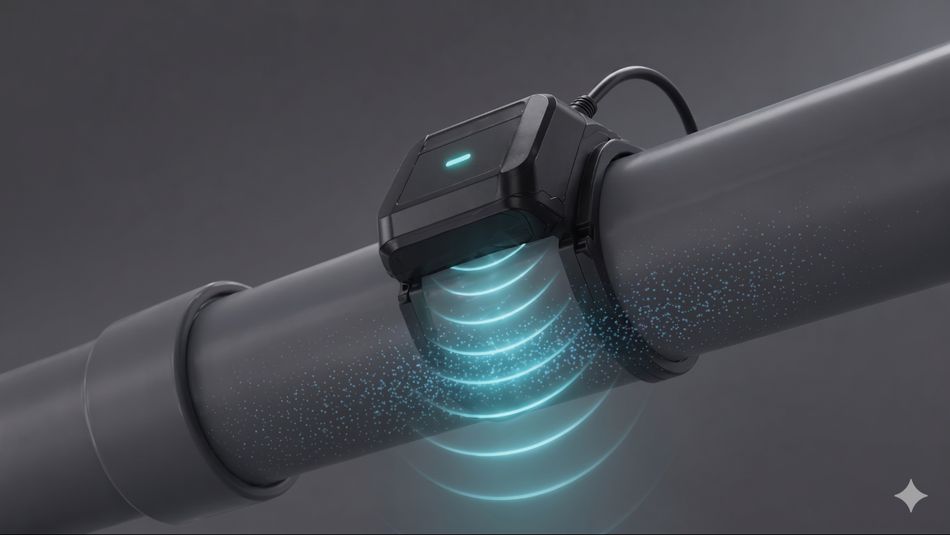
Next is promising non-contact sensing using moisture as an indicator. For example, by applying terahertz waves to the outside of PVC pipes and measuring the reflected waves, it can be determined whether water has entered.
Furthermore, scenarios where moisture presence impacts quality or degradation are numerous: moisture in paper or wood, humidity inside food/pharmaceutical packaging, trace moisture remaining in factory materials, or moisture within building materials. RTD-enabled portability facilitates increased measurement frequency and expanded targets, broadening the potential to cover "locations where measurement was previously impossible."
Film Thickness and Coating Inspection
Meanwhile, film thickness inspection for coatings and paints represents another critical application distinct from moisture detection. Film thickness, layer structure, and dryness directly impact performance and durability, yet conventional methods often relied on sampling evaluations. Since terahertz waves respond to layer structures and interface conditions, a compact system using RTDs could become a new tool for process control and inspection. ROHM aims to pioneer these broad sensing and measurement applications, starting with an evaluation kit.
Terahertz Communication
In the future, terahertz technology holds promise for ultra-high-speed wireless links in confined spaces like data centers and factories. While challenges remain, such as vulnerability to obstructions, progress in beam control and relay technology could open pathways for localized high-speed communication.
Whether terahertz technology becomes widely adopted as a practical solution will be significantly influenced by the availability of devices that make equipment smaller, cheaper, and easier to handle, similar to RTD.
From Potential to Practical Deployment
As terahertz technology moves closer to practical deployment, a growing ecosystem of companies is accelerating development across various applications like industrial sensing, imaging, and communication. In this new and emerging market, collaboration between device manufacturers and system integrators will be key to solving challenges related to the scalability, reliability, and manufacturability of terahertz technology.
Learn more about terahertz waves and applications on ROHM’s blog: Terahertz Waves - The Last Unexplored Frequency Band