Simplifying Power Architectures with Integrated Modules and Validated Discrete Components
RECOM scales power architectures without sacrificing performance or reliability

13 May, 2026. 12 minutes read

Electronics designers often need to balance the need to reach the market quickly and the time required to optimize their designs for the long term. This pressure frequently results in a less-than-optimal outcome: a good-enough prototype that prioritizes immediate functionality over an optimal solution for mass production.
Fortunately, RECOM offers different forward paths. With RECOM’s unique, unified ecosystem ranging from fully integrated power modules to validated discrete integrated circuits (ICs) and transformers, RECOM offers engineers the options they need to optimize their design based on their phase of the product lifecycle they’re in. Suddenly, teams can achieve both fast prototyping and high-volume optimization with products from a single provider.
In this whitepaper, we’ll discuss how RECOM offers the building blocks teams need to scale power architectures without sacrificing performance or reliability.
Choices for a Unified Power Architecture
The Value of Design Flexibility
Design teams often face compressed development time schedules that leave little room for ground-up circuit design. With RECOM modular integrated power converter solutions that house the switching controller, transformer and passive components all pre-assembled in a single package, engineers can bypass the complex task of discrete power stage design. Using these ready-made modules, development teams can speed time-to-market while reducing the bill of materials (BOM) to a single line item, which is pre-tested and pre-certified for fast time-to-market (TTM). Ultimately, this consolidation eliminates the logistical burden of managing dozens of individual component suppliers for a single power rail.
And, as requirements become more specialized or cost sensitive along the manufacturing process, engineers can move toward discrete architectures using the same core technology found in the modules. The choice of integration level is based on your application-specific needs. In any case, RECOM provides a scalable path where the underlying power expertise is constant across all form factors.
In this context, the procurement team benefits from a single-vendor relationship that covers both prototyping modules and production-scale ICs. This complete approach means that design knowledge gained during the modular phase directly translates into a discrete implementation, giving designers confidence that the system's electrical behavior will be predictable during the transition. In that way, RECOM helps product developers achieve lower costs associated with discrete designs without sacrificing the performance they’ve achieved via modules.
Integrating Reliability Over All Form Factors
Every component in the RECOM ecosystem adheres to strict reliability standards, regardless of form factor. For example, RECOM offers the same high-performance topologies, such as isolated or non-isolated architectures, in both modular and discrete formats. With architectural continuity between modular and discrete designs, engineers know their power stage will behave predictably, even when they need to change the board layout.
As part of this, RECOM mitigates the typical risks of discrete design by providing pre-validated sets of ICs and matching transformers. They specifically engineered these to operate together, eliminating the risk that usually accompanies sourcing disparate parts from different vendors. As such, validated component sets deliver modular-level certainty while providing the layout flexibility of individual components, allowing designers to distribute components around their PCB without sacrificing the validation standards they expect from a finished module.
In a similar vein, engineers can leverage RECOM’s technical expertise and support to skip the tedious trial-and-error process often required when matching third-party components for a custom supply. Because RECOM has already designed the core components as a pair, product designers don’t have to worry about the hidden parasitic effects that may fail emissions tests.
Furthermore, RECOM offers consistent support for various isolation levels across its portfolio, including functional, basic, and reinforced insulation. With a guarantee of consistent isolation performance across form factors, engineers can choose the most efficient form factor for their mechanical requirements without worrying about isolation performance.
With RECOM doing the heavy lifting for them, designers can instead focus on more important system-level improvements and design considerations.
Architectural Tools for Every Design Stage
Versatile Power Driver and Rectifier ICs
RECOM’s RVP Series of power drivers is an important element of the RECOM ecosystem because it blurs the lines between modular performance and discrete flexibility.
A popular offering in the RECOM discrete series is the RVP6501, a push-pull transformer driver that establishes a new benchmark for power density as shown in Figure 1. This component provides up to 100% more power capacity than standard industry alternatives while maintaining a compact SOT23-5 package. To ensure high-reliability operation, the RVP6501 also integrates advanced protection mechanisms, including short-circuit, overcurrent and overtemperature protection, that shield the device from catastrophic failure under fault conditions or during short-term operation outside of the specifications.
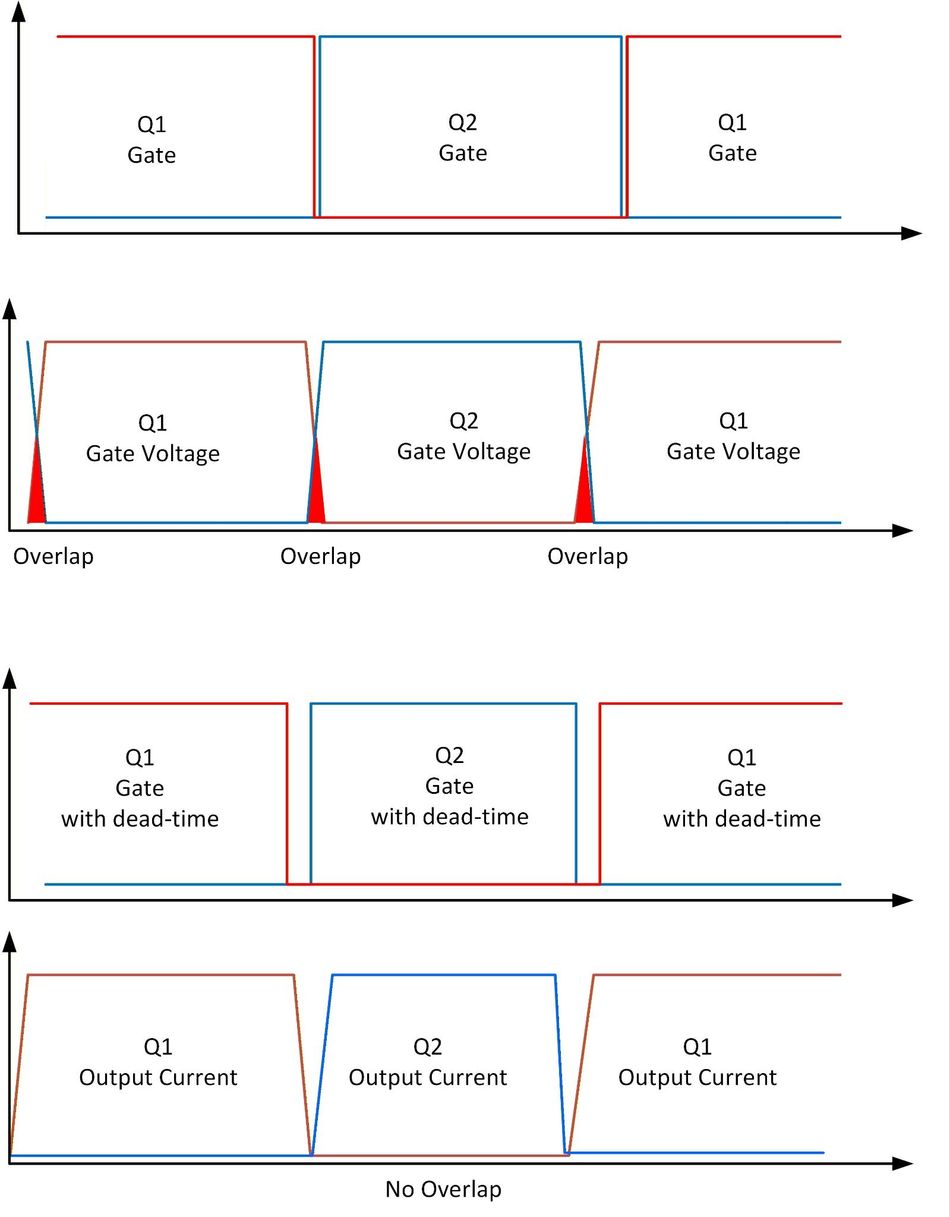
A further offering is the RVP010, which adds the functionality of 1A switches, an enable pin and clock select in the same SOT23 package. RECOM further enhances these electrical safeguards with adaptive break-before-make timing, a control method that introduces a specific dead time where neither internal switch is active. By using this timing, RECOM ensures that the transformer primaries always have sufficient time to de-energise completely between cycles, effectively eliminating the risk of transformer core saturation, even if the switch or transformer characteristics change with temperature or aging effects over time.
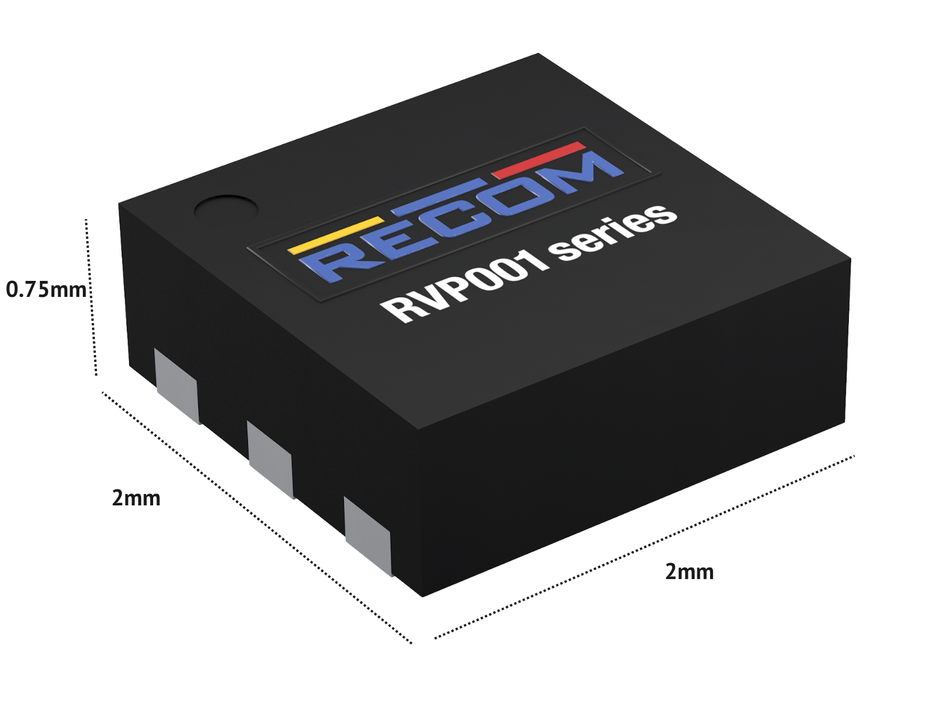
For reliable, long-term operation, RECOM prioritizes system robustness by integrating over-current and over-temperature shutdowns across its entire driver portfolio, regardless of the package type. For applications with lower power requirements ranging from 1 to 2 W, the RVP001, RVP003(S), and RVP005 provide sophisticated full-bridge solutions with input voltages up to 30 VDC. A full-bridge topology uses four switches to alternate the polarity of the voltage across the transformer, enabling efficient power transfer in extremely small footprints, such as the 2 mm x 2 mm x 0.75 mm DFN package.
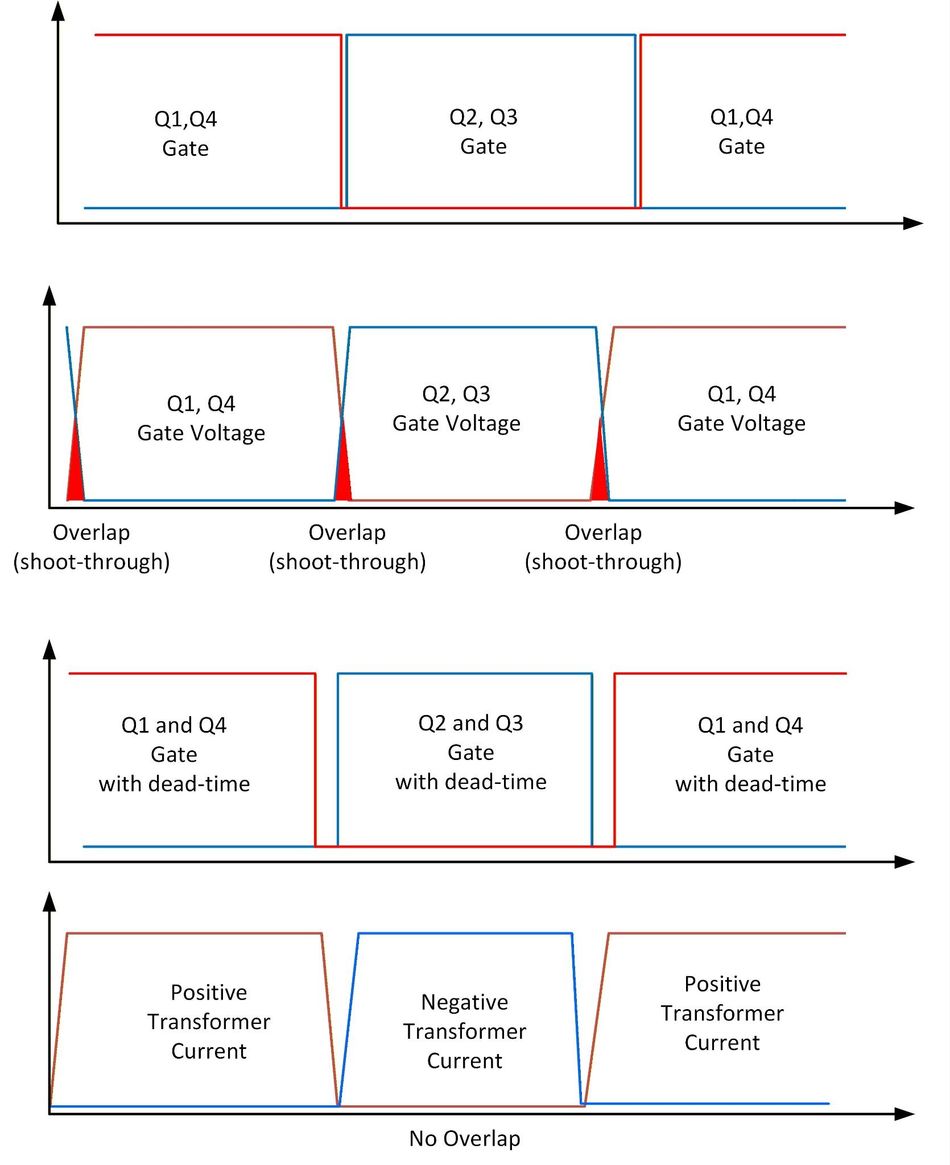
As in the push-pull topology, full-bridge switches also require a dead-time between switching cycles, but for a different reason: to ensure that both totem-pole transistors cannot be active at the same time (a phenomenon called “shoot-through”). Again, RECOM’s unique adaptive dead-time switching ensures reliable switching under all operating conditions, as shown in Figure 2. And, to address more demanding power requirements, RECOM offers the RVPW series, which supports wide-input flyback architectures capable of supplying up to 30 W of regulated power.
Complementing these drivers is the RVS and RVSY series of smart rectifiers, which introduces sophisticated tools designed to improve upon the efficiency of standard diodes. While traditional designs rely on passive diodes that suffer from a fixed forward voltage drop, these smart rectifiers utilize active MOSFET switching. This active approach drastically reduces both voltage drops and power losses by a factor of 40.
A highlight of this series is RVSY018, a self-powered synchronous rectifier controller that harvests its operating energy from a single rail in the circuit, eliminating the need for additional bias supplies and allowing operation over a wide range of output voltages and currents. The power IC combines sophisticated blanking and threshold programming with ultra-fast turn on switching times of 10ns for safe switching with CCM, DCM or flyback waveforms. By reducing the peripheral circuitry, this synchronous rectification controller simplifies the BOM and empowers designers to pursue more streamlined, cost-effective layouts. Ultimately, combining these intelligent solutions with active rectification allows engineers to maintain peak efficiency throughout the entire power conversion chain.
Fitting Magnetics to the Application
When teams design a power converter, especially without a fully integrated module, they frequently struggle to find the best transformer for their use case. RECOM designed its comprehensive transformer portfolio to be the missing link for engineers moving toward custom PCBs, providing the right magnetics for discrete silicon.
For example, RECOM’s wide array of standard SMD transformers is available with various turn ratios and isolation ratings tuned to match RVP drivers. These off-the-shelf magnetics help designers quickly implement a power stage that reflects the efficiency of RECOM’s proven modules. To assist circuit designers, RECOM also offers a range of Discrete Solution (DS) boards covering the most common input, output and isolation voltages that are premounted on a small PCB for immediate testing and evaluation. These DS boards are available ex-stock.
However, in the broad field of industrial electronics, a one-size-fits-all approach is not always possible. When off-the-shelf DS options do not match the customer’s needs, then RECOM will assemble an evaluation board from the standard driver, transformer, and secondary IC portfolio and deliver a working prototype within 20 working days. Full custom solutions where engineers specify exact requirements, such as non-standard input or output voltage requirements or extended creepage and clearance distances that they need in their designs to comply with specialized safety standards, can also be delivered quickly, the time taken depending on the complexity of the solution required. For this service, an MOQ of 50kpcs or 50kUSD (whichever is lower) is needed.
The flexibility of this program also applies to the internal architecture of the magnetic component itself. Teams can specify multiple windings or untapped configurations to support complex output rails, allowing a single discrete driver to power multiple isolated sections of a system simultaneously. Because they can customize so much, designers can design the power supply around the application, rather than limiting the application to the power supply design.
Finally, the deep magnetic design expertise used in RECOM’s world-class modules is directly available to customers using these discrete sets. RECOM's engineers have already done the hard work of validating all interactions between the silicon and the ferrite core. All these initiatives by RECOM make the discrete power stage as robust as its modular counterpart.
Topology and Efficiency
Selecting Topologies Based on System Constraints
When designing a power conversion stage, teams must balance conversion efficiency against component electrical stress.
The choice between push-pull and full-bridge topologies often depends on the system’s specific voltage-to-current ratio and the desired complexity of the magnetic components. Each choice offers advantages that help engineers match the power stage for either low-voltage, high-current throughput or higher-voltage rail stability. By choosing the correct path early in the design phase, designers can avoid costly layout revisions later.
Push-pull drivers like the RVP6501 and RVP010 use two MOSFETs to alternate the current through a center-tapped transformer, creating a balanced, efficient transfer of energy that fully utilizes the core’s magnetic flux capability for maximum power transfer in the smallest size. Engineers tend to choose this topology for applications with low-voltage inputs because of the lower RDS(on) of its N-channel MOSFETs and the fact that each transistor switches only half the average current of the total load. Because the topology minimizes voltage drop across the switches, the push-pull configuration is a staple for 5 V-to-5 V or 3.3 V-to-3.3 V isolated power supply systems that need a low-cost, small-footprint solution.
For systems operating at higher input voltages, the full-bridge architecture offers a strong alternative. Full-bridge drivers like the RVP001, RVP003(S), and RVP005 use four MOSFETs to energize the entire primary winding, simplifying transformer construction by eliminating the need for a center tap. In this configuration, each transistor switches half the supply voltage, making this topology ideal for 5, 12, 15, or 24 V supplies. By spreading the voltage stress across more silicon components, the full-bridge design helps the individual MOSFETs operate well within their safe operating limits, even under peak-load conditions. This setup effectively doubles the driver's voltage capability compared to simpler designs.
For longer operational lifetimes, the full-bridge drivers also integrate adaptive dead-time control to prevent hazardous cross-conduction (shoot-through) events. With this timing, the system completely disengages one set of switches before activating the next, preventing a direct short-circuit path across the supply rails (break-before-make). The difference is that the RECOM solutions can adapt the dead-time timing for optimal efficiency without the risk of shoot-through, as shown in Figure 3. As your design partner, RECOM will take the time to clearly explain which topology best matches your specific power-density goals and provide you with a set of guidelines to navigate the trade-offs between board space and electrical performance.
Advanced Rectification and Thermal Management
In high-density power architectures, where designers pack components into ever-smaller enclosures, thermal dissipation is paramount. Excessive heat threatens the power supply’s longevity and degrades the performance of the surrounding circuitry.
Fortunately, engineers can use RECOM’s RVS smart rectifiers to minimize heat generation during rectification. Specifically, designers can use the RVS series for active rectification, resulting in a significantly lower thermal signature than passive diodes, which are limited by a fixed forward voltage drop that inevitably generates heat as current increases. By replacing the diode with a high-efficiency MOSFET, the RVS series significantly cuts I2R losses. This thermal advantage, therefore, enables closer component placement and helps engineers shrink the PCB's overall footprint.
To further strengthen system safety, these devices also use secondary-side protection logic. No-load voltage limiters protect sensitive downstream digital components from over-voltage conditions that can occur during light-load or no-load operation, where ordinary converters may permit the output voltage to float dangerously high. These limiters always keep the power rail stable and within the safe operating limits of the connected load.
RECOM’s smart rectifiers also simplify the implementation process. They are self-synchronizing, which simplifies the control logic required for high-efficiency conversion by making external drive signals from the primary side obsolete. This set-it-and-forget-it functionality helps designers meet efficiency targets and deliver cooler, more reliable power systems.
Would you like to access the and download the formatted white paper?

This white paper discusses how RECOM offers the building blocks teams need to scale power architectures without sacrificing performance or reliability.
Versatility in Gate Driver Design
Optimizing Reference Designs for SiC/GaN
Gate driver power supplies are a use case where RECOM’s dual offering of modular and discrete solutions provides significant strategic benefits.
In the world of wide-bandgap (WBG) semiconductors, the power stage must be as nimble as the switching logic itself. To facilitate this, RECOM offers a variety of pre-validated reference designs that use standard, off-the-shelf modules. Engineers can start with these references for initial proof-of-concept testing and to verify their primary control algorithms and system logic without waiting for custom hardware.
But, as many designers start to use more specialized Silicon Carbide (SiC) or Gallium Nitride (GaN) drivers, they also face new challenges. For example, such high-speed drivers require highly specific, asymmetric rails, such as +18 and -3 V, to ensure the gate is fully enhanced and robustly turned off. RECOM helps designers deliver these ranges with custom-wound RMR transformers and RVP drivers. By tailoring the turn ratios of the magnetics, designers can produce the exact potential needed for optimal switching speeds, which directly impacts the efficiency and thermal management of the entire power inverter.
Beyond managing voltage precision, designers also must account for the unique nature of parasitics in WBG designs. Here, RECOM helps by offering drivers with exceptionally low coupling capacitance, typically around 2-4 pF, across the isolation barrier. This design decision protects the low-voltage control circuit from the high-frequency interference and high dv/dt slew rates common in SiC applications. Without this protection, noise could easily cross the barrier and trigger false switching or damage sensitive microcontrollers.
RECOM accompanies this protection with reinforced isolation rated at up to 6 kVAC/min, which is particularly useful for safety and reliability in high-voltage EV and industrial environments with high dv/dt and CMTI requirements. By combining superior dielectric strength with low parasitic values, RECOM is pushing the limits of what’s possible in WBG gate driver power supply design.
From Evaluation to High Volume
In the early stages of a project, engineers look for speed and simplicity by using fully integrated modules to validate their core technology and for fast TTM. However, as a product gets closer to full commercialization, the financial requirements change. For annual production volumes exceeding around 50,000 units, the discrete ecosystem is the preferred choice because it offers maximum cost optimization without compromising system performance.
With RECOM, switching from a module-based reference design to a high-volume production board is a standard, simple workflow.
When moving from a breadboard prototype to a final product, teams can leverage RECOM's 20-day Discrete Solution Program. This initiative allows engineers to test evaluation-ready PCBs before committing to mass production, significantly reducing the risk of the final launch. This means confirmation that the power stage performs as expected, that it fits into the space available, and matches thermal management requirements of the product.
It’s incredibly important for designers to preserve technical continuity in this process. Having the same manufacturer provide both the initial prototype module and the eventual production IC ensures that the switching logic and reliability standards remain consistent. RECOM’s support model makes re-validation of basic power-conversion physics unnecessary when changing form factors. Overall, RECOM’s offerings reduce the overall engineering burden, simplify the supply chain, and significantly shorten the total time-to-market for complex industrial and automotive systems.
Supporting Engineering
Systems-Level Support
Beyond products, RECOM is a deep technical resource for every product designer. Like a true design partner, RECOM helps engineering teams tackle the complexities of board-level power conversion with a suite of advanced digital assets. Specifically, their catalog includes accurate SPICE simulation models and AI-powered tools to assist in component selection and circuit verification. These virtual environments help designers predict electrical behavior before ordering physical hardware, which saves them significant time during the development phase.
The support extends into documentation, where accuracy and clarity are non-negotiable. Here, RECOM provides technical materials, including extensive application notes and datasheets, to support the entire design cycle from initial concept to final approval.
RECOM’s full support infrastructure minimizes the expertise gap for teams new to discrete power design. Instead of struggling with the nuances of transformer saturation or MOSFET gate timing alone, designers can rely on a trusted network of data and expert advice. By closing the gap between silicon and system implementation, RECOM helps manufacturers build robust products that perform reliably in the field. Their product ecosystem makes it accessible for every engineering department to jump to custom power stages.
Accelerating Validation and Testing
RECOM’s unique Discrete Solution Program significantly reduces the time and cost associated with custom hardware validation. While discrete designs typically require multiple board iterations to perfect, this program provides a shortcut by offering pre-validated component sets.
By engaging with physical hardware sooner, designers can proactively test their prototypes to identify potential layout or EMI issues before they become costly to fix in mass production. For example, spotting a noise interference problem or a thermal bottleneck during the initial pilot run prevents the project from stalling later. RECOM has even dedicated its prototyping line in Xiamen specifically to quickly delivering these high-quality discrete samples for clients.
RECOM’s commitment to speed and accuracy makes them an ideal partner for time-sensitive industrial and automotive projects. By stripping away the months of waiting typically associated with custom magnetics and silicon pairing, the Discrete Solution Program helps designers meet aggressive launch windows. With RECOM, you can have the confidence needed to deploy custom power stages in even the most demanding market segments.
Conclusion
RECOM is the only provider offering a comprehensive path to the simple adoption of high-performance modules and validated discrete components within a single ecosystem. Ultimately, this inclusive approach helps hardware designers scale their designs with confidence, knowing that RECOM has the tools and support they need at every stage of the product lifecycle. From the first benchtop prototype to the final mass-produced circuit, RECOM’s products and services deliver the stability and performance required for successful energy conversion, regardless of the end application.
Would you like to access the and download the formatted white paper?
This white paper discusses how RECOM offers the building blocks teams need to scale power architectures without sacrificing performance or reliability.