Sensing the Invisible: Sensirion Environmental Sensors for Indoor Air Quality & Refrigerant Safety
Discover how SGD4x, SFA40, STCC4, and SEN6x sensors by Sensirion help engineers measure refrigerants, formaldehyde, CO₂, and multiple air quality parameters in compact, low-power designs.

28 Oct, 2026. 4 minutes read
Introduction
Most people spend the majority of their day indoors, breathing air that carries a mix of pollutants they rarely notice: carbon dioxide (CO₂) building up in an occupied room, particulate matter (PM) drifting in from cooking or outdoor traffic, and volatile organic compounds (VOCs) such as formaldehyde off-gassing from furniture and finishes. If we add the refrigerants circulating through modern heating, ventilation, air conditioning, and refrigeration (HVACR) equipment, the list of things a building may need to measure grows quickly.
Sensing technology has advanced considerably, yet indoor air quality (IAQ) monitoring remains a demanding hardware problem. Each parameter relies on a different measurement principle, and every design forces trade-offs between accuracy, power consumption, size, and cost. Sensirion addresses this with a portfolio that runs from single-gas sensors to multi-parameter modules.
Why Is Indoor Air Quality Hard to Measure Well?
Unlike temperature, "air quality" is not a single quantity. CO₂ concentration is a proxy for ventilation adequacy, PM relates to respiratory exposure, and VOCs, nitrogen oxides (NOx), and formaldehyde each represent distinct chemical hazards. No single transducer captures all of them.
The physics also imposes constraints. Optical particle sensors need a controlled airflow path. Conventional non-dispersive infrared (NDIR) CO₂ sensors depend on an optical cavity whose path length limits how small the package can become. Gas sensors with heated sensing elements draw power that a battery budget may not tolerate. Mains-powered air purifier and a battery-powered wearable therefore sit at very different points on the same trade-off curve, which is why component selection starts with the application rather than the datasheet.
Refrigerant Leak Detection for A2L Systems: SGD4x
The HVACR industry is moving away from high-global-warming-potential refrigerants toward lower-impact alternatives such as R-32 and R-454B. Many of these are classified as A2L, meaning lower toxicity but mild flammability. Resultantly, safety standards such as UL 60335-2-40 now call for refrigerant detection in many A2L installations, depending on charge size and application.
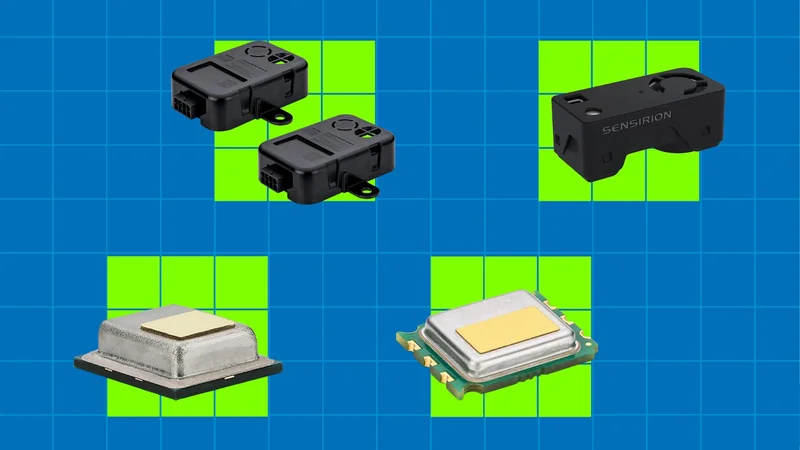
SGD4x sensors by Sensirion are designed specifically for this requirement as a complete A2L refrigerant detection system (RDS). They use the thermal conductivity measurement principle, which exploits the fact that refrigerant vapor conducts heat differently from ambient air. The dual-contact relay output allows the sensor to trigger a signal relay that starts a blower to disperse leaked refrigerant, switches off the load, or alerts a control board.
Two characteristics stand out for system designers. Fast response time shortens the window between a leak and mitigation, while multi-refrigerant calibration provides broad compatibility across A2L refrigerants. This lets one detector design serve multiple product lines in both residential and commercial HVACR equipment, rather than requiring a different sensor variant for each refrigerant.
Targeted Formaldehyde Detection: SFA40
Formaldehyde is among the most common indoor pollutants, released by wood-based furniture and flooring, paints, and cosmetics. Broad-spectrum VOC sensors report an aggregate signal across many compounds, which makes them useful for trend monitoring but less suited to tracking a specific substance of concern.
The SFA40 is designed to detect formaldehyde directly. Measuring just 10 × 13 × 2.4 mm³, it is compact enough to integrate into air purifiers, IAQ monitors, and air conditioners without forcing a redesign of the enclosure or airflow path. For appliance makers, this enables products that respond to a specific, well-understood pollutant rather than a generic "air quality" index.
Miniature CO₂ Sensing: STCC4
CO₂ has traditionally been one of the bulkier parameters to measure, largely because of the optical path lengths required by NDIR sensing. The STCC4 takes a different approach, applying recent advances in thermal conductivity sensing to provide direct CO₂ measurement in a 4 × 3 × 1.2 mm³ package.
The sensor is fully calibrated and delivers the accuracy required for IAQ applications while maintaining low current consumption. Its surface-mount device (SMD) design and tape-and-reel packaging support high-volume automated assembly, a practical consideration for consumer products built at scale.
That combination of size, power, and manufacturability opens applications previously limited by size and cost constraints. The examples include residential and consumer devices, as well as wearables that track CO₂ during sleep, a use case where a larger optical sensor would be impractical.
Multi-Parameter Monitoring in One Module: SEN6x
For products that need a complete picture of indoor air, integrating several discrete sensors adds layout complexity, firmware work, and supply-chain overhead. The SEN6x sensor module family consolidates these functions into a single platform, combining PM, relative humidity, temperature, VOC, NOx, and either CO₂ or formaldehyde sensing in a compact footprint.
Embedded processing algorithms handle much of the signal conditioning and compensation on the module itself. The result is reduced design and integration effort, a simpler bill of materials, and faster product deployment. Sensirion also positions the SEN6x for high measurement accuracy and an extended operational lifetime, both important for monitors and HVAC controls expected to run continuously for years.
Choosing the Right Sensor
The four families map to distinct design priorities:
SGD4x: Refrigerant safety in residential and commercial HVACR systems using A2L refrigerants.
SFA40: Dedicated formaldehyde monitoring in purifiers, monitors, and air conditioners.
STCC4: CO₂ measurement where board space and power budget are tight, including wearables.
SEN6x: Full multi-parameter IAQ monitoring with minimal integration effort.
The broader choice is between component-level and module-level integration. Discrete sensors give the most control over size and power, while a module like the SEN6x trades some of that flexibility for shorter development cycles and a simpler supply chain.
Conclusion
Indoor air quality monitoring has moved from a niche feature to an expected capability in HVAC systems, appliances, and personal devices, while the shift to A2L refrigerants has made leak detection a safety requirement. Sensirion's environmental sensor portfolio addresses both trends with devices tailored to specific measurement challenges, from a dedicated refrigerant detection system to a CO₂ sensor small enough for a wearable.
For engineers, the value lies in matching the sensing principle and integration level to the product's constraints. To explore the full range of Sensirion products, visit Mouser's Sensirion page.