Scaling Remote Monitoring with Industrial-Grade Connectivity
Enable scalable, long-range, low-power IIoT connectivity with LoRa technology — built for industrial environments where reliability, remote monitoring, and multi-year device lifecycles are essential.

07 Jan, 2026. 5 minutes read
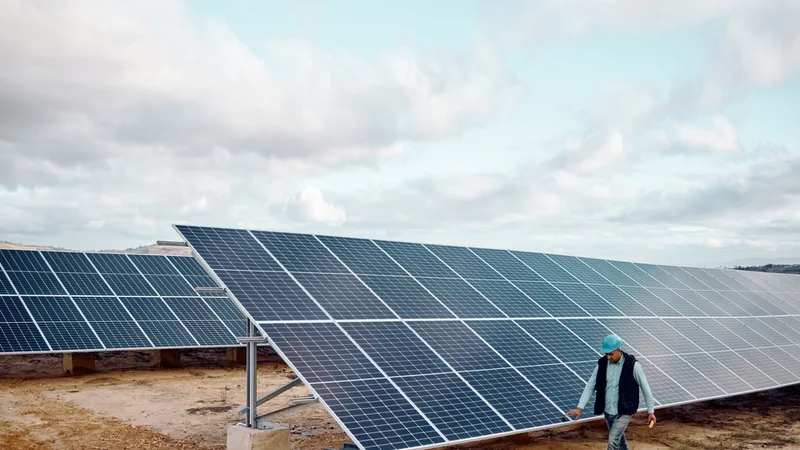
Engineering Expert Outdoor Solar Panel Inspection
The hardest part of Industrial IoT (IIoT) in factories and industrial settings is often the last meter of communication. Sensors may be affordable and data processing may be powerful, but if the link between devices and networks is unreliable, the entire system loses its value.
This “last meter” challenge is amplified by industrial realities. Wireless signals have to travel through dense infrastructure, withstand interference from heavy machinery, and reach across wide areas where wired options are impractical. At the same time, devices need to operate for years on constrained power budgets without frequent maintenance.
Connectivity designed for these conditions is what makes large-scale monitoring and automation possible. Here is where Semtech’s LoRa® technology plays a defining role, enabling scalable, low-power communication that holds up in environments where conventional options fall short.
The Challenge of Industrial Connectivity
Industrial sites present a unique communications problem. Nodes are often distributed across expansive areas such as production floors, power grids, or solar farms. Walls, machinery, and electromagnetic noise disrupt wireless signals. Many systems must also function in remote locations where physical access is limited and replacing batteries regularly is impractical.
Connectivity in this context needs to meet several conditions:
Range: Cover long distances without requiring dense infrastructure
Resilience: Maintain signal quality despite interference from motors, welding equipment, or switching devices
Energy efficiency: Support device operation long-term without frequent maintenance
Scalability: Connect thousands of devices to a single network without overwhelming bandwidth
Traditional technologies struggle to meet all of these simultaneously. Semtech developed the LoRa technology to do so, enabling wireless networks that reach farther, last longer, and scale reliably.
LoRa as a Connectivity Foundation
LoRa operates in sub-GHz frequencies using chirp spread spectrum modulation. This allows communication to extend up to 15 kilometers line-of-sight and penetrate through dense building materials in factory and utility environments. A single gateway can cover several kilometers in urban or industrial areas, making plant-wide or city-wide networks feasible with minimal infrastructure.
The protocol’s design also provides resilience against interference. LoRa links can operate below the noise floor, delivering reliable packet delivery even in RF-heavy environments. Adaptive data rate (ADR) further optimizes performance, balancing throughput and range across thousands of connected nodes.
Equally important, LoRa is inherently energy-efficient. With ultra-low average current consumption, LoRa-based transceivers can support up to a decade of battery life in low-duty-cycle sensing applications. This efficiency makes long-term monitoring possible in locations where maintenance is costly or access is restricted.
Semtech extended these capabilities through the LoRa Edge™ platform, which integrates long range, global 2.4GHz and Sub-GHz ISM bands, L/S-Band satellite connectivity, and low-power location-aware features all in a single architecture. This allows industrial operators not only to connect sensors but also to manage and locate them efficiently across their lifecycle.
Last month Semtech introduced LR2021, the first chip in Semtech’s LoRa Plus™ family. Incorporating a fourth-generation LoRa IP, the transceiver supports both Terrestrial and SATCOM networks in the sub-GHz, 2.4 GHz ISM bands, and licensed L/S-Band. The transceiver is designed to be backward compatible with previous LoRa devices, ensuring seamless LoRaWAN® compatibility. The device additionally features expanded physical layer modulations for fast long-range communication (FLRC) up to 2.6 Mbps and is compatible with various low-power wireless protocols including Amazon Sidewalk, Wireless M-BUS, Wi-SUN FSK, and Z-Wave when integrated with third-party stack offerings. The LR2021 features an advanced RF and analog architecture that supports a multi-region, single-SKU design, reducing external BOM costs, PCB footprint, and power consumption, while offering superior performance compared to previous LoRa transceivers.
Real-World Applications of LoRa Connectivity
Predictive Maintenance in Renewable Energy
In solar power installations, uptime is critical. PV Hardware, a solar technology provider, has deployed LoRaWAN networks across its solar tracker systems. By equipping trackers with LoRa-based sensors, the company continuously monitors motor activity and temperature. This real-time visibility enables predictive maintenance that prevents costly downtime, ensuring that large solar farms maintain peak efficiency.
Building Automation and Smart Grids
Industrial buildings and utility grids require visibility across diverse assets, from HVAC units to switchgear. LoRa supports distributed nodes that monitor conditions across multiple floors or city blocks, requiring only a handful of gateways. This reduces both infrastructure costs and maintenance overhead compared to mesh-based short-range alternatives.
One strong example comes from Czech Radiocommunications (CRA), which extended its LoRaWAN deployment to cover approximately 75% of the Czech Republic’s population. Starting from its roots as a national broadcast provider, CRA now enables broad IoT services by leveraging LoRa’s long-range and low-power characteristics. This transformation allowed CRA to deliver country‑wide monitoring and automation services with just a few gateways, establishing efficient and scalable infrastructure without overloading operational resources.
Remote Infrastructure Monitoring
Utilities managing water meters, substations, or solar inverters often need visibility into assets spread across remote locations. LoRa provides a long-range, low-power alternative to cellular networks, cutting recurring costs and extending device lifetimes.
For utilities, this translates into efficiency gains of up to 25%, lower carbon footprint through smarter energy use, and reduced total cost of ownership (TCO). With support for international standards such as DLMS and IPv6, LoRaWAN ensures interoperability while enabling operators to detect anomalies early and streamline maintenance.
Scaling with Reliability
At scale, LoRa networks provide an operational backbone. With the ability to connect thousands of nodes under a single gateway, industries can extend monitoring across entire facilities, cities, or distributed infrastructure.
For predictive maintenance, this means years of uninterrupted data to train analytics models.
For smart buildings, it allows centralized visibility into environmental conditions and energy usage.
For utilities, it enables real-time oversight of distributed assets without the energy burden of cellular.
Because LoRa devices draw so little power, they can remain in service with minimal maintenance, turning networks of sensors into persistent data sources. This longevity directly reduces maintenance cycles, lowers costs, and strengthens the business case for digital transformation.
That reliability scales further when paired with Semtech’s broader portfolio, combining protection, power management, and connectivity into a platform built for real-world stresses. By integrating these layers, engineers can build systems that are both functional and sustainable over long lifecycles.
Connectivity for Scalable IIoT
As IIoT deployments expand, connectivity becomes the deciding factor in whether systems can deliver continuous insight and operational value. LoRa technology provides the long-range, low-power communication that makes scalable, remote monitoring possible in industrial environments.
Semtech’s LoRa platform supports these demands with proven resilience, efficiency, and scalability. By enabling networks that cover kilometers, operate reliably in noisy conditions, and last for years on constrained power, LoRa establishes a wireless backbone for the next generation of industrial systems.
Our latest whitepaper, Protecting the Future of Industrial IoT: Circuit Protection and Power Solutions from Semtech, explores these principles in greater depth. Download the full whitepaper to explore application examples, testing data, and strategies for building IIoT systems that stay connected, deliver data continuously, and scale with confidence.