Podcast: Mouser's Matt Bell & The Next Generation of Automated Warehouses
In this episode, we speak with Matt Bell (VP of Outbound Operations at Mouser Electronics) about what it takes to run logistics and fulfillment at the scale of one of the world's largest electronics distributors—and how automation can improve operations without replacing people.

12 Mar, 2026. 27 minutes read
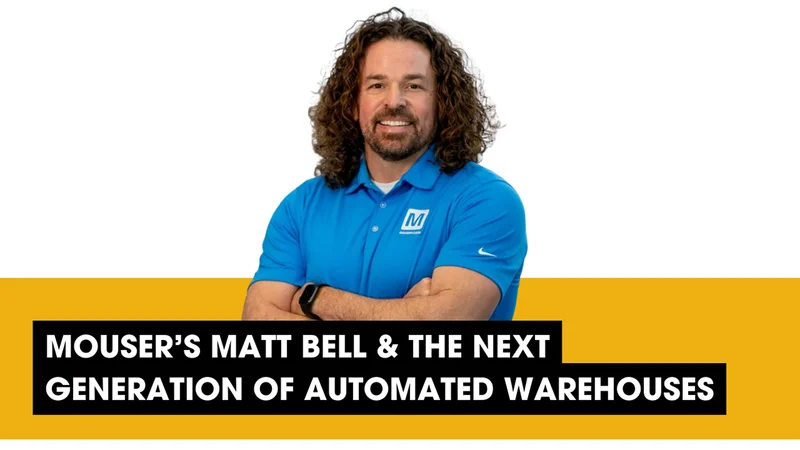
In this episode, we speak with Matt Bell (VP of Outbound Operations at Mouser Electronics) about what it takes to run logistics and fulfillment at the scale of one of the world’s largest electronics distributors—and how automation can improve operations without replacing people. Matt shares his journey from starting as an order puller in 2004 to leading the strategy, processes, and technology behind Mouser’s outbound operations.

This podcast is sponsored by Mouser Electronics.
Episode Notes
(00:00) Introduction to Matt Bell and Mouser Electronics
(03:14) Understanding Mouser's Operations and Scale
(06:12) The Role of Automation in Order Fulfillment
(09:15) Philosophy on Automation and Workforce Integration
(12:12) Growth and Expansion of Mouser's Operations
(15:15) Identifying Automation Opportunities
(18:09) Balancing Existing Technologies with New Innovations
(20:58) Strategic Investment in Automation
(22:04) Emerging Technologies in Logistics
(22:46) Navigating Technology Choices
(23:18) Flexibility in Automation
(24:54) In-House Development vs. Off-the-Shelf Solutions
(26:41) Collaboration Across Teams
(28:37) The Importance of Team Dynamics
(30:21) Lessons Learned Over Two Decades
(31:55) Advice for New Professionals
(33:48) Listening for Improvement
(36:37) The Scale of Operations
(38:23) Final Thoughts and Advice
This episode was brought to you by Mouser, our go-to source for electronics parts for any hobby or prototype. Click HERE to check out the many resources shared by Mouser across a range of topics from AI to Healthcare.
Want to hear more from Matt? Give him a follow on LinkedIn
Become a founding reader of our newsletter: http://read.thenextbyte.com/
Transcript
Hello friends, welcome back to the Next Byte podcast. Today on the show, we're joined by someone who has quite literally grown alongside one of the world's largest electronics distributors and a good friend of the show, which would be Mouser Electronics. Matt Bell is the vice president of outbound operations at Mouser, where he oversees order pulling and shipping for almost 850 employees. But what really makes Matt's story special is how he got there. He started back in 2004 as an order puller and he worked his way up through the organization. Over the past two decades, Matt has been at the center of Mouser's massive operational growth, helping scale a warehouse footprint that now spans about one and half million square feet and supports the shipment of tens of thousands of orders every single day. In this episode, we dive into what it really takes to run logistics at scale, how advanced automation like auto store systems and vertical lift modules are transforming modern warehouses, and importantly, why Matt believes automation should augment people, not replace them. We also explore the leadership lessons he's learned moving from the warehouse forward to the executive level and what manufacturers and engineers can take away from Mouser's approach to continuous improvement. So, if you're curious about the future of warehouse automation, operational scale, or people first engineering culture, then this is the episode for you. Or if you're like me and you just want to know how organizations fulfill your orders and turn it around within a day, then buckle up because this is for you. Let's dive in folks.
What's up friends, this is The Next Byte Podcast where one gentleman and one scholar explore the secret sauce behind cool tech and make it easy to understand.
Daniel: Where do we start? We should just do introductions first, right? So obviously we know you.
Matt: Yeah.
Daniel: But for the wider audience, right? Tell us about Matt, who you are, what you do, how you got started here.
Matt: So, my name is Matt Bell. I started back in 2004 with Mouser as an order puller and just over the years have been fortunate enough that people trusted me just enough to dig into things that we hadn't done before. And I've been able to do a lot of cool stuff over the years, whether it's learning people or management or processes or automation and all that stuff.
Daniel: And what's your job now?
Matt: Vice President of Outbound Operations.
Daniel: What does that mean to someone who doesn't work at Mouser? What's your scope?
Matt: So, I take care of order pulling and shipping and probably 850 people. And that's setting strategy. It's process improvement. It's a certain amount of accountabilities and it's just kind of, setting the path and making sure we hit our goals and are successful.
Daniel: We know folks who've listened to our podcast for more than a couple of episodes have probably heard something about our partnership with Mouser. So, they know what we say about Mouser to them, which is one of the largest electronics distributors in the world, intimate connections with lots of different folks in industry. What is that? That's kind of the extent of a lot of our folks' knowledge of Mouser. Maybe a lot of them are customers. I imagine they're customers. We've been customers in the past.
Matt: Yeah.
Daniel: What do you think, someone who hasn't been into the warehouse and seen everything yet, like we just had the awesome opportunity to, what are some of the things that you think someone might should know about Mouser or might be excited to learn about Mouser if they haven't been inside these four walls.
Matt: Oh my gosh. The scale. Our scale is pretty massive. And we do our best to get all the orders out on time. Not always successful, but for the most part we are. One of the coolest things I think about Mouser is just the people. I mean, y'all walked the floor with me. I mean, did anybody seem frustrated or grumpy or anything like that? It's a lot of really good people running around here trying to do their part to fulfill the orders for all of our customers.
Daniel: And for me as a customer, could you kind of walk us through and we were fortunate enough to physically be able to walk through, but could you kind of walk us through verbally what all the steps look like from the second I check out on my order on Mouser.com to when that package ships and makes its way to my house? There's a lot of coordination that goes on internally. Can you kind of walk us through what the major steps are and kind of all the different complications that are involved in making sure that it happens as fast and as efficiently as it happens?
Matt: Sure. We have 1.2 million SKUs in stock. We're cruising with about 1.5 million square feet of warehouse space. So, with about 1400 employees. So, when an order drops down into the warehouse, he gets separated out into all the different areas that we can pull out of. And everybody gets busy and we get drops of orders into the warehouse every five minutes. So, whenever you place an order, goes through all the upstairs, credit checks, know, all that kind of stuff, whether it's international or maybe there's some government restrictions and things like that. It'll come down in the warehouse. He gets separated out and we physically can pull the order at the same time all over the building. With our volume, we ship around 20 to 25,000 orders a day, about 75,000 lines. When you have that many SKUs in such a big warehouse with that kind of volume, you can't necessarily pull big batches of orders. So, what we do is we have to pull them all, and those are conveyed down to our consolidation area where then they're put back together in the customer order and then they're shipped out to the customer. And there's multiple different ways to pull orders, whether it's off of a pallet picker or auto store or a vertical lift module. Or if simply just from a shelf, people walking around with a cart pulling a runner. There are about 550 order pullers around there. So, they're always moving. They start at three o'clock in the morning and they don't finish pulling until 8.30.
Farbod: Now I got to ask, because I know our audience is going to be curious. What is an auto store and what is a vertical lift module in the context of the entire operation?
Matt: They're easy enough to look up. But you have an auto store which is it's basically a big grid and it's totes stacked on top of each other and on top of the totes there are robots that run around and they pick the tote whether you're putting stuff into the auto store or taking stuff out of the auto store it'll pick whatever tote that the order pool or stalker needs and it will even if it's at the very bottom. So, there's 16 totes tall and even if it's at the very bottom it'll dig that bottom went out and it'll scoot it over to the edge and then drop it down to the order puller or the stocker. So, no, I was going to say the vertical lift modules, similar concept, a little bit different. Except for totes, they have trays and trays are stored vertically and with an extractor that runs up and down and grabs the tray and delivers it down to the order puller or stocker at whatever area that they're working at.
Daniel: You were kind of mentioning earlier the one thing that if you could elucidate to everyone who hasn't been here, is scale. You were bragging a little bit. Can you give us some of the numbers on how large your scale is in terms of these automated machines you're using? I think you said you're the single largest install of these vertical lift modules in the world.
Matt: Yes. Yeah, we have like 220 right now. Not all of them are full. We are our new expansion. We're still filling those up. Just in the new expansion alone, we have room for 300 of them. The auto store, we're not near the biggest on the auto store. I mean, we have plans to definitely make it bigger in the immediate future. 200,000 totes versus the 76,000 that we have right now with plans for a really big auto store in the future. It's kind of funny. We go to like material handling trade shows and a lot of people that come out here, they mention it's like going to a trade show because we have one of everything and two of some, you know, two of a lot of things.
Farbod: Scale is something I want to build on. Okay. Again, I came in thinking one thing and you guys completely flew my expectations away in terms of like the amount of automation in place. Now, one of the constant themes of our podcast and one of the topics that Daniel and I like to talk about is the balance of automation and the impact that that can have on like people's lives and stuff, right? But what I've seen here at Mouser so far has been like this perfect blend of automation actually supporting the workforce instead of trying to replace it. So, I'm wondering like, what are your thoughts on that? And what has been your experience, you know, bringing more and more technology into the workforce?
Matt: It all depends on how you start. Okay, so whenever we first started, we were not good at like big massive change. So, what we did is we started extremely small. I had people in my shipping department. There was a, we had a silly table and on one side of the shipping desk, there was a printer and the other side, there was a scale and everybody would bounce back and forth between the two. So, what we did is we challenged them to come up with a better stand and integrate the scale and the printer in one stand together so they would not have to walk back and forth. And off of that basic building block of everybody getting together and working together and coming up with a good solution, we were able to make that process, I mean, it was substantially better because you're thinking at the time we were probably shipping 10,000 orders a day. And so, if you're not walking back and forth, wasting time 10,000 times a day, that's exactly what we need. And then it's the most important part of bringing in new automation is getting buy-in from everybody. If you come in and you just automatically start installing this brand-new shiny thing, it doesn't matter what it is. And everybody has a lot of questions and you don't take the time and effort to answer those questions and to take care of the concerns, then you have a buildup of people that question the motives behind it. But in any design, we do, even before we order the equipment, we're always getting input of not only the hourly employees on the floor who are actually doing the work, the management. Because I mean, I might help start the conversation to get us going, but the final design and the integration and how well it works. It all depends on the employees on the floor and how well they can make it work.
Farbod: I think it was really clear to us that that's the case when we saw one of the automated lines and then the manual version of it and how the automated was pretty much just a translated version of that just easier for the order picker.
Matt: So, over the years, we've kept the same basic process throughout the entire warehouse, whether it's order pulling or consolidation. And we've designed the automation to be inputted into the operation in such a way that it doesn't really impact how it's done. I mean, pulling is order pulling. Now, what we can make better is we can make delivery of the goods to the person. We can make that better. We can make the pick duration better because all the goods are coming to the person. Now, it can have more specialized equipment at each station instead of somebody walking through an aisle and having to go to the end of the aisle to count something or weigh something or anything like that.
Daniel: Just diving a little deeper on your philosophies on automation. You kind of mentioned there's some folks out of there who have a school of thought of, I'm going to use tools and technology and automation to replace people. You said you guys have got a different approach on it. Can you kind of explain what that is and how you've integrated that over the last couple of years? I mean, you've added a lot of cool, shiny toys. How is that your philosophy on that played out in practice as well?
Matt: So, I mean, you do have the folks out there that the only reason they're getting into automation is to reduce headcount, save money. We've never done that. It's always been we're going to build automation and we're going to use automation to make everybody faster. We're going to increase the capacity with uh automation or we're going to make our quality better. And as we do that, we used it to absorb growth rather than replace people. So, for instance, if we grow 20% in a year, maybe that year I only have to grow my head out 5% instead of that 20%. And it seems to really work well over the years. I mean, anytime we do have a disruptive automation that literally can come in and take somebody's job or make their jobs so much faster that it almost nullifies that position. We always have those talks ahead of time. Everybody who works in that area, I mean there's relentless one-on-one conversations about, hey, this is coming in. Here's what we think it's going to do. And what we need from y'all is just to be flexible. I mean, there's always going to be a spot here for you. Now, it might be you might switch departments, or you might go help another area for a little while, or you might just help get it up and running. And then we'll move on to the next automation project. So, we have never lost a person because of automation.
Farbod: That's awesome. Do you think this unique perspective and approach of yours comes from the fact that you were part of the people that were doing the order picking and stuff, and then now that you're the one implementing the automation, you're like, know what's going through their heads and what their challenges and struggles are.
Matt: Is it that unique?
Farbod: I think so. Yeah.
Matt: Growing up here and actually working through all the processes that we've been able to make better over the years. I think it's definitely helped with that. I don't know if it's that unique in the because it's been a necessity. Okay. Now, if we were in a industry company that had low growth and was just extremely stable and maybe it grew, you know, two or 3% a year, then I might have a different opinion as I've grown up through a position like that. But being with a company that has grown so much over the years, even if I wanted to replace people with automation. I never could. There's no opportunity to do it. Because as soon as we build something, it's consumed or used in a different way. And we've been able to continue that for at least a decade.
Daniel: Can you quantify? You said it's grown a lot during your tenure. It's continuing to grow a lot. I don't need actual sales numbers projections, but just from when you started, 21 years ago here to today. Kind of explain the difference in scale, kind of the difference in technology. Like how have you seen this grow from, I don't know, a teeny tiny warehouse to a giant warehouse? What does that look like over the last two decades of working here?
Matt: Oh my gosh. I don't even know how many square feet we've built over the years. I've been a part of four of the expansions. And I mean, when I first started pulling orders, we didn't even have a warehouse management system. We had a green bar printer and they literally they printed off these big sheets of paper that stickers on them and they would put them in kitty litter trays and they would stack these kitty little trays up and then I would come over there and I would grab me a stack and I would walk all the way around the building taking the counting out everything verifying part numbers and all that stuff and take the sticker off and put it on there. Fast forward to I think we did that in 2005 where we brought in our warehouse management system so it wasn't. It was pretty fast after I got here, but going into just intelligent ways to move orders back and forth. And then we went from there to not really moving orders back and forth, but just pulling everything as efficient as possible. I will tell you, at one point we are average per hour in the building for order pullers, which is like 14, and it's approaching 22 now. So, over the years, just the process improvements in the and the goals and accountabilities and fairly the people too. I mean, the better the people are, the better that the end product is going to be.
Daniel: That's awesome.
Farbod: One of the things that I was interested about, and you kind of told me a little about it, is how do you go about picking what to automate? Like obviously at a high level, you want to improve processes, all the different philosophies you mentioned, but how do you zero in on like this process or this machine is what we're going to have to go after next if we want to improve X or Y or Z.
Matt: So, it initially started with shipping. At one point I was the buyer of all of the shipping supplies. And when I got into the management side of the world, I recognized that, well, you know, we ship a lot of this at the time it was a six by four by two box, a little bitty box. It just occurred. It occurred to me one day; I wonder what we can do to automate that. And that's when we started down the path of the stand, you know, that we helped, that everybody helped design and all that stuff just to kind of get ready. And I did that in the shipping area on purpose just because that's where we were going to do our first automation. And so it was, we started in shipping with just the low hanging fruit, that one box. How do we automate that one box so that we can ship as many as possible. And it's crazy now, but after that first initial success with that first shipping lane, we had the idea of, okay, I think we should be able to ship in one hour what we currently do in one day. And, I thought if we could do that, we would never outgrow that, but it didn't take us very long to outgrow that. Because we easily can ship in one hour today what we used to in an entire day. But outside of that is a lot of the automation has come from also just necessity. So, if you're growing at 50% and you're just getting your butt kicked every single day. And it's really easy to identify your bottlenecks. Well, if I'm growing at 50% and I'm not pulling all the lines, well, there's a big problem, right? So, what kind of technology is out there to help us pull? And the first automation for order pulling was the vertical lip modules outside of the white carousels that we've had forever, but they never worked very well. So, whenever we started that project and then Kardex room started it's a great company at the time they had a quick ship program. So, we were able to go from initial concept to full beneficial use of 44 VLMs. I think it was like seven months. It was like it was fast. And as soon as we pulled the trigger on it and got everybody trained and used to it. I we were we were shaving 30 seconds on average on every pick travel time every single time. And when you're pulling, I don't remember what we were pulling back then, but just fast forward to today, if we're 75,000 lines a day, 30 seconds adds up to real numbers after a while.
Farbod: Sure. Now, one of the things that really stood out to me in terms of the technologies you guys’ use is you mentioning that sometimes you guys are the first to kind of like, you know, alpha test or beta test and give feedback to the manufacturer on what works and what doesn't. So how do you balance on doubling down on the technologies that you already have to meet that scale versus going out there and exploring something new?
Matt: I like to start small. If you start small, whether it's a girl's sort or a vertical lift module, we started with two vertical lift modules. And instead of going out there and I wonder if there's anything better out there. No, mean, it works. It works really well. It's reliable. So, every time we needed to increase order pulling uh efficiency, we added more. And the automated shipping lanes are the same. Sometimes we go in and we have different approaches to it. But for the most part, we go in and we start small with one and we test it and we make sure it works good. We make all the little tweaks we need to, and then we can double down and make and purchase a lot more.
Daniel: Kind of thinking now selfishly on behalf of our audience, right? If they were here and they could ask some questions, what would they want to ask you? And one of the things I'm thinking of is, you've got a pretty unique position sitting in, like, championing the strategic investment and strategic building of new automation, new technologies into this best in class in the world logistics warehouse. If someone were to get started today saying, want to build more interesting logistics technology, what are the things that you think are going to be really useful or really hot over the next coming years that might be worth learning more about this thing or getting experience in this space versus others that maybe you think are on their way down the hill?
Matt: That's a hard question. I'm kind of handicapped by the question because this has been my only company I've worked for.
Daniel: Even for you guys, are there specific things that you're I want to double down on this type of technology and I'm not going to fiddle around with this other type?
Matt: Well, sometimes you can't. You can't fiddle with other types because you're so invested in that technology. Sure, there's technologies out there that I might want to use something different, but I'm so invested in what I have right now. And that does happen that either I have to just deal with it or continuing to deal with it. Instead of, I mean, I'm not, if a piece of automation is not working correctly, your options are just make it better or rip it out. And we don't rip it out. We just make it better. I don't know, does that make sense?
Daniel: Yeah.
Farbod: To kind of build off of Daniel's question, as you've had more experience with the different tools and the different manufacturers, has your like framework for thinking and choosing a part or the tool changed in terms of this might be good now, but will it be good in five years? Has that evolved in your decision-making process?
Matt: I try to look at the longevity of any company and technology. We do champion some newer techniques, but for the most part, like vertical lift modules, they've been around for decades. AutoStore has been around forever. EuroStore has been around forever, too. So, what we'll do is we try to have some new approaches within that technology that make them better. But for the most part, we're picking things that they've been around for a minute and they're really reliable. And the most important part is that the company is willing to be flexible. I mean, because if a company is not willing to be flexible, I don't really want to work with them. I mean, we change really fast here. And anytime I run into an automation partner that is not willing to change, and that's really apparent right up front, whether or not, I mean, you don't even have to really invest in that technology. But some of those bigger companies that are just really rigid, I don't work with them.
Farbod: Got it. That makes sense. In terms of new technology, right? You guys showed us some tools that you make in-house. What's the decision-making process there? Do we do it ourselves, or does it make sense to pull in someone else to do it for us, or take something off the shelf to use?
Matt: That's a little bit out of my purview. More on the IT side of the world, which I don't think we've talked about that at all. But if you're going to be successful in automation, you have to have a really good, supportive IT team. And they need to be flexible, they need to be open to change, and they really need to be helpful. Our team, they do a fantastic job and a lot and I put a lot of weight into what they want to do, whether or not they want to program the autosore themselves. I mean, I think we were the only company in the United States that decided to program it ourselves instead of taking an off the shelf solution from the integrator we used. And it took a little bit longer than we anticipated or wanted it to. Of that was kind of in the COVID years there. So, it kind of slowed it down a little bit, but now we have ultimate flexibility. I can run upstairs and talk to those guys and if I want to change something on how things get delivered or how things get picked, we get going and we change it versus having to contact an integrator and work through that process. That kind of, anytime you get a chance to do it yourself, you should definitely do it yourself. It just makes things easier in the long run. A little bit more painful up front though.
Farbod: One of the things that's emerging as we've been here, like a theme about Mouser is almost a lack of silos. Like, whether it's the order pullers, the hourly workers, or the people working on automation or IT, it's very collaborative. It's not like, I'm doing my own thing, I have my own goals, you're doing your own thing, you have your own goals. It's like, collectively, we're trying to achieve this one thing. What are your thoughts? What are your thoughts? And how do we put it together? Am I right in that? Am I picking up the right vibe?
Matt: You are. There's always going to be silos to some extent. And for us, I might struggle with shift-to-shift kind of stuff, early shift versus late shift and things like that. But for the most part, everybody is extremely supportive on tackling what needs to be tackled. I mean, for instance, we've been kind of heavy on the back end as far as consolidation and shipping go. So, I asked the overnight folks, hey, can we get some people trained on some of the automation so after we leave for the day, they can continue working the automation to put us in a better position for tomorrow. And you know, so we'll have 15 people from the overnight team come in and work. And in the same way, a good example, IT, we just did a major integration of some new database. I'm not quite up to speed on all that stuff, but it's supposed to be awesome. Whenever we made the switch, wasn't just like make the switch. These guys, I'm telling you, they worked the first night. They came in at one o'clock in the morning and they weren't off until late that day. That was on a Saturday. We worked Saturday and then the Sunday we had some folks coming in. They were here on Sunday working all those days. And the hyper support that they gave us during that change was absolutely fantastic. It's helpful not to have silos when me and my counterpart and our boss, there's no like fighting or anything like that. It's, you know, we've all been working together for a really long time. My counterpart on the inbound side, he's been here since 98. So, and so we've grown up here together and just kind of, so we, anything that needs to be handled, I support him, he supports me, and then whatever challenge we come across as a team, we can always figure it out.
Farbod: We always talk about the secret sauce on the podcast of what makes a technology incredible or a company incredible. And I'm getting a sense that that's part of the secret sauce of Mouser is the collaborative nature of it.
Matt: Oh yeah. Oh yeah. Nobody wants to come to work every day and not have a good time or not be surrounded by people that are knuckleheads. And I don't think we have very many knuckleheads running around here. I truly enjoy coming to work with all the people that I work with. I mean, you take automation out, take the growth and the process improvements and all that just off the table. The secret sauce for us is legitimately the people. And they do a fantastic job.
Farbod: And just having walked the floor with you, feel like a lot of them feel the same way. Yeah. Just like you were saying, people were pretty happy. They weren't fish pumping each other. It was cool.
Matt: Yeah. I mean, it's really, can't even overstate that how important just helping people and getting them up to speed and making sure that nobody's just miserable coming to work.
Farbod: Yeah. Now you've been at Mouser for 21 years, closing on 22. Are there any lessons learned that you wish you had learned earlier or any key takeaways?
Matt: There's always lessons learned, whether or not I learned them. I'm not quite sure yet. It depends on the moment. I mean, probably slow down a little bit. Think things through a little bit more. Maybe get a few more people's opinions on whatever it is we're tackling at the moment. Which over the years I've tried to get better at that. When I was a little more young and gung-ho it was more, let's go. Let's go, come on. The world's just on the way. And we made quite a few mistakes doing that. And not checking yourself as far as, you know, the process is, it was built for a reason. So, you really need to have a good understanding before you change it. And whether or not that's just your deep understanding of it or just to your relentless conversations with everybody on the floor, I'd probably do a little bit more of that. I'd probably talk to people more.
Daniel: Yeah, in a similar vein, right? You may not consider yourself an expert, but I think that there's like through this experience you've had, I would consider you an expert in logistics and expert in warehouse automation for. We were kind of speaking a little bit earlier. We spent a lot of time with manufacturers, small media manufacturers. It seems like logistics, warehousing, all of that's an afterthought. If you were starting brand new with a factory today that's producing a bunch of parts and they need to get them out to their customers as fast as they can. What are kind of the basic building blocks or the basic lessons you've learned from your lived experience here at Mouser that you might tell someone to say like, make sure you tick this box first or make sure you keep this North Star in mind?
Matt: So, I'll come back to the people. I mean, that's the most important part. Don't be the smartest guy in the room. Because that's just silly. I mean, there's people that have 5, 10, 15, 20, 30 years of experience here. There's absolutely no reason why I shouldn't go talk to them to see what their thoughts or opinions are and then go from there. One of the things I try to teach management around here is just relentlessly listen. If you constantly get feedback on frustrations, you don't really need to identify anything to improve because it just, it's there. If you can just listen to people and listen to their ideas and their thoughts and their frustrations, specifically their frustrations, you can very, very quickly find a common thread that you need to make better. And if you don't make it better, you will not be able to go forward. So, I mean, it really, it all goes back to the people. I mean, what can you do to support, to help? And that's really what it is. just it's just being helpful. And being helpful goes both ways. It goes, well, I can I can physically help somebody. I can help develop them. But part of being helpful is also having hard conversations. You know, if people aren't doing the right thing, if they're being knuckleheads or if they're underperforming, well, part of being helpful is to is to get in there and have those hard conversations that address it. And you're transparent upfront and figure out a path forward.
Daniel: I really like what you said about listening for improvements. I think that that's robust advice for all sorts of process improvement, all sorts of product development, building new products, right? I feel like that's, it's a basic lesson that's lost on a lot of people is just listen and then go take that feedback and go do something with it. Then you're not searching for what your roadmap is or what you're doing next. When you listen, people bring stuff to you.
Matt: There's a reason we don't have any industrial engineers on staff here. Which is crazy when you think about it.
Daniel: Yeah, no, I didn't know that.
Matt: That's crazy. We don't. I mean, it's because the entire team is of that mindset to listen and make better. And I've found more success just with listening to everybody on what to make better than having engineers tell me what I need to make better. That being said, there's still a lot of good reasons to have engineers around. We've been fortunate enough to have a lot of people running around here that are really good at making stuff better. They're really good.
Daniel: That's awesome. I don't know. I didn't have too much else that I think we should hit. The one other thing I was thinking is just going back to scale, kind of circle this up on scale. Do you have any like eye-popping statistics on how many people you're reaching, how many countries you're reaching, stuff like that around, anything top of mind to kind of give people a picture of just how broad an operation all of this from Mansfield, Texas touches the rest of the world?
Matt: That's a good question and I should know the answer to that. I can spout off all the metrics on the warehouse. How many people we reach? I think read somewhere the other day we have 650,000 customers. I mean, we sell product all over the world. I think 55% of our product is international. Our shipments are international. So, all the key countries, of course, there's the ones that we don't do business with, but just about every other country, we're shipping to them constantly.
Farbod: I think on the TV coming in, I saw 79 countries were shipped to.
Matt: That sounds good.
Daniel: I think in the last week.
Farbod: Yeah, in the last week.
Matt: I should know the answer to that, I don't though.
Daniel: That's crazy, and it's just a lot of... And I was talking about this earlier with Raymond, but I'm a big fan of Charlie Munger, who's somewhat related with Mouser through ownership. And he said that one of my favorite quotes of his is that you should just pick something simple and do it really, really well. And that's how you build a good business. And Mouser is like the perfect, perfect demonstration of that, because it seems simple at the surface is like, we get stuff from our suppliers. send it, know, pack up the right orders to send to our customers. But there's a lot of work that you guys do that you do and your team does to make sure that the done really, really well part is actually done really, really well. I mean, we've visited almost 100 different factories and warehouses in the last six months. And this is by far, I mean, head and shoulders above from a logistics perspective compared to everyone else. I would say not just best in class, like it's the best.
Matt: Oh, well thank you. That's good to hear.
Daniel: Just a testament to the hard work you're doing, but also the scale that you're able to achieve, right? Without all these, what'd you say, 1.5 million square feet?
Matt: Yeah.
Daniel: 1.5 million square feet of warehouse working in concert with each other. It wouldn't work to the extent that it does. So, thanks for giving us a peek inside it. I'm going to give a little bit of a shameless plug. For anyone who's just listening to this in the audio format, they should check out some of the videos that we took together too. We're going to try put together some videos and share those so that folks can kind of see, VLMs, Eurosort, all these things you're talking about. Like, let's get some eyeballs on it too so people can see exactly all the cool, cool technology that's going on that makes the job possible.
Farbod: The last thing I wanted to ask you, some of the folks listening in, you know, they're people that are just getting started on their careers. Any advice that you would want to give them or want them to know? It can be specific to, you know, industrial automation and logistics or just as general as you want it to be.
Matt: If you're going to spend time getting better at something, I would say the two things that you want to focus on is critical thinking and pattern recognition. So, I mean, there's those people out there that are just naturally good at both. I'm not. And I've had to learn over the years. Those people that are naturally good at it, I mean, I keep them right beside me all the time. Because if I'm reaching for somebody for help, it's somebody that's going to be really good at pattern recognition. They can see things other people can't see. And it's going to be people that are coming up with ideas and thoughts that are out of the box. And they're not afraid to look stupid saying something because that's just silly. You never know when something is going to just come out that is going to change everything. So yeah, think spend some time learning and figuring out how to get good at critical thinking and pattern recognition because it is learnable.
Daniel: Thank you. think that's all I had. The only other thing is like open mic. Is there things you want to share with folks who are audience? Things that you need help with? Places to find job postings if you're hiring or somewhere to find you and connect with you? Is there any, you know, this is the opportunity to give a shameless plug.
Matt: Oh my gosh, I'm not good at shameless plugs. I mean, you know, there's always, there's a career section at Mouser if you're interested in come on out. And I don't do a lot of social media. mean, I think I haven't linked in, but I never get on it.
Farbod: I was going say we'll put in the show notes, but.
Matt: I mean, we were in a, they featured us in a modern material handling magazine. We were in that. That was cool. That's a really good article. You could check it out if you want to. It's kind of got some neat stats in it.
Daniel: Yeah, we'll get that link from you and we'll include that in the show notes as well so folks can dive a little deeper, read a little more. Really grateful for the time you spent with us here recording and then also showing us around the floor this morning.
Matt: Yeah. Thank you for getting me out of my comfort zone.
Farbod: Anytime. Hopefully we'll do it again in a couple of months.
Matt: Yeah. Come back mid next year sometime when more of our stuff is the new building is up and running. We'd love to have you all out.
Daniel: We've got that recorded. we're going to show up in a couple of months and knock on the door.
Matt: Mid next year. It'll be longer than a couple of months.
Daniel: Yeah. Thank you very much. Appreciate it.
Matt: All right. Thanks guys.
Daniel: Thank you.
As always, you can find these and other interesting & impactful engineering articles on Wevolver.com.
To learn more about this show, please visit our shows page. By following the page, you will get automatic updates by email when a new show is published. Be sure to give us a follow and review on Apple podcasts, Spotify, and most of your favorite podcast platforms!
--
The Next Byte: We're two engineers on a mission to simplify complex science & technology, making it easy to understand. In each episode of our show, we dive into world-changing tech (such as AI, robotics, 3D printing, IoT, & much more), all while keeping it entertaining & engaging along the way.