Multi-Parameter Indoor Air Quality Measurement with Sensirion SEN6x
IAQ monitoring includes tracking PM, VOCs, NOx, CO₂, RH/T, and more. Sensirion's SEN6x, available through Mouser Electronics, integrates these sensing needs into a single module, reducing system complexity while enabling scalable, compliance-ready solutions.

06 Apr, 2026. 8 minutes read

Introduction
People spend the majority of their time indoors, and while outdoor air quality receives most of the attention, indoor air quality (IAQ) has an equal, if not greater, impact on public health. IAQ is highly dynamic and can be influenced by occupancy, building materials, ventilation systems, cleaning agents, combustion sources, and outdoor air infiltration.
Assessing IAQ requires evaluating the combined effects of several different parameters, governed by different physical principles. This multi-domain requirement significantly increases the system-level complexity of IAQ monitoring devices and requires rethinking at the architecture level.
This article takes a deep look at IAQ monitoring from a system-level engineering perspective. It outlines the underlying measurement principles and challenges they bring for manufacturers building solutions around IAQ. It uses Sensirion’s SEN6x platform as an example to showcase how an integrated sensing approach can prove beneficial in such cases.
Factors That Determine Indoor Air Quality
No single measurement can fully capture IAQ. Therefore, systems need to keep an eye on several factors, all at the same time and continuously, in order to provide meaningful insights. Here are a few parameters that represent the IAQ when taken together:
Particulate Matter (PM1, PM2.5, PM4, PM10)
Particulate matter (PM) consists of airborne solid particles and liquid droplets. They originate from factors like combustion, cooking, human activities, and mechanical abrasion. These particles are categorized by their diameters, measured in micrometers (µm).
Larger particles (PM10) affect the upper respiratory tract; finer particles (PM2.5) penetrate deeper into the lungs, while extremely small particles (PM1) may reach the alveolar region and even enter the bloodstream. As different-sized fractions behave differently in indoor environments and in the human body, reliable PM sensing requires measurement of multiple particle classes.
Volatile Organic Compounds (VOCs)
VOCs are constantly changing carbon-based chemical compounds that readily evaporate at room temperature. A lot of indoor sources emit these, including furniture, paints, adhesives, cleaning products, building materials, cosmetics, and human metabolism activities. Cooking, smoking, and new furniture significantly elevate VOC levels temporarily. VOCs like formaldehyde (methanal) are associated with severe health risks even at low concentrations.
Nitrogen Oxides (NOx)
NOx, which primarily include nitric oxide (NO) and nitrogen dioxide (NO₂), are oxidizing gases generated by combustion. Indoors, they arise from gas stoves, fireplaces, and infiltration from outdoor traffic-related pollution. Even minimal exposure to NOx can cause respiratory irritation and increase susceptibility to respiratory diseases.
Carbon Dioxide (CO₂)
Carbon dioxide is a natural byproduct of respiration and is widely used as an indirect indicator of occupancy and ventilation effectiveness. In enclosed spaces, CO₂ concentration rises when there isn’t adequate ventilation to dilute exhaled air. High CO₂ levels have been associated with reduced cognitive performance, poor sleep quality, and overall discomfort.
Many CO₂ sensors in the market infer equivalent CO2 (eCO2) concentration from VOC sensor behavior. They assume that VOC output is correlated with human-emitted gases but fail to take non-human sources into account. The relationship between VOC concentrations and CO₂ is not fixed, which raises questions about the accuracy of eCO₂ readings. For accurate and reliable measurements, direct CO₂ sensing technologies are the preferred choice.
Relative Humidity and Temperature (RH/T)
RH/T has a direct impact on human comfort and the behavior of other pollutants. High humidity promotes mold growth, low humidity increases static discharge, and anything outside the optimal range of 30% to 50% may cause discomfort to humans.
Temperature affects the rate of chemical reactions. It also affects the air density and emission rates of VOCs. As far as human comfort is concerned, optimal temperatures may vary from person to person, depending on activity levels, clothing, and building design.
Due to these variabilities, continuous RH/T monitoring becomes essential feedback for HVAC systems. Accurate sensing can help maintain stable indoor conditions by identifying hot spots and poorly ventilated areas to enable better climate control strategies.
Sensirion SEN6x Platform: Simplifying IAQ Sensing by Design
As IAQ monitoring becomes a multi-domain environmental analysis challenge, Sensirion takes a unified approach to the measurement of PM, VOC, CO₂, NOx, RH/T, and more with its SEN6x Air Quality Sensor Platform. The core idea behind the product line is to deliver synchronized, multi-parameter IAQ measurement within a single mechanical and electrical interface.

Platform Overview
SEN6x integrates the key IAQ parameters into a single environmental sensing node. Depending on the variant, the platform measures one or more of the following parameters:
Particulate matter (PM1, PM2.5, PM4, PM10)
Volatile organic compounds (VOC Index)
Nitrogen oxides (NOx Index)
Carbon dioxide (CO₂)
Relative humidity and temperature
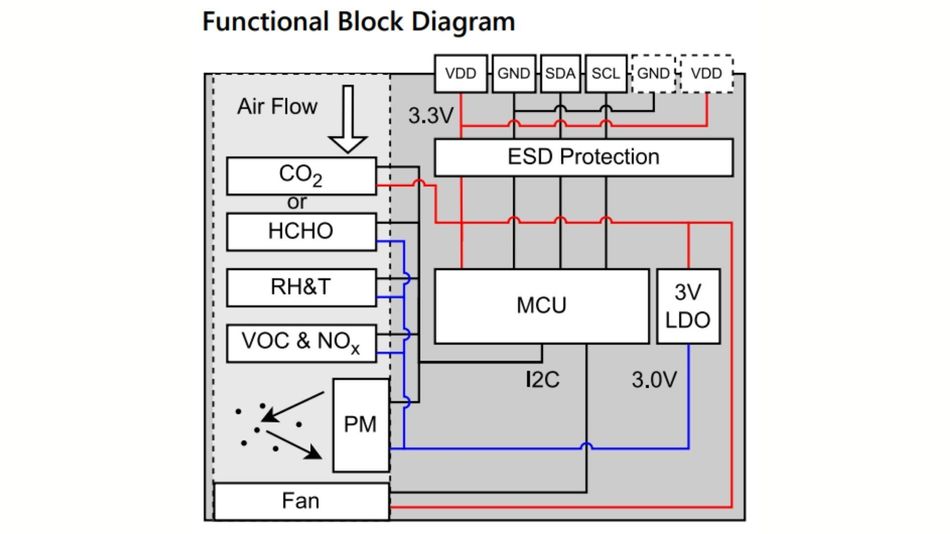
All the sensing elements are housed in a common module sharing a unified communication interface. The module also comes with an inbuilt signal processor. It is designed for continuous indoor operation and long-term stability.
Core Architecture and Working Principles
Each sensing domain within the SEN6x platform operates using an appropriate physical measurement principle integrated under a unified system design.
Optical PM Measurement
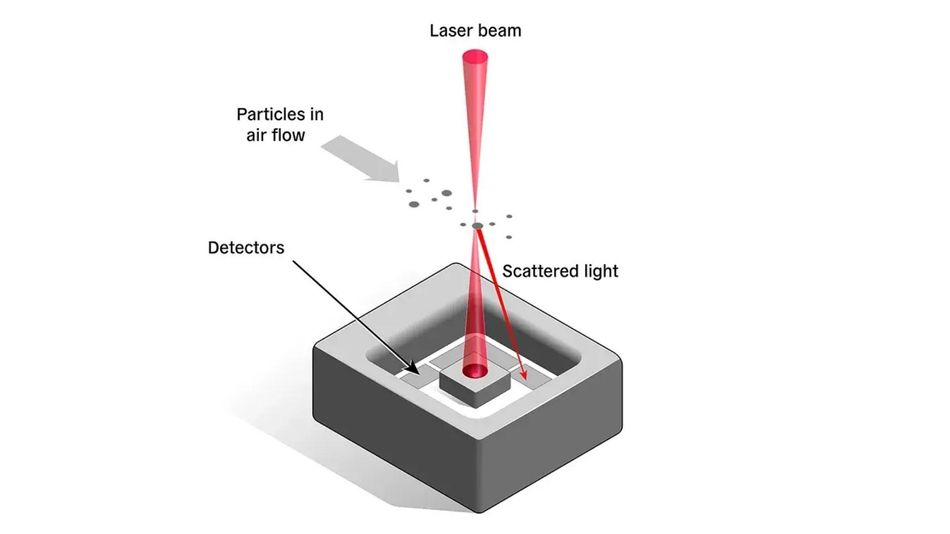
SEN6x measures the amount of PM in the air with laser light scattering technology. Airborne particles are drawn into an internal measurement chamber where they intersect a laser beam and scatter light. Photodetectors capture this scattered light and convert this information into particle size classification and mass concentration estimates across multiple size fractions. The optical chamber, light source, photodetector, and signal processing electronics are all integrated in the SEN6x module.
Gas Sensing for VOC and NOx
VOC and NOx monitoring is implemented in SEN6x with a metal-oxide-based gas-sensing element. The surface of the metal-oxide element is heated, which changes its electrical resistance based on exposure to gases. NOx are oxidizing in nature and increase the resistance of the element, whereas VOCs are reducing gases that consume oxygen and decrease the electrical resistance of the element. These resistance changes are processed with integrated algorithms and are used to calculate VOC and NOx index representing the concentrations.
Direct CO₂ Measurement
SEN6x variants such as SEN66 and SEN63C provide direct CO₂ measurement instead of inferred or eCO₂ values. This makes a difference in environments where VOC and CO₂ concentrations are not tightly correlated and presents a reliable insight for ventilation control, occupancy estimation, and compliance-driven applications.
RH/T with Compensation
RH/T sensing comes with onboard temperature acceleration and compensation algorithms that compensate for factors like self-heating and dynamic conditions, improving response time and measurement reliability.
Key Features and Specifications
Across the SEN6x family, the products are designed for continuous IAQ monitoring and come with:
Digital output via I²C interface
Integrated signal processing and compensation algorithms
Factory calibration
Compact mechanical footprint
Designed operation across typical indoor environmental ranges
Compact form factor of 55.2 x 25.6 x 21.3 mm, and a weight of ~20 g
Long operational lifetime of up to 10 years, suitable for continuous 24/7 use (formaldehyde lifetime limited to > 6 years)
Table 1: Overview of primary variants of the SEN6x family
Variant | PM (PM1–PM10) | RH/T | VOC Index | NOx Index | CO₂ | Formaldehyde |
SEN63C | ✔ | ✔ | – | – | ✔ | – |
SEN65 | ✔ | ✔ | ✔ | ✔ | – | – |
SEN66 | ✔ | ✔ | ✔ | ✔ | ✔ | – |
SEN68 | ✔ | ✔ | ✔ | ✔ | – | ✔ |
SEN69C (coming soon) | ✔ | ✔ | ✔ | ✔ | ✔ | ✔ |
Development and Production Advantages Over Discrete Sensors
Consolidating multiple sensing domains into a single compact module does more than simplify the architecture; it changes the development and manufacturing equation for engineering teams. The impact is visible across the workflows.
Development Phase Advantages
When engineers go with a discrete architecture, each sensor typically requires its own driver, initialization sequence, compensation routines, and signal conditioning. Managing communication timings, coordinating sampling intervals, and integrating separate algorithm packages for the sensors becomes a cumbersome process.
With SEN6x, all sensing domains are accessible through a single interface so that firmware development shifts from low-level sensor management to high-level system logic orchestration, reducing code complexity and memory overhead.
Validating a multi-parameter IAQ monitoring system would require testing it under various environmental conditions like changing temperature, humidity, occupancy, particulate load, and ventilation. With discrete systems, diagnosing performance deviations can be a complex task because errors may originate from placement, airflow imbalance, or various other factors. An integrated platform reduces these challenges with internal airflow management and synchronized sensing, significantly cutting down the testing and validation efforts.
With a large number of discrete components in the system, the number of failure points is high. It gets difficult to know when electrical noise, mechanical stress, airflow interference, or thermal gradients start impacting the data quality in such cases. Consolidating sensing in a pre-integrated module lowers overall risk.
Production and Supply Chain Benefits
Beyond engineering, using a conventional discrete sensing model directly influences manufacturing efficiency. Each sensor requires a different mounting, electrical connection, airflow consideration, and quality check. This may involve additional connectors, cables, airflow ducts, or board space allocation. Each additional component increases assembly time, handling steps, and points of failure. SEN6x reduces the number of components that must be placed, connected, and verified on the production line, translating into faster assembly.
In addition to bill-of-materials (BOM) reduction, this architecture simplifies procurement coordination and inventory handling. All SEN6x variants share the same footprint and interface, meaning enclosure designs and PCB layouts can be standardized. Manufacturers can easily differentiate entry-level and premium-tier products with module selection, and their product portfolios have room for future improvements.
Applications Enabled by SEN6x
As module architecture remains consistent across SEN6x variants, manufacturers can target different markets while maintaining a unified hardware foundation. Some of the most common areas of applications include:
Smart Home and Consumer Devices
IAQ awareness is getting increasingly integrated into smart home and consumer devices. Devices that operated independently, such as air purifiers and air conditioners, now incorporate environmental monitoring to improve automation and user feedback.
In air purifiers, VOC and NOx indices can be used to regulate fan speeds and filtration intensity dynamically. Direct CO₂ measurement enables ventilation awareness. RH/T data is crucial for comfort monitoring and compensation logic.
Office and Commercial Buildings
Commercial spaces require continuous monitoring across meeting rooms, open offices, and shared environments. As the number of occupants is always high, demand-controlled ventilation, HVAC optimization, and comfort monitoring are critical.

Education and Public Spaces
Schools and public facilities often present additional challenges due to the highly variable occupancy and diverse air quality sources. Data provided by SEN6x can be used to improve occupant comfort as well as correlated information to track vaping in schools.
Unlocking More Value with Sensor Fusion
Measuring multiple AQI parameters provides raw environmental data, which is often insufficient for taking higher-level decisions. For example:
Rising PM levels, for instance, could mean cooking, but without NOx data, it’s hard to tell whether the source is combustion-related or something else.
A high VOC index may suggest cleaning activity, but combining this with humidity trends can refine interpretation.
By adding PM measurements with CO₂ levels, it is possible to get a clearer differentiation between high occupancy, poor ventilation, or a pollution event.
As indoor air events are rarely about a single parameter, analyzing temporal patterns and multi-parameter correlation can add significant value to the system capabilities, enabling it to respond more precisely. Here are some examples of sensor fusion use cases:
Open-Window Detection and Energy Optimization: Changes in RH/T and CO₂ concentration can be collectively used to indicate when a window has been opened. Recognizing this event can allow Heating, Ventilation, and Air Conditioning (HVAC) or air purifier systems to adapt operation and save some energy.
Pollen Awareness and Ventilation Control: For occupants sensitive to airborne allergens like pollen, correlating PM size fractions with humidity and seasonal patterns can support awareness of outdoor particle infiltration.
Occupancy and Ventilation Optimization: Direct CO₂ measurement combined with PM and gas data allows systems to estimate ventilation adequacy more accurately. This can enable features like demand-controlled ventilation in commercial and public spaces.
Context-Aware Alerts: Most traditional systems push alerts when a single parameter crosses a threshold. Instead, sensor fusion enables smarter notifications. For instance, a combination of elevated NOx and PM may indicate combustion-related exposure, while elevated VOC without PM may be a sign of material off-gassing.

Standards and Compliance Readiness
IAQ monitoring is increasingly influenced by regulatory requirements. Commercial buildings and public facilities are under pressure to offer better environmental conditions, both for occupant well-being and for compliance and certification purposes. A general trend in this space is to move toward continuous monitoring rather than periodic testing.
RESET® is a standard that defines continuous monitoring requirements for parameters such as PM, CO₂, and total VOCs. The WELL Building Standard™ focuses on occupant health and comfort. California Title 24 mandates energy efficiency standards for new buildings, promoting high-performance designs. SEN6x variants are designed to align with the sensing requirement referenced by such standards, enabling OEMs to design compliance-ready devices and facilities.
Conclusion: From Sensing Components to IAQ Platforms
As expectations from indoor environments increase, engineers are gradually switching from measuring environmental parameters with discrete components to more integrated platforms like SEN6x to focus more on building application-level intelligence on top of consolidated environmental data.
Sensirion SEN6x modules and evaluation kits are available through Mouser Electronics. Visit Sensirion SEN6x Air Quality Sensors to explore specifications, availability, and development resources.