Inside EchoGlow: Building On-Device AI with the Arduino® UNO™ Q board at Hackaday Europe
Inside the hands-on EchoGlow workshop, where makers trained and deployed on-device AI on the new Arduino® UNO™ Q at Hackaday Europe, 2026

25 Jun, 2026. 6 minutes read
Introduction
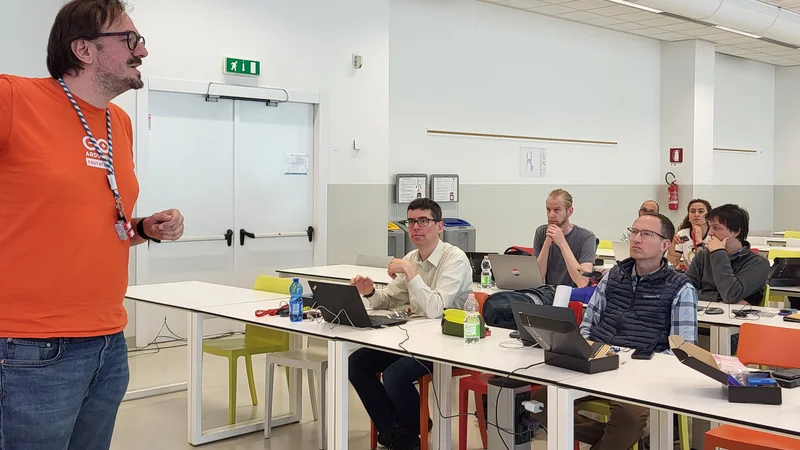
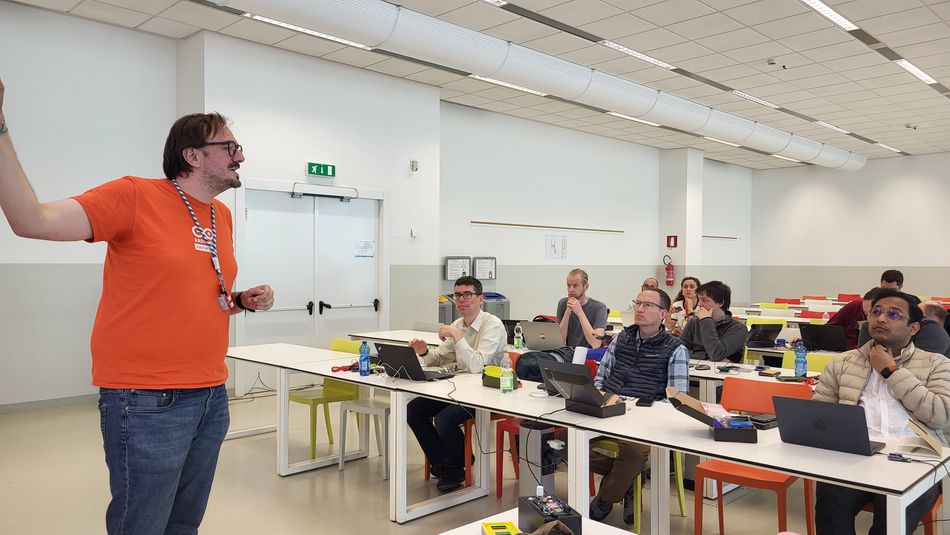
The 6th Hackaday Europe conference, held in Lecco, Italy, on May 16–17, 2026, included a workshop that sold out well before the event began. Over three hours, a room of developers, hardware engineers, and first-time makers trained and deployed a voice-controlled edge AI device from scratch — for many, their first time taking a machine learning model from data collection through to a working build.
The session was EchoGlow! It had run twice before, in Berlin and Belgrade, but this was its first edition in Italy. The focus was on UNO Q and the on-device AI it enables, placed directly in the hands of the developers and hardware engineers building the next generation of edge applications.
New SBC in Town: Meet UNO Q
UNO Q is a powerful new single-board computer (SBC) that brings advanced Linux capabilities into the beloved UNO form factor, without leaving the traditional Arduino microcontroller behind. The board runs on a dual-brain architecture: a Qualcomm Dragonwing™ QRB2210 microprocessor (MPU) running Debian Linux, paired with a real-time STMicroelectronics STM32U585 microcontroller (MCU). One brain handles high-level computing and AI inference; the other handles deterministic, real-time control of sensors and hardware. They reside on the same board and communicate via a Bridge library, so a single device can run a Linux application and a real-time sketch simultaneously.
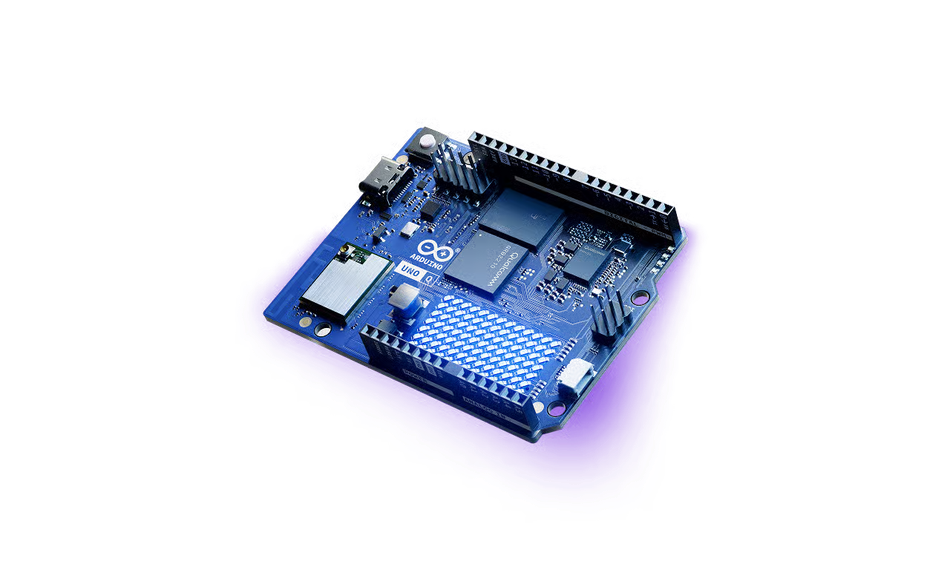
The specifics will be familiar to anyone who has reached for a single-board computer before. The MPU is a quad-core Arm Cortex-A53 with an integrated GPU, backed by up to 4 GB of LPDDR4X RAM and onboard eMMC storage. The MCU runs the Arduino core on a real-time operating system, handling GPIO, sensors, and timing-critical tasks with the dependability the UNO is known for. Dual-band Wi-Fi 5 and Bluetooth 5.1 handle wireless connectivity, a USB-C port covers power and video output, and standard Arduino compatible headers keep the existing ecosystem of shields and accessories in play.
The familiar footprint compatible with existing shields and carriers, paired with simplified workflows, lower the barrier for the existing Arduino community to step up into Linux-class compute and AI workloads. But the form factor is only half the story. The brand’s signature ease of use — extensive documentation, a deep library of online resources, and software tools such as Arduino® App Lab – is what lets everyone play an active role in the AI revolution rather than watching from the sidelines.
You can explore the full specs of the board at the UNO Q - Product Page.
Gen AI & Robotics Ready
UNO Q is built for a specific and increasingly important class of work: lightweight Edge AI machine learning models, robotics applications, and IoT solutions, alongside Small and Large Language Models (SLMs/LLMs) running locally on the device. It can even run agents created for embedded systems, such as OpenClaw, directly at the edge.
Precision matters here, because "edge AI" spans a wide performance range. UNO Q is the right tool for compact, responsive, on-device intelligence; not for the heaviest robotics or generative workloads, which is exactly where the more capable Arduino® VENTUNO™ Q comes in. In practical terms, UNO Q occupies a clear position: enough compute to run real machine learning locally, on a board small and inexpensive enough to deploy in the field.
The shift — intelligence moving off the cloud and onto the device itself — is the broader story the edge AI community has been chasing for years, and EchoGlow put it into a working build.
"Hackaday Europe is all about testing the limits, and what better way than training and deploying your own models to an edge device within hours? The future is now!" — Giovanni Salinas, Supplyframe DesignLab
Flexible, Gen AI–Friendly Software Ecosystem
The reason UNO Q feels so approachable comes back to that dual-brain architecture. With an MPU and an MCU on the same board, it is effectively a full Linux microcomputer and a classic Arduino microcontroller in one. This means, a single piece of hardware can run a Linux application, execute a real-time sketch, and serve an AI model at the same time.
The software ecosystem is built to match. Development spans a remarkably wide toolchain, from the modular "Bricks" of Arduino App Lab all the way to advanced tools like Claude. That range is what bridges hardware and software seamlessly, letting builders assemble smart applications out of components they can understand and recombine.
It is also what made a genuinely complex edge AI build approachable for a mixed-skill room. The Arduino App Lab IDE ships with ready-to-run examples for advanced AI applications that anyone can pick up, run, and modify as needed. A beginner can start from a working template; an experienced developer can rebuild it from scratch.
What Attendees Actually Built — The EchoGlow Project
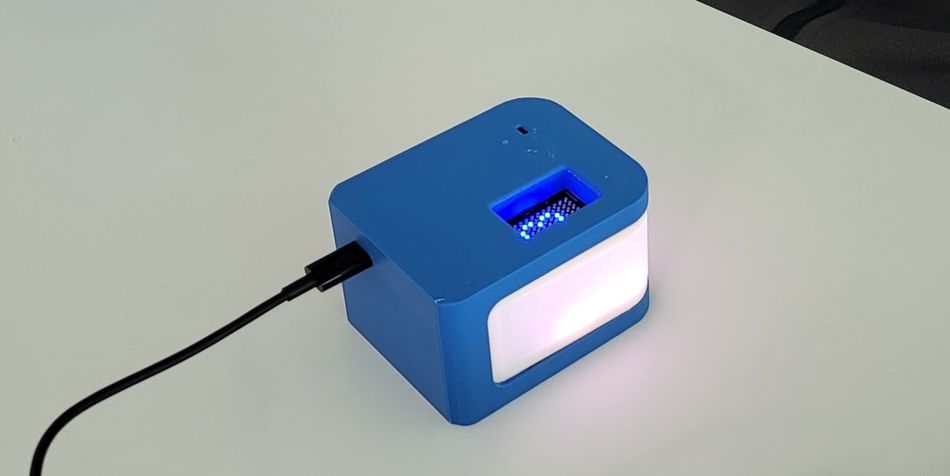
EchoGlow was structured as a complete build rather than a demonstration. Over three hours, each participant moved through the full edge AI workflow end-to-end. First, they collected their own training data in Edge Impulse, teaching a model to recognize voice commands. Next, they assembled an LED matrix display and enclosure to pair with UNO Q. Finally, they deployed everything as a working, voice-responsive smart lighting system.
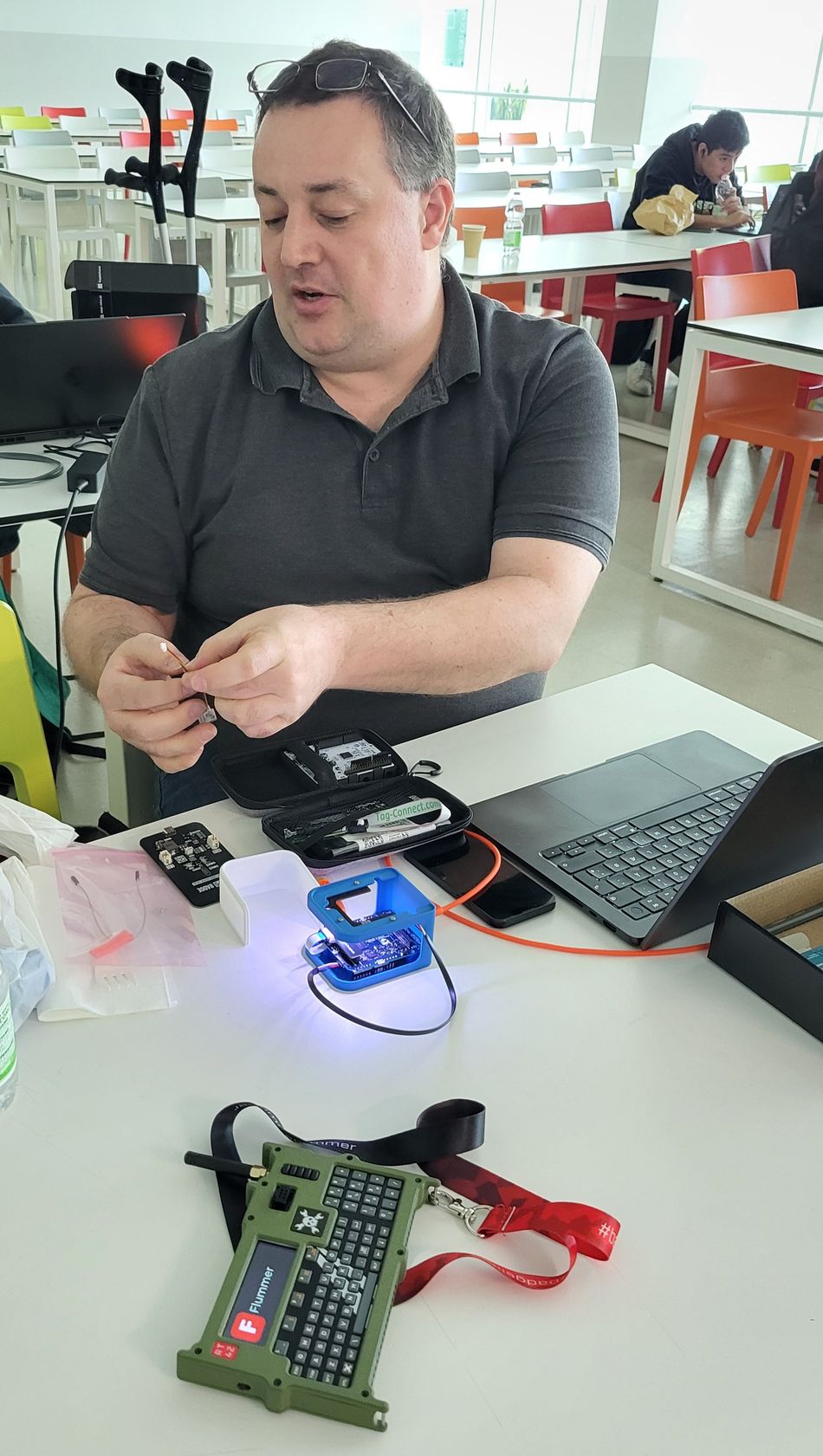
The outcome is a functioning edge AI device, trained and shipped on real hardware in a single afternoon. The entire application is customizable, so the attendees walked away with something they could keep modifying, extending, and rebuilding into their own projects.
"It feels magical how Makers can now use an Arduino to create its own voice recognition device in minutes. I never get tired of their joy with their first EchoGlow response!" — Julián Caro Linares, Arduino
Cross-Industry Collaboration
EchoGlow came together through a deliberate collaboration across the edge AI stack. Qualcomm Technologies, Inc. and Arduino brought the silicon and the platform; Edge Impulse provided the model-training pipeline; and Supplyframe DesignLab supplied the workshop framework and facilitation, turning it all into a hands-on experience.
On the ground, Arduino engineers Leonardo Cavagnis (Senior Engineer, Qualcomm Europe), Julián Caro Linares (Senior Engineer, Qualcomm Europe) and Christian Sarnataro (Staff Engineer, Qualcomm Europe) supported Giovanni Salinas from Supplyframe DesignLab — the creator behind EchoGlow — in guiding participants through every step. The sold-out room is itself a signal: demand for real, hands-on edge AI experiences is outpacing the supply of places to get them.
Voices From the Workshop
For the facilitators, the most remarkable aspect of the event was the community that formed, rather than just the hardware itself.
"I was genuinely inspired by the incredible mix of technical backgrounds and the energy people brought to the workshop. Seeing makers, developers, and creatives all exploring edge AI together made the experience truly special." — Leonardo Cavagnis, Arduino
Attendees came away with the same impression — and, notably, with the confidence to keep going on their own:
"I was very curious about the new UNO Q, and this workshop left me both inspired and ready to start creating other AI projects. The facilitators did a great job walking us through the capabilities and example projects, and were excellent in guiding us through all the steps. Fantastic workshop, would highly recommend to anyone interested in creating their own data-driven AI models." — Rehana Al-Soltane, Raspberry Pi Foundation
What’s Next?
EchoGlow was a snapshot of a larger shift: edge AI is becoming something you can train, deploy, and ship in an afternoon, and UNO Q is built to put that capability in as many hands as possible.
The momentum continues into the summer maker calendar. Open Sauce returns to San Mateo, California, on July 17–19, 2026, and it is exactly the kind of gathering where this hands-on, build-it-yourself edge AI energy thrives.
If EchoGlow proved anything, it is that the gap between "curious about edge AI" and "shipped a working device" is now measured in hours. The fastest way to close it is to start building. Explore the board and get started at the UNO Q store page.
Qualcomm branded products are products of Qualcomm Technologies, Inc. and/or its subsidiaries. Arduino, UNO and VENTUNO and the Arduino logo are trademarks or registered trademarks of Arduino S.r.l.