How MFF4 eSIM Enables Miniaturised Device Design
for the always-connected world

25 Mar, 2026. 8 minutes read

Embedded SIM or eSIMs are essential to unlocking next-generation device design and scalability. At the heart of eSIM functionality is the eUICC, the Embedded Universal Integrated Circuit Card that sits inside the device, stores operator profiles, handles authentication and enables updates via Remote SIM Provisioning RSP, removing the need for physical SIM swaps and cumbersome practices that stifled prior Over-the-air update mechanisms.
The topic of always-connected isn't just about mobiles anymore. Connectivity is now a core requirement across wearables, asset tracking, EVs, e-bikes, industrial equipment, and a growing range of IoT devices. The global connected device volume is expected to hit 23.9 billion devices in 2026 [1]. This shift has been enabled by miniaturization, which reduces the physical size of components while increasing efficiency.
Today's products are expected to always be connected, work seamlessly across the globe, and meet strict security requirements. To make this happen, miniaturiization is no longer optional. It is a crucial requirement to build the next generation of connected products.
Why designers feel the squeeze
As user expectations continue to rise, product designers are under constant pressure to deliver more features, such as always-on connectivity and AI, while keeping devices compact. On a PCB, every millimeter matters [2]. Designers need space for processors, memory, sensors, and antennas. Even with careful layout optimization, traditional connectivity hardware can feel dated in the current scheme of things.
Removable SIM cards require trays and mechanical tolerances that use up valuable PCB area. To address this issue, many product teams are moving toward embedded SIM solutions to optimize space and efficiency. According to GSMA specifications, an embedded form factor can save up to 90% of the space compared to traditional SIM housing [3].
Embedded form factors help towards this - however, once you solder an eUICC on your device PCB, management and customization to destinations can be hard to manage as a different soldered component is needed for each geography or market. This can be a hindrance to managing product variants or SKU (Stock Keeping Units), and harmonizing reliability testing during manufacturing. This implementation challenge provided impetus to the need for eSIMs in IoT - something we’ve discussed earlier.
SIM form factors: what product teams need to know
Not all SIM cards are made the same way, though. To understand why eSIMs stand out, it helps to understand how SIM form factors (FF) have evolved over the years.
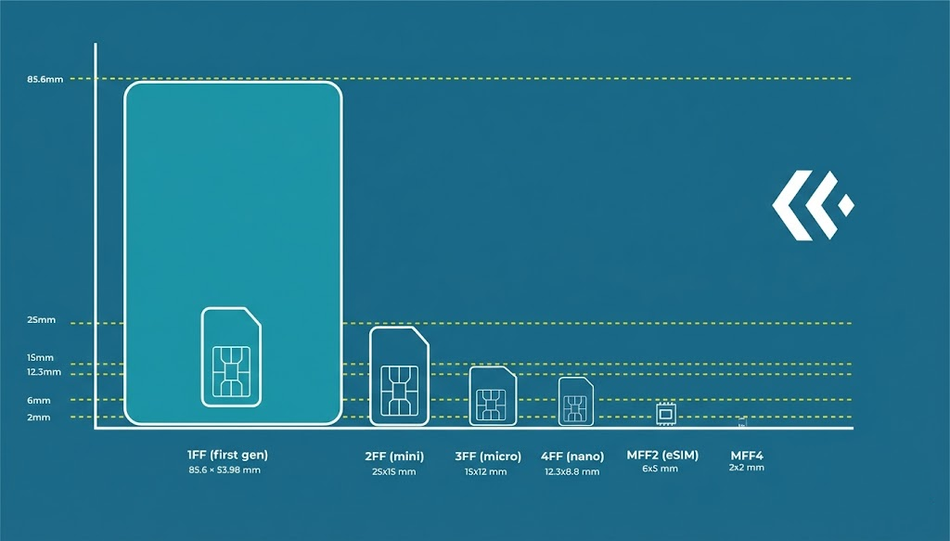
1FF (Full SIM)
These were the first commercially used SIM cards. Introduced in 1991, 1FF cards were roughly the size of a credit card and were primarily used in early car phones. At the time, device size was not a major constraint, so the large format was acceptable.
2FF (Mini SIM)
This became the standard SIM for early GSM mobile phones. Measuring 25 × 15 mm, it significantly reduced size compared to 1FF while remaining removable. For many years, 2FF was the dominant format in feature phones.
3FF (Micro SIM)
As smartphones became slimmer, Micro SIMs reduced the plastic around the chip while keeping the same electrical interface. Popularized in the early 2010s, this format helped free up internal space for other components such as the memory card slot.
4FF (Nano SIM)
The smallest removable SIM format in widespread use today. Nano SIMs strip away the excess plastic, leaving just the chip with a minimal bezel. While they save space compared to earlier formats, 4FF cards still require a tray and connector.
MFF2
MFF2 was the first widely adopted soldered SIM form factor in IoT and is often what people mean when they refer to eSIM hardware. Defined by ETSI, MFF2 measures 5 × 6 × 0.75 mm and uses an 8-pin layout designed to operate across industrial temperature ranges.
By soldering the SIM directly onto the PCB, MFF2 removes the need for SIM trays and connectors. This improves mechanical robustness, reduces failure points, and frees up valuable board space. These advantages have made MFF2 a popular choice for industrial, automotive, and long lifecycle IoT products where reliability and longevity are crucial.
MFF4
MFF4 pushes miniaturization even further with its compact design. With a footprint of just 2 × 2 mm, MFF4 significantly reduces the space requirement for cellular connectivity.
Despite its small size, MFF4 is a compact 8-pin soldered package that complies with JEDEC MO-229F specifications [4]. It supports UICC signals including VCC, RST, CLK, IO, and interfaces such as I3C or SPI.
How does MFF4 form factor work with eSIM architecture?
By dramatically shrinking the SIM footprint, designers get more freedom at the system level. From a manufacturing perspective, soldered eSIMs lead to more streamlined assembly processes compared to removable SIMs. There are fewer mechanical failure points, making it easier to build rugged products ideal for industrial settings.
These form factors often matter in product design as physically containing the capability of an energy efficient, fully functional and remotely provisionable eSIM into the ever compact devices such as wearables, asset trackers, meters, etc, has been nigh impossible in prior years. Often, the limiting factor is the memory size that allows for adequate number of connectivity profiles as well as the critical software stack that can enable security - the primary function of the SIM or eSIM and all the business logic for eSIM functional management.
From the view of how these can be remotely provisioned, the eSIM RSP standards are largely form-factor agnostic. The same operating system and subscription management logic can run across MFF2, and MFF4-based eSIM, or iSIM implementations. But this will depend on the provisions available to you to fit the secure OS, associated applets for business logic and profile management and the needed profiles all within the memory size. The secret to achieving this is an OS tuned to the needs of energy-efficient devices, such as those IoT demands. And an added advantage with choosing the right eSIM OS is that the one time investment of the decision and implementation expertise spans across all form factors easily, keeping the toolchain consistent and simplifying scalability across product portfolios.
Putting this into practice for eSIM Operations: Why SGP.32 Matters
The requirement of being able to have multiple profiles either pre-provisioned or switchover can result from a variety of use-case requirements. But, this is where a new standard addresses how to manage complexity not only within one device but to take it to fleet level in various scenarios.
Managing connectivity across a fleet of thousands devices can be an operational challenge - something that now is increasingly in the realms of product design from the word go. Different regions, multiple network operators, and various data plans add to the complexity. This is where eSIM lifecycle management standard SGP.32 streamlines the process to manage devices such as robots, smart meters, and connected vehicles. It is compatible with LPWAN (Low Power Wide Area Networks), which may use HTTPS/CoAP or other data protocols and not able to support SMS for provisioning as was the case in smartphone use (as consumers) [5].
Additionally, SGP.32 offers secure remote profile downloads and subscription switching without in-person access to devices. It also allows fallback or bespoke profiles to be deployed remotely in case of network issues or when business conditions demand.
Key Advantages of eSIM’s multi-faceted evolution
Moving to eSIMs deliver several benefits. For starters, soldered and embedded form factors, especially as compact as MFF4, free up valuable PCB area for additional electronics, sensors, batteries, radios, or for other innovations. The soldered approach also reduces connector points prone to mechanical failure. eSIM designs are also less susceptible to wear and tear.
Security, the primary function of SIM technology is also stronger. In the physical sense, eSIMs are harder to tamper, which is critical for industrial, automotive, and medical devices. Functionally, eSIM is the implementation of a SE (Secure Element) layer for cryptographic operations and to enforce robust authentication protocols - with the new remote management capabilities introduced in SGP.32 with the eIM, this becomes the digital anchor for trust and end-to-end security.
From a business perspective for manufacturers, eSIM enables SKU consolidation. A single hardware variant can be deployed globally, with connectivity profiles provisioned over the air. This streamlines supply chains and enables faster market entry.
Operationally, eSIMs adherent to SGP.32 and functionally certified with the GSMA eSA scheme, allow for the secure transfer of profiles through data structure that is standardised for simpler fleet level remote access. When such eSA scheme certified eSIMs are used, this allows efficient integration for the best utility for the eSIM - either through a device-side agent called the IoT Profile Assistant - native to the eUICC, or one that is resident in the device.
Device-Side Integration: Choosing The Right eSIM Enablement Suite
Device-side software integration plays a critical role in time-to-market and long-term success. Two popular integration approaches are IPAe and IPAd.
IPAe
IPAe (IoT Profile Assistant embedded) focuses on faster utilization of eSIM capabilities and simplifies GCF certification when a product uses an eSA certified eSIM. In this approach, the profile assistant resides within the eSIM chip rather than in the device's main operating system. This approach is effective for devices that need to end-to-end security or demand long battery life, or are low-power devices.
IPAd
On the other hand, IPAd (IoT Profile Assistant on the Device) hosts IPA software on the device's operating system. It offers more customization and control potentially desirable in complex use cases. However, it requires a device with sufficient processing power beyond the scope of many IoT devices. Additionally, it takes longer for development and certification work.
Moving on to SDKs and software utilities, product teams should look for ones that translate across most devices for maximum compatibility to development toolchains. While the choice of IPAd SDKs is increasing, it is useful to understand if it is suited for IoT implementation, or a derivative of LPA used in smartphones. Further, pay good attention to the API structures, opting for SDKs that allow the scalable, open API3.0 or similar such that upstream integration and handovers are simpler through manufacturing, volume production and ultimately device lifecycle. Choosing the right enablement suite is not just about getting connected. It paves the way for certification, operational efficiency, and scaling.
Case study: A global smartwatch brand switches to modern eSIM for scale and innovation
A global smartwatch heavyweight moved to bring in LTE-connectivity to its premier products and expand into further global markets. With scale came growing complexity around region-specific hardware variants. Traditional SIM-based designs would not ever meet the compact hardware specs, plus, MFF2 soldered form factors required different SKUs for different markets, which slowed regional launches. If based on prior standards, pre-determining every aspect of one-to-one relationship per market would be a severe shackle to meet the market timeline for this innovator.
Transitioning to MFF4-based eSIMs with SGP.32 features, the same hardware platform could be shipped worldwide to meet local market requirements, with the right customisation - i.e. with the right connectivity profile securely embedded per market during manufacturing.
The brand launched with multiple networks, including non-terrestrial network (NTN) connectivity as a premium feature. It could appeal to trekkers or those who need a fallback in case of network outages or switchover for the profile that was suitable for streaming usecases vs pure messaging. By relying on eSIM standards such as SGP.32, these features can be introduced with minimal changes to the core hardware - and with the confidence that end-to-end security enables new use-cases that were never imagined possible on a smartwatch.
Their success with premium product lines integrating eSIMs in volume production with over 500,000 per year should bear evidence that eSIM-first and eSIM-only device experiences are not restricted to premium smartphone brands alone, but within reach of wider IoT experiences. Furthermore, moving away from pre-determined agreements that rely on bootstrap profiles changing over to operational profiles when in field, the use of advanced SGP.32 features (typically deemed/found as ‘optional requirements’) and In-Factory Profile Provisioning from Kigen, allowed them to provision devices within minutes - shaving off multiple months of development delay.
Partner Selection: What to Look For
Choosing the right technology partner for eSIM integration is as critical as choosing the hardware itself. When evaluating vendors, look beyond the mandatory ‘Profile State Management Operations’ on the standards spec sheet. Prioritize vendor solutions that support quality in pragmatic scenarios, interoperability - both technically, and commercially, and troubleshooting capabilities. Look for evidence of successful deployments in similar verticals to see how they address real-world challenges.
Effective partners can also prompt teams to address key connectivity questions early, including how devices will connect after production, how provisioning can be validated in real factory conditions, how to maintain a global SKU with local compliance, and how to scale securely across diverse networks
Conclusion
The future of hardware is compact and always connected. The MFF4 form factor is a key driver of this shift. It frees designers from focusing on connectivity logistics and allows them to focus more on building innovative products.
If you want to explore how MFF4 and SGP.32-ready IoT eSIMs can support your business, get in touch with Kigen. It was the first company to introduce compact MFF4 eUICC solutions.
Resources:
1. https://iot-analytics.com/number-connected-iot-devices/
2. https://www.proto-electronics.com/blog/techniques-for-pcb-design-under-space-constraints
3. https://www.scribd.com/document/395847381/e-SIM-Report
4. https://kigen.com/resources/blog/the-future-of-esim-hardware/
5. https://kigen.com/resources/blog/sgp-32-iot-esim-certification-and-oem-success/