New Dual-Channel Standard Digital Isolators for Industrial Equipment
Toshiba's four DCL32xx00 isolators trade speed and transient immunity for lower supply current.

02 Oct, 2026. 4 minutes read
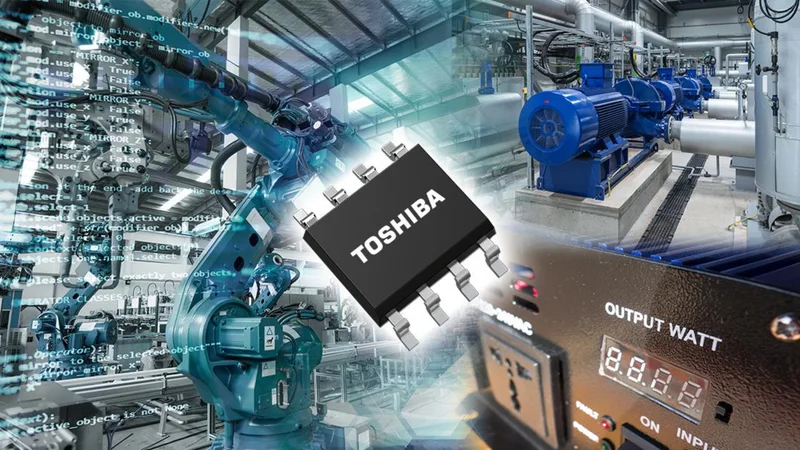
Toshiba Dual-Channel Standard Digital Isolator
What is the announcement
Toshiba Electronic Devices & Storage Corporation announced the DCL32xx00 series on 1 October 2026: four dual-channel digital isolators for industrial equipment. Toshiba says the DCL32xx00 draws 0.2 mA per channel (typical) at 1 Mbps and carries data at up to 25 Mbps.[1]
The DCL320C00 and DCL320D00 have two channels in the same direction. The DCL321C00 and DCL321D00 have one channel each way, the arrangement a UART link needs. The C00 and D00 suffixes set the default output state, low or high. All four use magnetic coupling, are rated for 3,000 Vrms isolation, run from 2.25 V to 5.5 V between -40 °C and 125 °C, and come in an 8-pin narrow SOIC package.[1]
Why does it matter
The DCL32xx00 is the two-channel version of the quad-channel DCL34xx0B series that Toshiba introduced in mid-2026, with the same per-channel current, data rate and timing.[2][3][4] Toshiba described the technique in the DCL341x0B, the first DCL34xx0B parts, as a proprietary edge transmission method.[4] Edge-based schemes signal across the isolation barrier when the input changes state, so supply current falls with the data rate.[5][6] Toshiba's 150 Mbps DCL54x01 isolators use on-off keying, where a carrier crosses the barrier for as long as the input holds one logic state, an approach that draws more supply current at low data rates.[5][7]
At 1 Mbps and 3.3 V, the DCL320C00 draws 0.16 mA and 0.26 mA on its two supplies. The DCL520C00, Toshiba's 150 Mbps dual-channel isolator in the same package and pinout, draws 5.7 mA and 2.7 mA, about 20 times more per channel (calculated from the datasheet figures). At 25 Mbps the DCL320C00 draws 3.1 mA per channel against about 5 mA for the DCL520C00. The DCL32xx00 gives up speed and transient immunity in exchange: its guaranteed common-mode transient immunity (CMTI) is 30 kV/µs against 100 kV/µs for the DCL52xx00 series, and its maximum propagation delay at 3.3 V is 52 ns against 19.1 ns.[2][8]
Texas Instruments' ISO7021, a two-channel isolator with one channel each way, draws 120 µA per channel at 1 Mbps and 3.3 V with no load, where the DCL32xx00 draws about 180 µA. At rest the ISO7021 needs 4.8 µA per channel against roughly 130 µA for the DCL32xx00, but the ISO7021 tops out at 4 Mbps.[2][6] In the same 25 Mbps class, Analog Devices' MAX12930, a two-channel 3,000 Vrms isolator in a narrow SOIC, draws 0.39 mA per channel at 2 Mbps and 0.91 mA at 25 Mbps (3.3 V, no load, calculated from the datasheet figures). The DCL320C00's 3.1 mA at 25 Mbps includes a 15 pF load on each output.[2][9]
Technical specifications, Toshiba DCL32xx00 series (DCL320C00, DCL320D00, DCL321C00, DCL321D00)
| Specification | Value |
|---|---|
| Channels (forward:reverse) | DCL320C00, DCL320D00: 2:0. DCL321C00, DCL321D00: 1:1 |
| Default output | C00 parts: low. D00 parts: high |
| Maximum data rate | 25 Mbps (2.25 V to 5.5 V, -40 °C to 125 °C) |
| Supply current at 1 Mbps, 3.3 V (typ., 15 pF load, 25 °C) | DCL320x00: 160 µA (IDD1), 260 µA (IDD2). DCL321x00: 215 µA per side |
| Supply current at 1 Mbps, 5 V (typ., 15 pF load) | DCL320x00: 225 µA (IDD1), 375 µA (IDD2). DCL321x00: 305 µA per side |
| Supply current at 25 Mbps, 3.3 V (typ., 15 pF load) | DCL320x00: 3.4 mA (IDD1), 2.8 mA (IDD2). DCL321x00: 3.2 mA per side |
| Quiescent supply current, 3.3 V (typ.) | DCL320x00: 110 µA (IDD1), 155 µA (IDD2). DCL321x00: 135 µA per side |
| Propagation delay | 3.3 V: 38 ns typ., 52 ns max. 5 V: 33 ns typ., 46 ns max. 2.5 V: 46 ns typ., 63 ns max. |
| Pulse width distortion (max.) | 8 ns up to 10 Mbps, 13 ns up to 25 Mbps |
| CMTI | 30 kV/µs min. (VCM = 400 V, 25 °C) |
| Isolation voltage | 3,000 Vrms for 60 s (UL 1577) |
| Maximum repetitive peak isolation voltage (VIORM) | 566 Vpk |
| Maximum surge isolation voltage (VIOSM) | 5,200 Vpk |
| External creepage and clearance | 3.8 mm |
| Supply voltage | 2.25 V to 5.5 V |
| Operating temperature | -40 °C to 125 °C |
| Package | SOIC8-N, 4.9 × 6.0 mm, 1.75 mm maximum height |
| Safety approvals | UL 1577 and cUL approved. VDE 0884-17 and CQC listed as planned |
| Price | not stated |
Sources: [1][2]
The 0.2 mA figure is a typical value at 3.3 V and 25 °C with a 15 pF load, averaged across both supplies. At 5 V the same sum gives 0.3 mA per channel, and the 3.3 V datasheet maximums give 0.42 mA.[2] Each channel carries signals one way only. Toshiba's release names I2C as a use for the DCL320C00 and DCL320D00, but I2C needs a bidirectional channel, and standard unidirectional isolators provide one only with external components.[1][10] The DCL52xx00 datasheet describes reinforced insulation with a 10,000 Vpk surge rating. The DCL32xx00 is rated at 5,200 Vpk, so the two families share a pinout but differ on insulation.[2][8]
Recommended Reading: Gate Driver Design for Modern Power Electronics. Compares optocoupler, capacitive and magnetic isolation and explains why CMTI matters next to fast-switching power stages.
References
- Toshiba Launches Dual-Channel Standard Digital Isolators that Contribute to Lower Power Consumption in Industrial Equipment, Toshiba Electronic Devices & Storage Corporation, 1 October 2026. Press release.
- DCL320C00, DCL320D00, DCL321C00, DCL321D00 data sheet, Rev. 1.8, Toshiba Electronic Devices & Storage Corporation, 8 September 2026.
- DCL34xx0B low power quad channel digital isolators data sheet, Rev. 1.6, Toshiba Electronic Devices & Storage Corporation, 8 September 2026.
- Toshiba augments standard digital isolator portfolio with two quad-channel, low power devices, Toshiba Electronics Europe, 16 June 2026. Press release.
- The Use of Robust Digital Isolators in the Harsh Environments of Electric Motor Drives, Analog Devices, 1 August 2016. Vendor technical article comparing isolator architectures, not tied to this product.
- ISO7021 Ultra-Low Power Two-Channel Digital Isolator data sheet, SLLSFA0C, Texas Instruments, July 2019, revised May 2024.
- Basics of the Standard Digital Isolators, Rev. 1.2, Toshiba Electronic Devices & Storage Corporation, 10 April 2023. Application note covering the DCL54x01 series.
- DCL520C00, DCL520D00, DCL521C00, DCL521D00 data sheet, Rev. 1.4, Toshiba Electronic Devices & Storage Corporation, 8 September 2026.
- MAX12930/MAX12931 Two-Channel, Low-Power, 3kVRMS and 5kVRMS Digital Isolators data sheet, 19-8563 Rev. 10, Analog Devices, August 2021.
- Top 6 Design Questions about I2C Isolators, SSZT517, Texas Instruments, March 2019. Vendor technical article.