Designing AGVs for 24/7 Logistics Operations
Why Reliable Motion Systems Matter in Modern Warehouse Automation

24 Sep, 2026. 10 minutes read
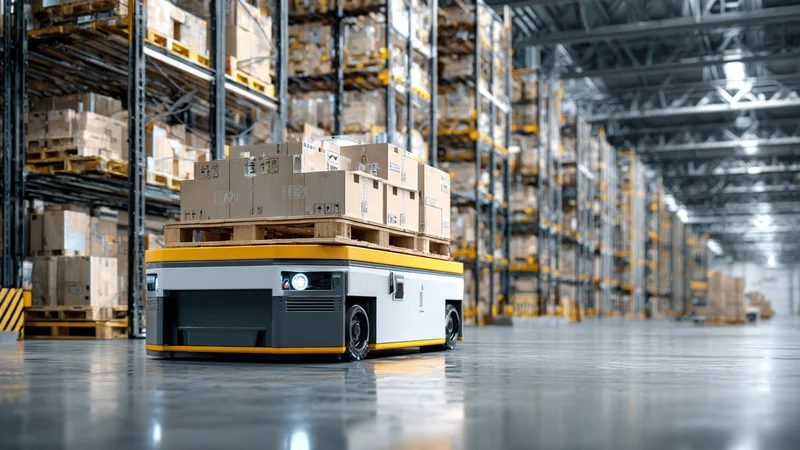
Warehouse automation has evolved rapidly over the past decade. What began as a series of pilot projects and isolated deployments has become a critical component of modern logistics infrastructure. Driven by the growth of e-commerce, rising customer expectations, labor shortages, and increasing pressure on fulfillment operations, warehouses are adopting autonomous technologies at an unprecedented pace. Autonomous Guided Vehicles (AGVs) and Autonomous Mobile Robots (AMRs) are increasingly responsible for moving inventory, transporting materials, supporting picking operations, and maintaining throughput across modern fulfillment facilities [1].
As adoption increases, the engineering challenges facing warehouse robotics are changing. In the early stages of deployment, the primary goal was often to demonstrate autonomous navigation or prove that a robotic system could perform a specific task. Today, the focus has shifted toward operational performance. Warehouse operators are no longer evaluating whether robots can work; they are evaluating whether robots can work continuously, reliably, and efficiently under demanding real-world conditions [2].
This shift has significant implications for robotics design. A vehicle that performs well during a controlled demonstration may encounter very different challenges when operating continuously across multiple shifts, navigating crowded facilities, or transporting heavy payloads over extended periods. As a result, motion-system design has become an increasingly important consideration in the development of warehouse robotics.
Drive architectures influence far more than movement alone. They affect energy consumption, thermal performance, reliability, safety, maintenance requirements, and overall system scalability. For engineering teams designing AGVs and AMRs, understanding how motion-system decisions impact long-term operational performance is becoming essential to successful deployment [2].
Operational Challenges in 24/7 Warehouse Robotics
Continuous Duty Cycles and Uptime Requirements
Modern warehouses rarely operate on predictable schedules. Many fulfillment centers run continuously, processing thousands of orders per day while attempting to maximize throughput and minimize downtime. In these environments, AGVs and AMRs are expected to function as operational assets rather than experimental technologies [1].
Continuous operation places unique demands on robotic systems. Unlike robots operating in controlled work cells, warehouse robots frequently travel long distances, perform repeated acceleration and deceleration cycles, and operate for extended periods with limited opportunities for maintenance. As robotic fleets grow, uptime becomes increasingly important. A single vehicle failure may only have a minor impact on operations, but repeated failures across a fleet can quickly affect productivity, maintenance costs, and overall system performance. The drive system plays a central role in meeting these demands because they are directly involved in nearly every movement the robot performs [2].
Environmental and Mechanical Stress Factors
Warehouse environments present a range of operational challenges that are often underestimated during development.
Although warehouses may appear relatively controlled compared to outdoor environments, robotic systems are routinely exposed to vibration, mechanical shock, dust, debris, temperature fluctuations, and uneven operating conditions. Repeated exposure to these factors can accelerate wear and place additional stress on motors, gearheads, bearings, and other motion-related components [2].
Thermal management is another important consideration. Continuous operation generates heat throughout the drive system, particularly in applications involving frequent starts, stops, and changes in direction. If thermal performance is not properly addressed during the design phase, elevated temperatures can reduce efficiency, affect component lifespan, and ultimately limit system performance [2].
Warehouse operators are simultaneously seeking higher throughput and more efficient use of available floor space. These requirements create a complex engineering challenge: robots must deliver consistent performance while operating within increasingly constrained environments and under demanding duty cycles.
Human-Robot Interaction and Safety
Another defining characteristic of modern warehouse automation is the increasing interaction between robots and people.
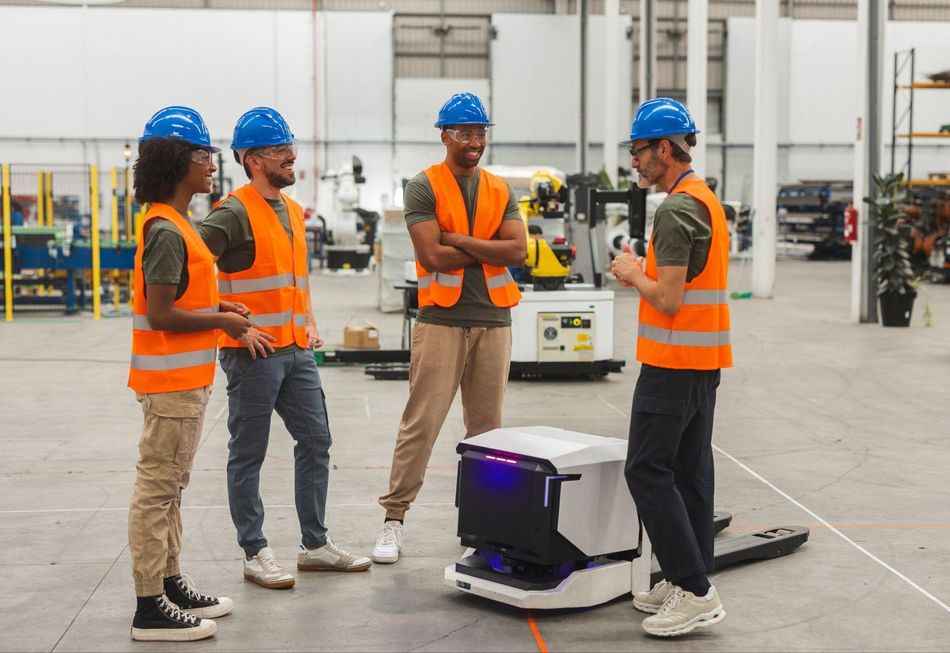
While some automated systems operate within dedicated zones, many AGVs and AMRs now share working environments with warehouse personnel. This trend creates new requirements for motion control, positioning accuracy, and system predictability [1].
Safe operation depends on more than obstacle detection or navigation software. The motion system itself contributes significantly to overall safety performance. Acceleration profiles, braking behavior, positioning precision, and response times all influence how safely a robot interacts with its environment [2].
Predictable movement is particularly important in facilities where workers and robots operate in proximity. Abrupt motion, inconsistent stopping behavior, or reduced positioning accuracy can create operational inefficiencies and increase safety risks. As robotic deployments become more sophisticated, engineering teams are increasingly considering safety as an integrated design challenge rather than a standalone feature. Motion systems must support both operational performance and safe interaction with people, making reliability and controllability essential considerations throughout the development process [2].
Why Compact Drive Systems Matter in Modern AGVs
The challenges associated with continuous operation, environmental exposure, and human interaction have led to a growing focus on drive-system design. As warehouse robots become more capable and more widely deployed, engineers are seeking ways to improve performance without increasing system size, complexity, or energy consumption.
These requirements have elevated the importance of compact, integrated motion solutions.
Increasing Demand for Compact, High-Performance Robotics
Warehouse operators continue to push for greater operational efficiency. Robots are expected to navigate narrower aisles, operate within increasingly dense storage environments, and transport heavier payloads while maintaining high levels of agility and responsiveness [1].
These requirements place significant pressure on motion-system designers. Rather than increasing system size to achieve higher performance, engineering teams are focusing on maximizing power density to deliver greater torque and efficiency within limited installation space [3].
Compact drive architectures can also provide greater flexibility when integrating batteries, sensors, communication systems, and navigation technologies. This enables designers to optimize overall robot architecture while preserving the maneuverability needed for warehouse operations.
Compact Motion Technologies for AGVs and AMRs
Advances in motion technology are helping support these requirements.
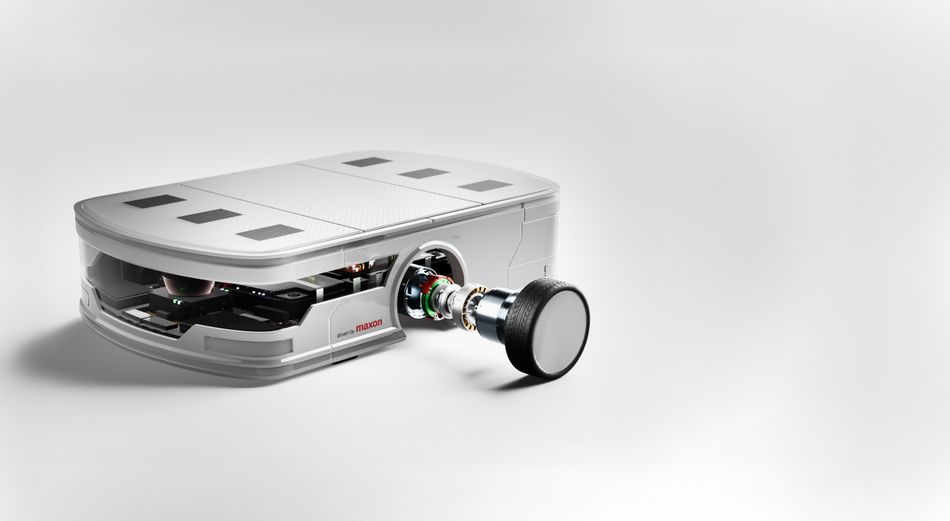
Modern AGVs and AMRs increasingly utilize integrated wheel-drive systems, compact motors, advanced gearhead technologies, and distributed control architectures designed to maximize performance within limited installation envelopes [1][3].
Integrated approaches offer several advantages. By combining motion components into more compact assemblies, engineers can reduce mechanical complexity while simplifying system integration. This can help shorten development cycles and reduce the number of interfaces that must be managed throughout the design process [3].
Communication and control technologies are also becoming more tightly integrated within motion architectures. Rather than treating motors, controllers, and feedback devices as separate subsystems, many robotics developers now view them as interconnected elements of a broader motion platform [2].
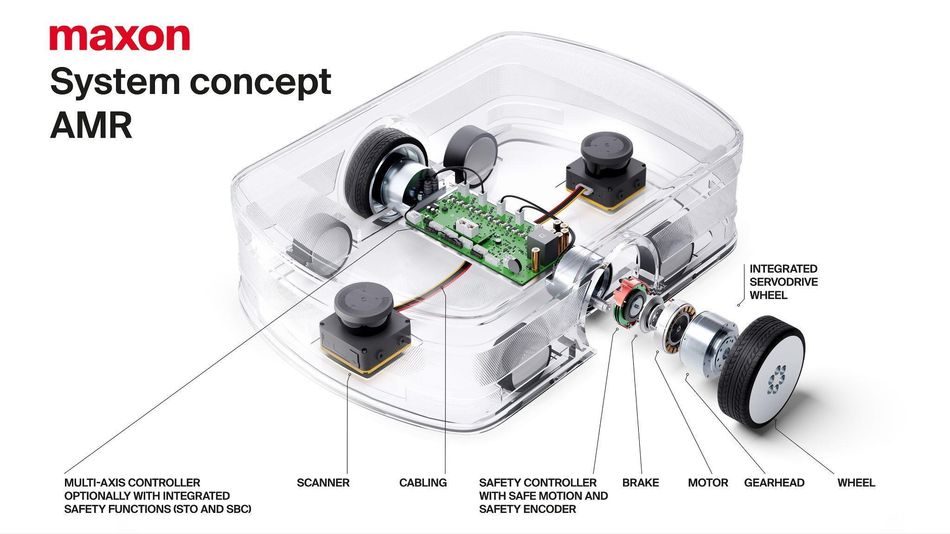 Maxon System concept AMR. Source: maxon
Benefits of Compact Integrated Motion Systems
The benefits of compact motion systems extend beyond space savings alone.
Smaller, more integrated architectures can improve maneuverability by reducing packaging constraints and enabling more flexible vehicle designs. They can also simplify assembly and maintenance by reducing the number of discrete components required within the robot [3].
Energy efficiency is another important consideration. Because many warehouse robots operate on battery power, improvements in drive-system efficiency can directly influence operational runtime and fleet productivity. More efficient motion systems help reduce energy consumption while supporting longer operating periods between charging cycles [3].
Perhaps most importantly, integrated architectures help establish a foundation for scalability. As robotics programs move from prototype development into larger deployments, engineering teams often discover that integration complexity becomes a major obstacle. Simplified motion architectures can help reduce this complexity, making it easier to adapt designs across multiple vehicle types and deployment scenarios [2].
As the warehouse robotics industry continues to mature, compact drive systems are becoming more than a packaging solution. They are increasingly viewed as a strategic enabler of performance, efficiency, and long-term scalability. For engineering teams, the challenge is no longer simply making robots move; it is ensuring they can deliver dependable performance throughout years of continuous operation [2].
Motion-System Design as a System-Level Engineering Decision
Beyond Individual Components
As AGVs become more capable and autonomous, engineering teams are increasingly recognizing that drive-system performance depends on the interaction of multiple technologies rather than the selection of individual components.
Historically, motors, gearheads, controllers, encoders, and software were often evaluated independently. While each component remains important, the overall performance of an AGV depends largely on how these technologies work together. A high-performance motor cannot compensate for communication delays, inefficient control algorithms, thermal constraints, or poorly matched gear ratios [2].
This interconnectedness becomes particularly important in modern warehouse environments, where robots are expected to navigate dynamically, respond quickly to changing conditions, and coordinate multiple subsystems simultaneously. Motion quality is influenced not only by actuator performance but also by control architecture, sensor feedback, and communication systems.
As a result, many robotics teams are adopting a more holistic approach to motion-system development, viewing the drive architecture as a unified platform rather than a collection of discrete components [2].
Early Motion-System Decisions and Their Impact
Many of the most significant motion-system decisions occur long before hardware is finalized.
Choices related to actuator architecture, power distribution, communication protocols, and thermal management often influence nearly every aspect of the robot's design. Once packaging constraints, structural layouts, and battery configurations have been established, modifying the motion system can become costly and time-consuming [2].
Early design decisions also affect long-term performance. Motor sizing influences thermal behavior. Controller selection affects communication requirements. Gear ratios influence efficiency, responsiveness, and battery consumption. These relationships become increasingly complex as robots grow more capable and compact.
For this reason, many robotics engineers emphasize defining motion architecture requirements during the earliest stages of development. Addressing these considerations upfront can reduce integration challenges later in the design cycle and help avoid costly redesign efforts [2].
Simulation and Early Validation
Simulation has become an increasingly important tool in robotics development.
Before committing to physical prototypes, engineering teams can evaluate actuator sizing, thermal behavior, energy consumption, and control-system interactions within virtual environments. This approach helps identify potential integration issues before they become embedded within hardware designs [2].
For AGVs operating under demanding duty cycles, simulation can provide valuable insight into battery usage, drive-system efficiency, and thermal performance across a wide range of operating scenarios. It also allows engineers to compare design alternatives and validate system assumptions before committing to production hardware.
While simulation cannot replace physical testing, it can significantly reduce development risk and accelerate development timelines. In large-scale warehouse automation projects, identifying performance limitations early can help avoid costly redesigns and support a smoother transition from prototype to deployment [2].

Reliability and Efficiency in Real-World Logistics Operations
Designing for Long-Term Reliability
Long-term operational success depends on more than achieving performance targets during development. Warehouse robots must maintain consistent performance over thousands of operating hours while operating under demanding duty cycles and varying environmental conditions.
Drive systems are subjected to repeated acceleration cycles, fluctuating loads, mechanical shocks, and continuous operation. To support long service life, engineers must consider factors such as overload tolerance, thermal resilience, ingress protection, and component durability during the design process [2][3].
These considerations play an important role in ensuring that robotic systems continue to perform reliably throughout their operational lifecycle. Reliability is not simply a maintenance concern; it is a fundamental design requirement that influences overall system effectiveness [2][3].
Energy Efficiency and Operational Performance
For battery-powered AGVs and AMRs, energy efficiency directly influences operational capability.
Every watt consumed by the drive system affects runtime, charging frequency, and fleet productivity. Even modest efficiency improvements can have a significant impact when multiplied across large robotic fleets operating continuously throughout a facility [3].
Achieving efficiency requires careful balancing of torque, speed, and power consumption. Oversized systems may provide additional performance but can increase energy usage and system weight. Undersized systems may struggle to maintain performance under demanding operating conditions.
Efficient motion architectures help maximize available battery capacity while supporting the dynamic performance requirements of warehouse operations. As operators seek to improve productivity and reduce operating costs, energy efficiency is becoming an increasingly important consideration during system design [1][3].
Supporting High-Throughput Logistics Applications
Warehouse robotics now supports a wide range of logistics applications beyond simple material transport.
AGVs and AMRs are used within shuttle systems, autonomous transport carts, goods-to-person operations, and automated storage and retrieval environments. These applications often require robots to perform thousands of movements each day while maintaining high levels of accuracy and availability [1][3].
In these environments, even small inefficiencies can accumulate quickly when multiplied across thousands of daily movements. Maintaining throughput, therefore, depends not only on navigation and automation software but also on the motion system's ability to deliver consistent performance under continuous use.
Such environments place considerable demands on motion systems. Vehicles must accelerate and decelerate efficiently, navigate confined spaces, manage varying payloads, and maintain consistent performance despite continuous use.
As throughput expectations continue to increase, the ability to combine reliability, efficiency, and precise motion control will remain a key factor in determining operational success.
Scaling from Prototype to Deployment
Challenges in Moving Beyond Demonstration Systems
Many robotics projects achieve impressive results during development but encounter unexpected challenges during deployment.
Laboratory environments often provide ideal operating conditions that differ significantly from those found in active warehouse facilities. Real-world deployments introduce variability, environmental stress, maintenance requirements, and operational pressures that may not be fully captured during initial testing [2].
As robotic fleets scale, engineering priorities shift from proving functionality to ensuring consistency across large numbers of deployed systems. A design that performs well in a single prototype may require significant refinement before it can support hundreds of units operating simultaneously across multiple sites.
Successfully bridging this gap requires engineering teams to consider deployment realities from the beginning of the design process.
Value of Integrated Motion-System Partnerships
As robotics systems become more complex, collaboration across disciplines is becoming increasingly important.
Motion-system suppliers are often involved not only in component selection but also in integration support, system optimization, and scalability planning. Access to application expertise can help engineering teams navigate trade-offs related to performance, efficiency, packaging, and reliability [2].
Integrated approaches may also simplify development by reducing the number of separate interfaces to manage throughout the project lifecycle. This can help accelerate development while reducing integration risk.
Long-Term Outlook for Warehouse Robotics
The role of AGVs and AMRs in logistics operations is expected to continue to expand.
As warehouses become more automated, robots will increasingly function as essential operational infrastructure rather than supplemental technologies. Expectations regarding uptime, efficiency, safety, and scalability will continue to rise.
Meeting these expectations will require engineering teams to focus on long-term performance as much as initial functionality. Reliability, energy efficiency, system integration, and maintainability will become increasingly important differentiators as warehouse automation matures.
Conclusion
Warehouse automation is evolving from a technological innovation into an operational necessity. As AGVs and AMRs assume greater responsibility within fulfillment centers, distribution facilities, and logistics networks, the demands placed on robotic systems continue to increase.
Meeting those demands requires more than advanced navigation, autonomy, or software capabilities. Long-term success depends on a robot's ability to operate safely, efficiently, and consistently under real-world conditions. Uptime, energy efficiency, thermal performance, and maintainability are no longer secondary considerations; they are core engineering requirements that influence overall system effectiveness.
For design teams, this places greater emphasis on motion architecture. Decisions related to actuators, drive systems, control strategies, and system integration directly impact how well a robotic platform performs throughout its operational lifecycle. The challenge is no longer simply making robots move; it is ensuring they can deliver dependable performance throughout years of continuous operation.
As warehouse robotics continues to mature, success will increasingly be defined not by whether robots can perform a task, but by how consistently they can perform it at scale. Engineering teams that prioritize system-level motion design from the earliest stages of development will be better positioned to build the reliable, efficient, and scalable automation systems that modern logistics operations demand.
Download the complete maxon guide to AMR drive selection and functional safety. This practical resource helps you make informed engineering decisions when developing autonomous mobile robots (AMRs). Reducing integration risk and improving fleet performance.
References:
- maxon Group. Logistics Automation Solutions. Available at: https://www.maxongroup.com/en-us/market-solutions/mobility-solutions/logistics-automation
- Maurer, M. Robots in the Real World: What It Takes to Build Motion Systems That Deliver. maxon Thought Leadership Interview.
- maxon. Precision Drive Systems: Drive Solutions for Autonomous Transport Systems (AGV/AMR Brochure), 2024.
- maxon Group. Robotics Solutions. Available at: https://www.maxongroup.com/en-us/market-solutions/mobility-solutions/robotics