Arduino® VENTUNO™ Q Board: Dual-Brain Edge AI SBC for Robotics and Physical AI
Explore the Arduino VENTUNO Q edge AI SBC: dual-brain architecture, up to 40 TOPS NPU, ROS 2 support, and Arduino App Lab for AI and robotics development.

28 Aug, 2026. 4 minutes read
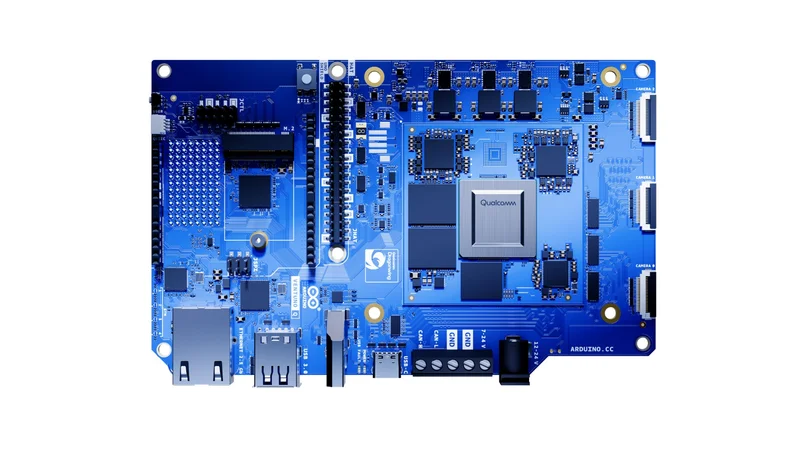
Arduino VENTUNO™ Q Edge AI SBC
Introduction
Edge artificial intelligence (AI) has shifted from a niche research focus to a baseline requirement for modern embedded systems. Designers building robots, industrial controllers, and smart devices increasingly need on-device inference to reduce latency, improve privacy, and enhance reliability, rather than relying on the cloud. However, most edge AI boards available today are optimized for inference alone, leaving the deterministic, sub-millisecond control needed for motion and actuation as a separate engineering problem.
The VENTUNO Q, available through Mouser Electronics, addresses this gap directly. Built as a dual-brain single-board computer (SBC), it pairs a high-performance AI processor with a real-time microcontroller, enabling perception and physical action to coexist on the same hardware. This article walks through its architecture, hardware specifications, development workflow, supported AI models, and the applications it is purpose-built to enable.
The Edge AI–Robotics Convergence Challenge
Traditional edge AI deployments often split intelligence and control between two distinct platforms: a Linux-based SBC for neural network inference, and a separate microcontroller managing motors, sensors, and timing-critical I/O. While functional, this split introduces communication latency, increases bill of materials (BOM) complexity, complicates firmware coordination, and forces engineering teams to maintain two parallel development pipelines.
Robotics, industrial automation, and any application where AI must directly drive physical actuators demand more than just inference throughput. They require synchronized perception (vision, audio, language understanding) and deterministic action (motor control, CAN networks, GPIO timing) within a single coherent system. The VENTUNO Q is designed around this convergence.
The Dual-Brain Architecture
The AI Brain — Qualcomm® Dragonwing™ IQ-8275 handles all heavy compute. It integrates an 8-core Qualcomm Kryo™ CPU, a Qualcomm Adreno™ 623 GPU, a Qualcomm Hexagon™ NPU delivering up to 40 dense TOPS, and a Qualcomm Spectra 692 image signal processor. This combination supports complex neural network inference, including large vision models, language models, and multi-modal AI workloads, in real time.
The Action Brain — STM32H5F5 is a 250 MHz Arm® Cortex®-M33 microcontroller with 4 MB flash and 1.5 MB SRAM, running an Arduino core on the Zephyr real-time operating system. It guarantees stable, deterministic responses on GPIO, PWM, and CAN-FD interfaces, which are essential for safety-critical control loops and zero-jitter motor operation.
The two processors communicate through a Remote Procedure Call (RPC) bridge, allowing the AI brain to issue high-level decisions while the action brain executes them at hard real-time speed. This eliminates the multi-board integration overhead and dramatically reduces the latency between perception and physical response.
Key Hardware Specifications
VENTUNO Q is engineered for production-grade workloads, with memory, storage, and connectivity scaled for serious edge AI deployment. High-bandwidth LPDDR5 memory enables concurrent multi-model inference; the triple MIPI-CSI camera capability supports stereo depth, multi-angle inspection, and 360° awareness. The inclusion of CAN-FD makes the board immediately deployable in industrial motor control and vehicle-grade networks.
Unified Development with Arduino App Lab
Hardware capability is useful only when developers can access it efficiently. Arduino App Lab is the unified development environment that ships with VENTUNO Q, bridging embedded C/C++ sketches, Python scripts, and AI model deployment into a single, consistent workflow. Engineers no longer need to context-switch between toolchains for the MCU and the Linux side of the system.
VENTUNO Q supports two setup modes to match different team workflows:
Single Board Computer mode — Connect a monitor, keyboard, and mouse for a full Linux desktop experience, with Arduino App Lab launching natively.
PC-based mode — Tether the board to a laptop or desktop over USB-C or network, and run Arduino App Lab from the host machine.
Arduino App Lab does not restrict developer choice. The MPU runs full Ubuntu or Debian, so standard tools like VS Code, PyCharm, Docker containers, Python virtual environments, and SSH-based remote development all work as expected.
Ready-to-Run AI Models for Faster Deployment
Through integration with Edge Impulse and the Qualcomm AI Hub, VENTUNO Q ships with access to a wide library of pre-optimized models tuned for its NPU. Out of the box, developers can deploy:
Local LLMs — Qwen for on-device natural language understanding, with no cloud dependency or data transmission.
Local VLMs — Qwen VLM for image captioning, scene understanding, and OCR.
Speech — Whisper for automatic speech recognition and Melo TTS for natural voice synthesis, enabling fully offline conversational interfaces.
Vision — YOLO-X for real-time object tracking, MediaPipe for hand and gesture recognition, and PoseNet for body pose estimation.
For custom workloads, the Edge Impulse pipeline lets teams upload training data, train cloud-side, automatically quantize for the Dragonwing IQ8 NPU, and deploy directly into Arduino App Lab with one click.
Engineered for Robotics and Physical Actuation
VENTUNO Q is built from the ground up for systems that must move, manipulate, and respond to the physical world. It offers native ROS 2 compatibility for advanced robotics development, and App Lab includes pre-built Robotics Bricks that bundle common functionality into reusable, accessible components. Real-time motor and actuator control is supported through sub-millisecond GPIO, PWM, and CAN-FD response. Compatibility with Arduino UNO™ Shields, UNO Carriers, Raspberry Pi HATs, and Arduino Modulino™ nodes extends prototyping options without forcing custom hardware design.
Conclusion
The VENTUNO Q closes a long-standing gap in the edge AI landscape, where intelligence and physical control have typically required separate hardware. By bringing a 40 TOPS AI processor and a deterministic real-time microcontroller onto a single board, and pairing them with a unified development environment and curated AI model library, it shortens the path from prototype to production for robotics, industrial systems, and intelligent edge devices.
The VENTUNO Q is available through Mouser Electronics. Visit the product page to explore specifications, availability, and development resources.