Six Years Later: A Follow-Up Conversation with Alex MacDougall
The SamacSys founder on two acquisitions, 1.4 million engineers, and why AI makes trusted part data matter more than ever.

21 Sep, 2026. 10 minutes read
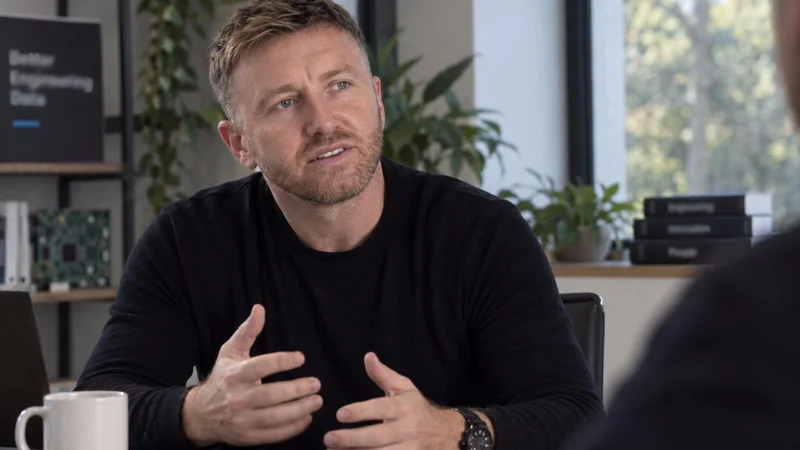
Alex MacDougall
Six years ago, Wevolver spoke with SamacSys founder Alex MacDougall about his journey building a company around a deceptively simple problem: engineers were spending far too much of their time creating CAD models that should already exist.
At the time, SamacSys had recently been acquired by Supplyframe, and MacDougall was looking ahead. He predicted a future in which engineers would find it almost unbelievable that previous generations had manually created component models. He also talked about modular engineering and the possibility of AI eventually generating designs from functional requirements.
Quite a lot has happened since.
Supplyframe was subsequently acquired by Siemens. Adoption has continued to grow, the platform is now used by nearly 1.4 million engineers, and MacDougall has remained involved far longer than he originally expected.
He has also written Built, Not Given, a book that reveals a considerably more complicated story behind the entrepreneur we interviewed in 2020.
So, six years later, we caught up with him again.
1. When we spoke in 2020, SamacSys had recently been acquired by Supplyframe. Six years later, what has changed - and what hasn’t?
Well, after just looking back at our conversation from then, I’ve realised two things: the watch I’m wearing hasn’t changed, but this office has - and it’s much nicer than my old one!
But back to the business… that has definitely changed, mostly in scale.
Our goal was always super simple: engineers shouldn’t be wasting time drawing CAD models of electronic components. If we could solve that properly, engineers would just expect the models to be there. That is what has happened and it’s great to see.
As you know, today there are nearly 1.4 million registered engineers signed up with around 350,000 CAD model downloads every month. We also now have thousands of manufacturers on the platform, it’s become something engineers simply expect and I see our Green icons everywhere.
On a more personal note, there are now people working on it I’ve never even met, solving problems before I know they exist. As a founder that’s both wonderful and mildly offensive!
I spent years at the heart of things and then discovered that ultimately you have to make yourself less necessary so the idea can continue without you!
2. Back then, you said engineers of the future wouldn’t believe their predecessors spent time building CAD models. How close is the industry to that reality now?
Much closer.
When I started all this, engineers spent hours creating symbols, footprints and 3D models and that was completely normal. The industry had effectively accepted this huge duplication of effort.
Imagine all those engineers, at all those companies independently drawing the same models. Nobody would deliberately design a system that way, but that’s what was just happening.
Today an engineer can search for a component, get the model and get on with their design very quickly.
But the win isn’t somebody saying, “SamacSys is awesome.” Strangely it’s an engineer being slightly annoyed when a model isn’t immediately available.
We’ve gone from engineers having no expectation that a CAD model would be there, to them being annoyed when it isn’t. That’s a pretty big change.
3. SamacSys started with a simple mission: has the problem you set out to solve become bigger than that?
Not entirely, but a little bit.
The CAD model was the obvious pain point because I’d experienced it myself. But there is also a larger issue: engineers need reliable technical information when they’re making decisions.
A CAD model isn’t just a picture. It represents something real - electrical connections, physical dimensions, thermal characteristics and the relationship between a component and the product being designed around it.
CAD models are part of a much bigger technical-data problem. That’s becoming even more important now with AI.
If a human engineer is working with bad CAD model information, they can sometimes notice that something looks wrong. AI can potentially make the wrong decision extraordinarily quickly and with tremendous confidence.
Now it’s important to have trusted, structured part data that machines as well as humans can understand.
4. Supplyframe itself was subsequently acquired by Siemens. What has it been like taking something you started as an independent business through two acquisitions?
It’s been fascinating, difficult and much longer than I originally expected.
When SamacSys was acquired, I had a two-year earnout. My plan was to complete that properly, hand everything over and take a break for a little while.
Then Siemens acquired Supplyframe.
Apparently I have a terrible habit of completing one tour of duty and accidentally signing up for another. So two years became more than five.
The biggest adjustment was moving from an environment where I could make a decision and immediately execute it, into organisations where responsibilities are deliberately shared between wider teams.
That’s sensible at scale, but it’s very different psychologically for a founder.
You learn that building something and integrating something require different skills. Neither is necessarily easier.
5. Founders often leave after an acquisition. Why did you stay, and has working inside larger organisations changed the way you think about building technology?
I stayed initially because I’d committed to it.
There were employees, customers and engineers relying on what we’d built. I didn’t want to sell the company, take the money and immediately walk away.
Then Supplyframe was acquired and there was another commitment to fulfill.
Working within larger organisations has definitely changed my perspective. A founder can get used to speed. If something needs doing, you find a way, make the decision and get on with it.
At larger scale you begin to understand why structure exists. You’re balancing infrastructure, security, legal requirements, different products, countries and thousands of other considerations.
I still occasionally think, “I could have done this by lunchtime in 2015.” But in 2015 we also had considerably fewer lawyers to think about!
Both ways have advantages and disadvantages I think.
6. In our 2020 interview, you predicted that AI could eventually generate parts of an electronic design from functional requirements. Were you right - and what did you underestimate?
Even if I do say so myself, I think my estimate was right. What surprised me was how quickly AI became accessible to everyone.
In 2020 I was thinking primarily about specialised engineering systems: tell the software that a product needs USB power, a display, wireless connectivity and certain physical constraints, and eventually it could help construct the design.
That still makes sense.
What I underestimated was that millions of people would first become comfortable having conversations with AI about everything from software to what they should cook for dinner.
The AI apps arrived before the specialist engineering capability; that's been interesting to watch.
Now I believe the engineering challenge is making sure AI has something trustworthy underneath it, because an AI system can produce a very convincing answer.
Unfortunately, electronics don't care whether an answer sounds convincing. The board either works or it doesn’t.
Physics remains annoyingly resistant to marketing!
7. There’s enormous excitement around AI in engineering. Where do you think the industry is getting AI right, and where is it getting it wrong?
Well we all have seen that AI is incredibly powerful when it removes repetitive work and allows engineers to spend more time solving actual engineering problems.
That’s essentially the same philosophy SamacSys started with but where I become more cautious is when AI is treated almost like a magic answer to everything.
Engineering has constraints. Components have dimensions and pins have specific functions. Increasingly, products have regulatory requirements, so a confident hallucination in a poem might be ok. A confident hallucination in a medical device is somewhat less charming.
The opportunity is obviously enormous, but engineering AI needs strong foundations. We need to make sure we’re asking, “What information are we feeding it?” So we get more correct outcomes.
8. Why do you think data is becoming more important rather than less important in an AI-driven design environment?
Because automation amplifies whatever you put into it. Good inputs can create enormous efficiency. Bad inputs can create enormous efficiency at producing mistakes!
If an AI system is going to recommend components, generate sections of a circuit or eventually contribute to complete product designs, it needs to understand the components it’s working with at a level that goes far beyond a part number and a paragraph from a datasheet.
It needs structured, validated information, but it seems most people are looking at the clever thing happening at the interface.
I’m more interested in the boring bit underneath it, I’ve made quite a good career out of boring bits underneath things!
9. Is the opportunity still primarily ECAD models, or does the same problem exist across other engineering disciplines?
The underlying problem absolutely exists elsewhere.
Electronics was where I understood the issue well enough to attack it. ECAD was therefore the obvious starting point for me.
But mechanical engineers also spend significant amounts of time finding, validating, recreating and managing technical information around mechanical parts.
The broader principle is the same: highly skilled engineers shouldn’t repeatedly recreate information that could be generated once, validated properly and made available at the point of design.
So there’s potential anywhere we can remove unnecessary friction from engineering, basically making it simpler to go from an idea, to a product in your hand.
10. Looking back, what turned out to be harder: building SamacSys, scaling it globally, or integrating it into larger organisations?
They’re all difficult in completely different ways.
Starting from nothing is frightening because there is quite a risk. You’re trying to persuade people that a problem they’ve tolerated for years suddenly deserves solving.
Scaling is difficult because everything can break at the same time and you have to fix things while people still rely on it.
Integration is difficult because you have less direct control, to be blunt.
I learned something from all three.
But I like building things. There’s something very satisfying about identifying a problem, having almost no resources and just figuring it out.
11. The first time we interviewed you, we concentrated mainly on the company. You’ve since written Built, Not Given. Why did you decide to tell the story behind the business now?
I actually resisted writing it for a long time.
Publishers approached me around the time SamacSys was sold in 2019, but I didn’t think I had anything particularly useful to say. I was still in the middle of it.
Later I realised the business was almost the easy part of the story to explain. The part the writers found more interesting was why I approached things the way I did.
As you know I didn’t have the best start in life, effectively without guidance from a young age. I joined the military then discovered I had a medical condition that changed that career path.
The book isn’t really saying, “Look what I achieved.”
It’s more: “This is what happened, this is what I tried, this is what worked, and perhaps some of it will be useful to somebody else.”
That’s a much better reason to write a book, to try and help others, rather than just explain your story.
12. How much did your experiences before SamacSys shape the way you built the company?
Almost all parts of my life shaped it I suppose.
My childhood taught me independence. Marines training taught me discipline. Engineering taught me precision. Sales taught me how to communicate value. And some badly run businesses taught me what happens when standards disappear.
None of it felt useful while it was happening. I certainly wasn’t sitting in a freezing tyre-fitting workshop thinking, “Excellent, another important chapter in my future leadership philosophy.”
Mostly I was thinking that it was cold and I wanted to get the grease off my hands!
By the time I started SamacSys, I understood engineers because I’d been one. I understood PCB software because I’d supported and sold it. And I understood the commercial side well enough to work out who might pay for what we were building.
The business came from all of those experiences I guess.
13. You’ve built a career while adapting to muscular dystrophy. Has that changed your definition of ambition or success as you’ve got older?
100% yes!
As the book explains, when I was about twenty, a doc told me to prepare to be in a wheelchair by twenty-five.
I’m now in my forties and I’m still walking and generally irritating the prognosis, but living with a degenerative condition does change your relationship with time.
Most people can tell themselves they’ll do something physical in five or ten years. I don’t know what I’ll be able to do by then. So I’ve tended to do things right away.
I’ve been very lucky to do a lot of fun things and sometimes the condition has limited me but I've mostly found a way around it.
When I was younger, success was about proving I could do something despite the circumstances.
Now it’s much more about having control of my time, being present for my family, staying physically capable for as long as possible and doing things that are actually useful.
It only took me about forty years to work out I should be useful!
14. Founders tend to make success look inevitable. What part of building SamacSys felt least inevitable while you were actually living through it?
Most of it if I’m honest!
That’s one of the reasons I wanted the book to be unpolished.
Success stories become suspiciously tidy when they’re told backwards. Someone spots an opportunity, has a vision, assembles a brilliant team, overcomes adversity and eventually exits for millions.
Lovely! Living through it doesn’t feel anything like that in real life!
You’re worried about paying people. A customer changes direction. A server goes down. Somebody leaves. Something you were convinced would work doesn’t. Then something you thought was relatively insignificant suddenly becomes important.
I obviously didn’t know it would succeed. I just kept solving the next problem and kept going.
That’s probably the least exciting business advice imaginable, but unfortunately I think it’s true for me.
Basically parts of success are repetitive and fairly boring while it’s happening but you have to get through it.
15. Six years ago we asked what was next for SamacSys. This time: what’s next for Alex MacDougall?
There are still big engineering problems I want to work on with Supplyframe and Siemens. Especially as AI is so hot at the moment and I find the topic fascinating.
Outside engineering, I want to write more, work with founders and companies where my experience might be useful, and hopefully help people avoid some of the mistakes I made. I’ve accumulated quite a good collection of those!
I also have my charitable ‘Built Forward Fund’, which will use proceeds from the book and anything else I build around it to provide help to people who need it. Nothing grand, just if people need equipment, food, transport or an opportunity and we can help, we will help.
I have a young family, and as I said a moment ago, I’m much more conscious of time than I used to be. I spent years behaving as though every available hour needed to be converted into progress. I don’t want to do that forever, especially as my bones creak more these days!
So I doubt there’ll be one giant “next thing”, just working on interesting problems, helping good people build good things, spend time with my family, do some more things that are probably slightly stupid while I’m still physically able to do them, and enjoy myself.
That feels like a pretty decent plan, let’s check in again in another six years and see how that goes!
Recommended reading:
- Alex MacDougall's first Wevolver interview: "Alex MacDougall is on a mission to solve a problem at the core of the electronics industry"
- Alex MacDougall's Wevolver profile with his articles here.