YAGEO Group AEC-Q200 Hybrid Polymer Capacitors
High-Reliability Hybrid Polymer Capacitors for Automotive Applications
General
| Product Type | Semiconductors & ICs |
| Applications | Mobile, Automotive, Aircraft Installations |
| Key Features | 68 µF to 560 µF, Up to 63 VDC, Low ESR, Stable Capacitance |
Technical Specifications
| Capacitance Range | 68 µF to 560 µF |
| Rated Voltage | Up to 63 VDC |
| Operating Temperature | -55°C to +135°C (some series up to +150°C) |
| Vibration Resistance | Up to 30g (Other Series), Up to 20g (PHA227, PHH227) |
| Ripple Current | High Ripple Current Handling |
| Diameter Options | 16.2 mm, 18.2 mm, 20.2 mm |
| Applications | Mobile, Automotive, Aircraft Installations |
Overview
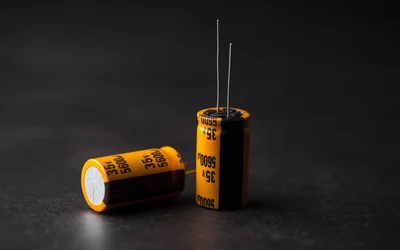
YAGEO Group AEC-Q200 Hybrid Polymer Capacitors are designed for demanding automotive and transportation applications requiring high temperature tolerance, ripple current capability, and vibration resistance. Constructed with a polarized all-welded design, the winding is contained in a cylindrical aluminum can with a high-purity lid and rubber gasket, and impregnated with a liquid electrolyte to support self-healing behavior. These capacitors deliver outstanding electrical performance, including stable capacitance and low ESR under dynamic operating conditions.
The PHA223, PHH223, PHA227, and PHH227 series are offered in both axial and radial crown variants, with diameters of 16.2 mm, 18.2 mm, and 20.2 mm. Vibration resistance is specified up to 20 g for PHA227/PHH227 and 30 g for other series, ensuring reliability in harsh environments. The variants, such as the A787 series, feature high CV ratings. The series meets AEC-Q200 standards, is halogen-free, and fully meets RoHS and REACH compliance, supporting long-term automotive and aerospace system integration.
YAGEO Group AEC-Q200 Hybrid Polymer Capacitors - Features
The YAGEO Group AEC-Q200 Hybrid Polymer Capacitors are built for high-demand environments requiring durability and stability. Let’s explore their features in detail:
Design and Construction
The YAGEO Group AEC-Q200 Hybrid Polymer Capacitors feature a polarized, all-welded construction. The internal winding is contained within a cylindrical aluminum can, sealed with a high-purity aluminum lid and a quality rubber gasket. This design provides structural integrity and environmental protection. The winding is also impregnated with a liquid electrolyte, which facilitates self-healing capabilities in the event of dielectric breakdown.
Electrical Characteristics
The hybrid polymer design enables high ripple current handling and low ESR performance, ensuring electrical stability. They are suitable for use in high-temperature environments. The A787 series is notable for offering high capacitance-to-voltage (CV) ratios. The impregnated electrolyte contributes to self-healing behavior, extending performance reliability during overload or fault events.
Mechanical and Mounting Features
The capacitors are designed to withstand mechanical stress, offering vibration resistance up to 30g for most series and up to 20g for the PHA227 and PHH227 series. Specific variants, such as the PHH225, include a radial crown feature, which allows for vertical mounting in a standing position. The PHA223, PHH223, PHA227, and PHH227 series are available in diameters of 16.2mm, 18.2mm, and 20.2mm.
Environmental and Reliability Characteristics
The capacitors are qualified for AEC-Q200 compliance, making them suitable for high-reliability automotive standards. They demonstrate vibration resistance up to 20 g in PHA227/PHH227 series and up to 30 g in other variants, ensuring mechanical endurance under dynamic conditions. The devices also support high-temperature operation, maintaining consistent performance across wide environmental ranges.
Applications
The YAGEO Group AEC-Q200 Hybrid Polymer Capacitors are suited for environments requiring stable capacitance, high ripple current tolerance, and vibration resistance. In automotive systems, they support functions such as DC/DC converters, power control units, and onboard electronics, where low ESR and reliability are critical. Their self-healing behavior and wide –55 °C to +125 °C temperature range enable dependable use in mobile and aircraft installations, where exposure to mechanical stress and thermal fluctuations is common. The combination of compact cylindrical packaging, axial or radial crown mounting, and vibration resistance up to 30 g makes them suitable for compact, space-constrained applications.
Where to find it

Mouser Electronics
Mouser Electronics is a worldwide leading authorized distributor of semiconductors and electronic components.
References
Recommended Specs
Continue Reading
This guide explores the crucial factors in capacitor polarity, its mathematical analysis, identification, and advanced practices for improved circuit performance.
This article explores the basics, types, and key considerations surrounding decoupling capacitors in electronic systems, providing insights into mastering power integrity in modern designs.

Energy storage is a vague term. Here, we go through common questions people have about supercapacitors. Topics range from how batteries compare to supercapacitors, what energy density is, what power density is, and how supercapacitors are unique in both their construction and their application.

4 minutes read