What Is Compressed Air?
Compressed air is the invisible force behind a vast array of applications, from your basic bicycle pump to the worlds vast industrial manufacturing facilities. Its such a vital power source that its sometimes called a fourth utility, a form of energy that ranks with water, electricity and natural

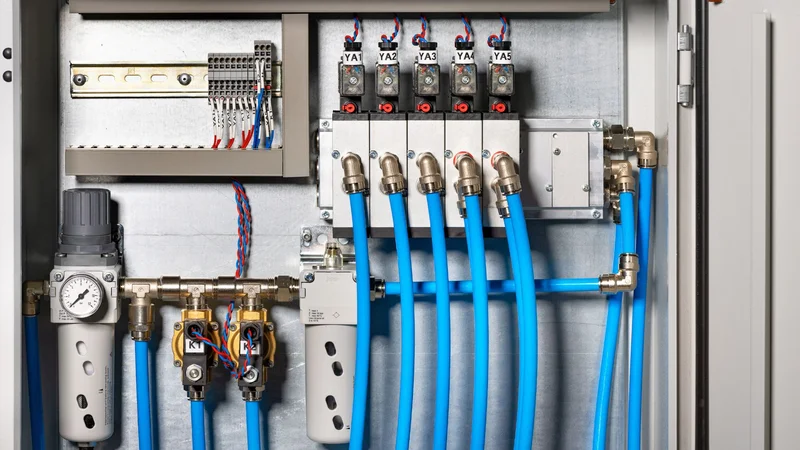
This article was first published on
www.rowse-pneumatics.co.ukCompressed air is so reliable and versatile that it’s become the keystone of many worldwide operations. It’s freely available: you don’t have to dig it up or refine it, although you will need some electricity for the compression process. You’ll find it in the automotive industry, in manufacturing processes, control and automation applications, transportation, medical and pharmaceuticals, and even in everyday household appliances.
So, What Exactly Is Compressed Air?
Compressed air represents a source of stored energy derived from the ambient atmosphere. Taking ordinary atmospheric air and compressing it squashes the molecules forcibly into a smaller space. While reducing the overall volume of the air, this process also increases its pressure, which can be harnessed to move something like a piston rod. In terms of physics, this means translating a static force into a kinetic power: ie, something that moves and can drive connected applications.
In order to understand this resource more fully, we’re going to explore the fundamental principles of compressed air. We’ll look at how it’s created, what we use it for, what advantages we gain from its use, and how we can use it most efficiently.
Understanding The Principles Of Air Compression
Compressed air starts out as just air. This air is then fed through a compressor, which reduces its volume and raises its pressure to a greater level than the air you normally breathe. The average atmospheric air pressure is measured at 1,013.25 millibars, or Mbar, and represents the amount of force that’s being exerted by all the air molecules above the ground pressing down on the point where you measure it. Other units of measurement referring to the same pressure are kiloPascals (kPa), atmospheres (atm), or pounds per square inch (psi). For industrial purposes, air pressure is usually stated in psi.
Average atmospheric air pressure can vary according to things like changes in the weather and how high above sea level you are when it’s measured. At sea level, it’s usually 1,013.25 Mbar, which can also be expressed as 1 Atm and 14.7 psi. When you compress it, this pressure can be increased to levels as high as 137,895-413,685 Mbar, or 2,000-6,000 psi. This level of compression can usually only be achieved by industrial high-pressure air compressors. For most pneumatic applications, pressures of 80-100 psi are the most commonly used, but you should always be sure to match your compressor to your application’s specific pressure requirements.
How Compressed Air Is Created For Industry
The production of compressed air relies on the air being mechanically squashed until the smaller volume is at a much higher pressure. This increases its available force and potential kinetic energy, which you then channel into your various applications. Three main processes are involved: compression, cooling and storage.
Compression
Compressors are typically run on electricity and a motor. They suck atmospheric air through an inlet valve into a chamber, where it’s compressed to the desired level of pressure. There are different types of air compressors used for this process, including:
Reciprocating or piston compressors are most commonly used for small-scale enterprises and those where use is only intermittent. They have a motor-driven crankshaft, with a system of valves and pistons inside a cylinder to pull in the air and compress it.
Rotary screw compressors, which are a more efficient option for applications where usage is high and/or continuous. They have two screws inside a chamber that interlock to compress the air.
Centrifugal compressors, which are typically found in large-scale industrial processes. They compress the air using a high-speed rotating impeller.
Cooling And Drying
The more you compress a volume of air in a closed chamber, the hotter it gets. It also gets wetter, as the moisture in the atmospheric air condenses. This heat and condensed water needs to be disposed of, or it will have the potential to damage your pneumatic system.
You can reduce the compressed air’s heat using water- or air-cooled cooling systems. To get rid of the moisture, there are various drying options you can use, including chemical absorption, centrifugal water separation or specialised air dryers.
Storage And Distribution
The great advantage of compressed air as a power source is that you can choose whether to use it immediately, or keep it for use later or elsewhere. When it’s passed through the compression, cooling and drying processes, you have two alternatives. Either you can pipe it directly out to whatever pneumatic applications you’re running on your premises, or you can store it in tanks. These can then be transported off-site if necessary. The most important factor for maintaining a reliable and stable supply of compressed air is that it’s controlled and stored properly.
Where Are You Most Likely To Use Compressed Air?
Compressed air is a clean form of energy that’s both powerful and consistent. You’ll find it in a wide variety of locations and circumstances, including in simple actions like pumping up your car tyres. It’s also widely adopted in industry, where it plays a vital role in many sectors.
Manufacturing And Automation
Compressed air is the lifeblood that runs through many of today’s automation and manufacturing processes. It’s used to run large conveyor systems, automated assembly lines, pneumatic equipment and robotic systems. It also aids processes like plastic moulding, metal fabrication and spray painting and powers hand-held
pneumatic tools like sanders, drills and riveters.
Transportation And The Automotive Industry
Compressed air is widely used in the automotive industry. It drives such processes as the assembly and painting of vehicles, as well as inflating their tyres. You’ll also find it in the air brakes used in trains and buses for public transportation and in heavy goods vehicles. Some cars are also designed with air suspension systems based on compressed air.
Aerospace And Defence
Compressed air is crucial to the aerospace industry for many purposes. Hydraulic system accumulators are used in aircraft maintenance and jet engine testing. In the defence sector, you’ll find compressed air systems in naval operations, military vehicles and missile launch systems.
Energy
The energy sector has many branches, including exploration of oil and gas resources, extraction and refining activities and power generation. You’ll find compressed air used for pneumatic actuation in power plants, as well as various process control and cooling systems.
Construction And Mining
Compressed air is a key component in construction and mining, where it powers a range of equipment and tools. These can include sandblasters and nail guns, as well as concrete breakers and jackhammers. In underground mining operations, you’ll find compressed air in ventilation and drilling equipment, and in systems for conveying materials.
Agriculture
You’ll find several compressed air systems at farms and agricultural facilities. They’re used for things like pneumatic seeders and irrigation systems, automated livestock feeding and processing systems, and milking machines.
Food And Beverages
As a clean form of power, compressed air has a strong role in the food and beverage industry. Food production systems demand the highest levels of precision and hygiene and must comply with strict air quality standards. Compressed air is ideal for this, as it has no messy drive systems and always filters out contaminating materials. As well as aeration, mixing ingredients and conveying food and beverage items, pneumatic systems are found in filling, bottling and packaging processes.
Medical And Pharmaceutical
Compressed air is crucial for a range of medical and pharmaceutical applications. You’ll find it in respiratory devices and ventilators, anaesthesia systems, dental equipment and surgical tools. Contamination-free air is critical to the pharmaceutical industry, where you’ll find pneumatic equipment in clean rooms and product packaging systems.
Electronics And Semiconductors
The precision required for electronic and semiconductor manufacturing is supported by ultra-clean and dry compressed air. It’s used in the production of microchips and cooling-sensitive components, as well as circuit board assembly.
As well as these core industries, you’ll also find compressed air systems in textile production, woodworking, plastics, climate control, dry cleaning and many others.
Advantages Of Using Compressed Air
As we’ve seen, compressed air is the energy of choice for many industries because it offers significant advantages over other drive systems:
It’s a clean source of energy that’s ideal for applications that need to be pure and free from contaminants.
It’s safe and reliable. Unlike other power sources, such as electricity, gas or oil, compressed air offers no risk of fire or explosion. Even in extreme conditions, compressed air systems are very robust, so you can use them in hazardous environments like refineries or chemical plants. They can operate in dirty or dusty environments, high or low temperatures, even in underwater applications.
It’s incredibly versatile. Compressed air powers all sorts of equipment and tools, both automated and manual, so you can use it in your small workshop as well as in a large industrial plant. Compressed air demonstrates its versatility by functioning as both active equipment supplier and energy carrier. Electricity or water is a linear form of power that flows in an unbroken line from source to usage point, and compressed air can be created and stored up.
While you can use compressed air directly from the source, you also have the option to store it in tanks. You can either take these to another location to carry out a variety of tasks, or keep them on site as a backup. This provides a reserve of stable, continuous power, available at all times, keeping it available to use directly for your pneumatic applications or tools.
Disadvantages Of Using Compressed Air
Although compressed air offers considerable advantages, you need to manage pneumatic systems efficiently to prevent energy wastage and unnecessary costs. Some primary disadvantages include:
The amount of energy required to compress air is significant, though you can reduce costs using effective maintenance and efficient compressors.
You have to work on maintaining air quality, making sure it’s free of moisture and other contaminants to maintain equipment performance.
To ensure optimal performance, you need to design a pneumatic system with close attention to the efficient layout of piping and storage.
You need to inspect pneumatic systems regularly, as air leakage can lead to significant energy loss.
Why Choose Compressed Air?
Use of compressed air is increasing in many industrial applications, but most noticeably with the development of better high-pressure systems. Many industrial processes use high-pressure compressed air, especially for aircraft systems. You’ll also find it in breathing equipment for military applications, firefighting, medical and diving.
It’s critical in these cases for engineers and stakeholders to understand the principles of air compression, and particularly its upper limits. This is essential if you’re to ensure your equipment safety, optimise your compression processes, and explore the technological boundaries of air compression. Increasing the air pressure makes it hotter, and may eventually cause it to ignite, so high-pressure applications are at greater risk of explosion. Also, the air might reach what’s known as a “critical point”, where trying to compress it further would transform it from a gas into a dense, liquid-like substance.
Compressed air is a key source of energy. When properly controlled, it’s safe, reliable and versatile. You’ll find it in industry applications as widely diverse as hospitals, construction sites or manufacturing plants. Provided you maintain and manage a pneumatic system efficiently, you’ll be able to optimise your energy consumption and operating expenditure. The technology continues to develop, with new advances in system design, air treatment and compressor efficiency. With climate considerations and sustainability in mind, compressed air represents an increasingly valuable energy resource for future applications.