What Investors Look for in Photonic Startups? Perspectives from PhotonVentures Photonics VC Fund
PhotonVentures explains how venture capital investors assess photonic chip startups, focusing on scalability, ecosystem alignment, and market readiness. They highlight key signals of investment readiness and the role of early validation opportunities like the Global Photonics Engineering Contest.

05 Jun, 2026. 6 minutes read

Introduction
PhotonVentures is a European venture capital fund dedicated to integrated photonics, investing in companies from seed to Series A and supporting their transition from early validation to scalable businesses. As a specialized deep tech investor, the fund combines capital with direct access to a global ecosystem of foundries, designers, and system integrators via PhotonDelta.
This article outlines how investors evaluate early-stage photonic chip startups, what differentiates investment-ready teams, and how companies can position themselves for scale, drawing on the perspective of PhotonVentures. It focuses on the practical signals investors look for across technology, market readiness, and ecosystem alignment.
Understanding Deep Tech Investor Mindset
Investing in integrated photonics requires a different approach from traditional venture capital. Technologies often originate in academic environments, depend on complex fabrication infrastructure, and follow longer development timelines. At the same time, they enable critical innovations in areas such as AI, quantum computing, and advanced sensing.
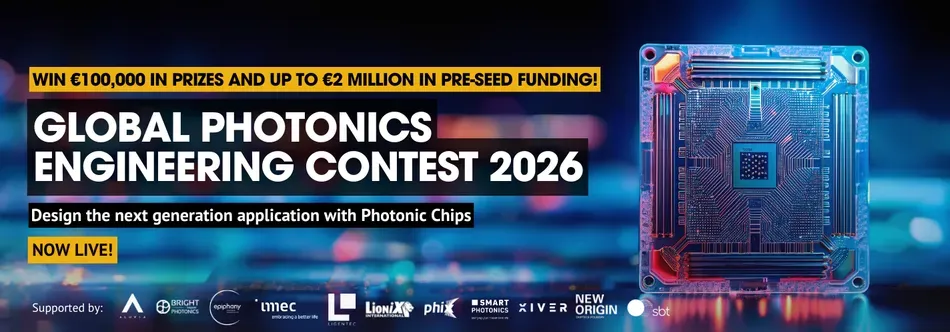
In this context, initiatives like the Global Photonics Engineering Contest play an important role. They surface emerging teams and ideas at an early stage, providing visibility and initial validation where conventional investment signals are often still limited.
LEARN MORE AND PARTICIPATE NOW
Deep tech investing requires discipline and patience. In integrated photonics, timelines are long, capital requirements are high, and execution depends on access to specialized infrastructure. At the same time, timing is critical. Investing too early, before the technology, market, or ecosystem is ready, can be just as challenging as being too late, when the opportunity has already matured. Success depends on aligning technological readiness with market demand and ecosystem maturity.
PhotonVentures evaluates opportunities not just on market size, but on whether a technology can successfully move from lab to scalable production. This means taking fabrication, packaging, and system integration into account from an early stage, as teams that overlook this complexity often run into difficulties later.
The integrated photonics supply chain is tightly interconnected. Startups that understand this early and position themselves within the ecosystem have a clear advantage, as development often depends on close collaboration with foundries, packaging providers, system integrators, and application partners. Access to these relationships can accelerate development and improve the path to commercialization.
Early validation signals are therefore critical. The Global Photonics Engineering Contest provides a clear example. It gives insight into how teams think about applications, how they execute, and whether they can translate technology into relevant solutions.
For investors, strong participation can provide early insights into how teams move beyond research and think about applications and execution. For startups, it is an opportunity to validate ideas, test their positioning, and start building credibility with the industry and investors.
PhotonVentures’ Approach to Assessing Photonics Startups
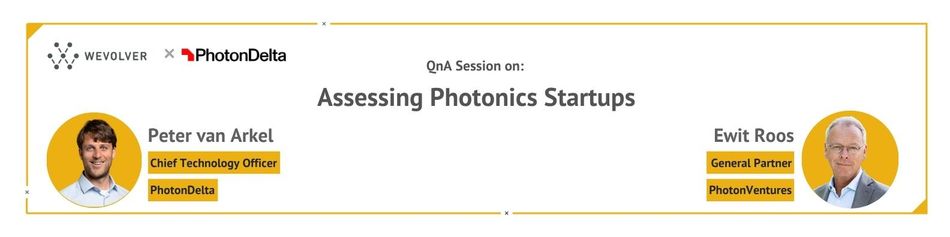
Peter: What makes a photonic chip startup investable at the seed or Series A stage?
Ewit: Technology alone is not investable. We see many strong technologies, but very few with a clear application and real customer pull.
At the seed to Series A stage, we expect more than research. A prototype, early customer engagement, or a pilot project shows that the team is serious about building a business. It does not have to be perfect, but there should be clear evidence that the technology can function in a real-world setting and address a defined market need.
We invest with scale in mind from day one. Timing plays an important role in this. Even strong technology needs to align with market readiness and the broader ecosystem to scale successfully. If a team cannot demonstrate how their technology will be manufactured and integrated into a system, we consider that a key risk. In integrated photonics, scalability and integrability are core, not optional.
Peter: How do you evaluate whether a team is ready to transition from research to commercialization?
Ewit: The key factor is mindset and execution discipline. Moving from research to company building requires different priorities.
We look for teams that are willing to make trade-offs. In research, you optimize for performance, but in business, you optimize for impact and timing. That distinction matters. For example, a team may develop an integrated photonic chip with extremely high performance in a lab environment, but commercial success depends on understanding what the customer actually needs. In many cases, delivering a solution that meets the required specifications reliably, can be manufactured at scale, and integrates efficiently into existing systems is more important than achieving the absolute highest technical performance.
A clear view on the market is also essential. Teams should understand who the customer is and why the solution is valuable. It is a strong signal when they bring in people with commercial or operational experience early on.
Peter: What role does ecosystem alignment play in your investment decisions?
Ewit: It is fundamental. We assess whether a startup understands the supply chain and actively engages with the right partners early on, including foundries, packaging partners, and system integrators. Companies that are well positioned in the ecosystem are generally better equipped to handle technical challenges and move toward scalable production.
At PhotonVentures, we actively support this process through our network and PhotonDelta, connecting companies with the right partners globally. In integrated photonics, companies that are not embedded in the ecosystem do not scale.
The Global Photonics Engineering Contest serves as an early entry point into this ecosystem, giving teams exposure to industry stakeholders and helping them start building relevant connections at an early stage.
Peter: What qualities do you look for in founding teams?
Ewit: We look for technical depth combined with ambition. The best teams are not only strong in research but also driven to build a company that can operate and compete globally.
Clarity is equally important. Founders should be able to explain what they are building, why it matters, and which problem they are solving in simple terms, such that it is understandable beyond the technical community.
Resilience also plays a major role. Building an integrated photonics company takes time, involves setbacks, and requires teams to stay focused and keep moving forward despite complexity and long development cycles.
Peter: What are common red flags you encounter?
Ewit: Lack of market focus is a recurring issue. Strong technology alone is not enough if there is no well-defined use case or understanding of where the solution fits within the market.
Another red flag is ignoring manufacturability and system integration. Teams that treat these as secondary considerations often face significant challenges later when trying to scale or transition toward production.
We also see unrealistic expectations on timelines and capital. Integrated photonics is complex, and underestimating that complexity leads to problems later on. In many cases, teams start thinking about the full system and the path to production too late.
What Differentiates Investment-Ready Photonics Startups
Investment-ready photonics startups think beyond the chip from day one and design for scale. They incorporate manufacturability from the outset and understand how their technology will move through the supply chain.
They actively engage with partners and build relationships early. This shows awareness of how the ecosystem works and what is needed to scale.
Their value proposition is clear and application-driven. They focus on solving a specific problem rather than pushing technology without a defined use case.
Strong teams are also realistic in how they approach commercialization. They understand the capital required, the development timeline, and the milestones needed to reach the market. They also have a clear sense of timing, understanding when the market is ready and how to align their development accordingly.
Less mature teams tend to stay heavily focused on research and prioritize technical advancements without sufficient attention to product definition, customer requirements, or commercialization strategy. This can slow decision-making and make it difficult to translate strong technology into market adoption.
Execution, focus, and ecosystem awareness are what set investment-ready startups apart.
The Role of Ecosystem Investors
In integrated photonics, capital alone is not enough. Access to the right ecosystem is critical.
PhotonVentures operates as an ecosystem investor. Through PhotonDelta and its broader global network, the fund connects companies to foundries, packaging partners, system integrators, and customers.
This access helps companies move faster, reduce risk, and make better decisions early on. It also shortens the path from prototype to product.
For early-stage teams, the Global Photonics Engineering Contest can be a first step into this ecosystem. It provides visibility and opens the door to meaningful connections.
From there, companies can move toward partnerships and eventually investment. This progression is essential in a field where collaboration drives success.
Conclusion
The bottleneck in photonics is no longer innovation; it is execution, scaling, and timing. The challenge is no longer only to prove the technology, but also to scale it at the right time.
PhotonVentures supports companies that are ready for that step by combining capital with access to the ecosystem needed to build and scale.
The Global Photonics Engineering Contest plays a role in identifying the next generation of teams. It offers a platform to demonstrate capability and connect with the industry.
For startups ready to move beyond research, it can be the starting point of building a scalable photonics company.