Ultra-Low-Power Wireless Connectivity for the Matter Smart Homes
Explore ultra-low-power wireless design for Matter smart homes, enabling multi-protocol support with Bluetooth LE, Thread, and Zigbee for scalable, energy-efficient IoT devices.

07 May, 2026. 3 minutes read
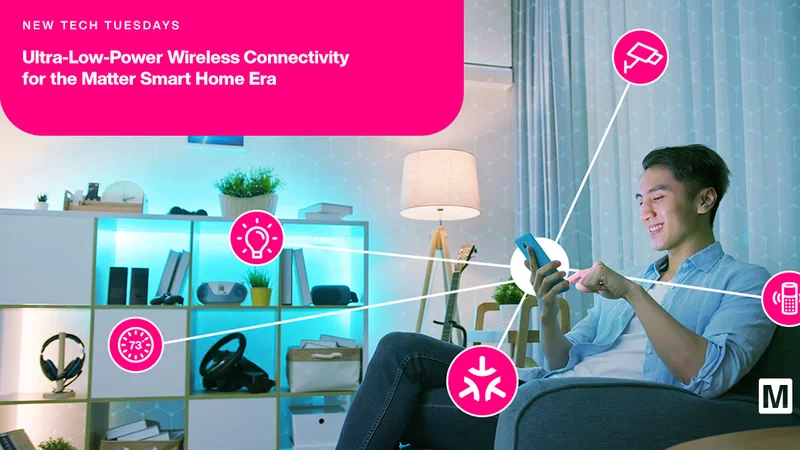
Power is still one of the first constraints engineers consider when designing connected devices, especially in smart home and Internet of Things (IoT) applications. Protocols like Bluetooth® Low Energy, Thread, and Zigbee are designed to enable devices to communicate reliably while consuming minimal energy. As Matter becomes more common across the smart home space, developers now need platforms that can handle both Matter-based designs and the wireless ecosystems that already exist.
Recent Matter deployments have changed what the devices are now expected to handle. Today’s Matter devices face growing demands to onboard securely, stay connected, and work across ecosystems, while running on limited power. These expectations are changing how engineers approach ultra-low-power wireless design, which can no longer optimize for a single protocol in isolation. This week’s New Tech Tuesdays explains why ultra-low power designs must support multiple wireless stacks on the same hardware without surpassing power budgets or overloading the system.
Ultra-Low-Power for Battery-Driven IoT
Bluetooth Low Energy, Thread, and Zigbee exist because most devices can't afford the power cost of keeping wireless on all the time. A good fit for things like setup or short status updates, Bluetooth Low Energy works best in quick, intermittent data exchanges. Meanwhile, Thread and Zigbee support scalable mesh-based networks that are ideal for smart homes and building automation.
By optimizing factors such as radio duty cycles and data packet efficiency, these protocols make it possible for batteries to last many years in devices like sensors, smart locks, and lighting. This efficiency is critical if IoT deployments are expected to scale into the millions of nodes.
Building Devices for a Multi-Protocol Smart Home
The Matter standard is allowing devices from different manufacturers to work together securely, driving demand for multi-protocol system-on-chips (SoCs) that can support Bluetooth Low Energy for commissioning and Thread or Wi-Fi/Ethernet for operational networking. This means devices must support multiple wireless stacks and manage them efficiently on the same hardware. Developers can’t treat wireless choice as an isolated decision. Devices often need to support more than one protocol on the same hardware, which imposes limitations. Battery life decreases faster, memory usage increases, and performance can be harder to manage.
Navigating these challenges is why multi-protocol support is gaining significance in the wireless networking landscape. Many products need to work with Matter while still supporting existing wireless designs. Platforms that can handle both make it easier to test ideas and move forward without constantly changing the hardware.
The Newest Products for Your Newest Designs®
Developers aiming to achieve ultra-low-power multi-protocol connectivity can utilize the advantages of the Arduino ABX00137 Nano Matter Board, which is built around the Silicon Labs MGM240SD22VNA Series 2 wireless module. The board features a 32-bit Arm® Cortex®-M33 CPU with 1,536kB flash and 256kB RAM, making it well-suited for low-power wireless communication.
The board supports Bluetooth Low Energy, Zigbee, and Thread protocols and is designed for Matter development. With its multi-protocol compatibility, the Arduino ABX00137 enables easy integration with smart home systems by making it easier for engineers to build Matter-compliant devices without managing multiple hardware platforms. In the rapidly growing field of automation technology, this flexibility can reduce development time and accelerate time-to-market for new smart home and industrial IoT (IIoT) products.
Significance for Future IoT Designs
As smart environments grow more complex across consumer and commercial applications, ultra-low-power wireless connectivity will continue to focus on power efficiency, while meeting increasing expectations around security and lifecycle. There must also be a concentration on interoperability. For example, recent Matter updates have expanded support for additional device types and energy management features.
New IoT devices are being asked to do more and more. They must onboard securely, stay connected, and work across differing ecosystems while running on tight power. To meet the growing pressures, more integrated designs and better radio frequency (RF) efficiency are needed.
Multi-protocol platforms make it easier for developers to keep up with these changes. Instead of redesigning hardware each time standards evolve, teams can use a single platform to explore and adapt to new wireless requirements.
Conclusion
Ultra-low-power wireless connectivity is now a key design constraint as automation makes its way into more smart homes and across diverse industrial applications. With Matter development bringing Bluetooth Low Energy, Thread, and Zigbee together in real products, engineers now have to consider power, security, and interoperability simultaneously.