The Importance of Haptic Feedback in Automotive Switch Design
Dive into why the haptic feedback of an electromechanical switch directly influences usability, driver distraction, and perceived system quality.

18 Jun, 2026. 4 minutes read
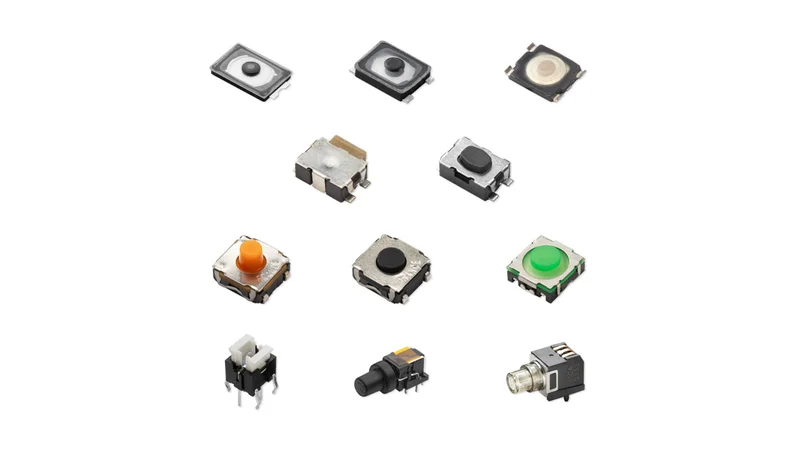
In automotive human-machine interface (HMI) design, switch feel is a functional engineering parameter. The force profile, travel distance, tactile response, and acoustic feedback of an electromechanical switch directly influence usability, driver distraction, and perceived system quality. These haptic characteristics are engineered through switch architecture, material selection, and mechanical tuning to meet application-specific requirements. This article discusses the importance of haptic feedback in automotive switch design, the mechanical parameters that define tactile performance, the engineering challenges involved in developing reliable automotive HMI systems, and how C&K addresses these requirements in automotive applications.
In modern vehicle cabins, electromechanical switches are important for high-frequency controls where reliable tactile confirmation is required without visual attention. Although touchscreens are now very common in automotive interiors, users’ feedback indicates that the physical switching solutions for critical and frequently accessed functions, like in steering wheel, console, and dashboard interfaces, are preferred.
Haptic Feedback as a Functional Design Parameter
In electromechanical switch design, haptics is defined by the controlled mechanical response during actuation and release. It is the result of how force, displacement, and internal mechanics interact across the switch architecture. From a design perspective, perceived tactile feedback is governed by a defined set of mechanical parameters including actuation force (Fa), actuation return force (Fra), tactile differential (ΔF = Fa − Fra), mechanical travel (Tm), and return force characteristics (Frr). These parameters determine the force-displacement curve of the switch, which ultimately defines click perception, snap ratio, and return behavior.
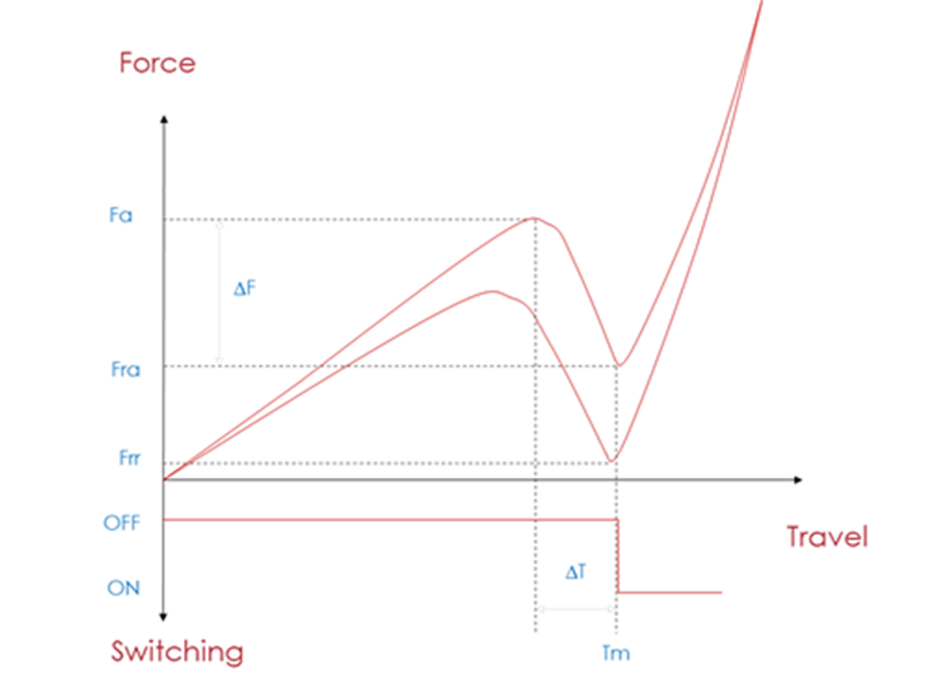
Switch manufacturers can tailor this force profile by tuning spring geometry, contact design, actuator structure, and material selection to achieve application-specific behavior. For instance, short-travel designs with high snap ratios generate a distinct tactile and acoustic event. On the other hand, long-travel configurations prioritize smoother actuation with reduced acoustic output.
Engineering Challenges in Automotive Switch Design
Automotive switch development involves much more than just selecting a standard component from a catalog. Interior packaging constraints, integration complexity, and long-term reliability requirements make switch engineering an application-specific and challenging process.
For instance, advanced steering wheels may incorporate controllers for cruise control, media systems, voice commands, driver assistance features, and gear selection within a limited mechanical envelope. Engineers are required to integrate multiple switching functions and maintain ergonomic accessibility and reliable tactile differentiation between controls at the same time.
Miniaturization is another design constraint in these applications. Reducing switch size while maintaining consistent tactile response requires tight tolerance control across the entire mechanical assembly, including the switch mechanism, housing geometry, actuator interface, and overmolded components.
Similarly, automotive switches are required to withstand millions of operating cycles while maintaining stable force-displacement characteristics throughout the product lifecycle. Variations in tactile performance can negatively affect both perceived quality and functional reliability.
Environmental durability also complicates the design process as automotive interior switches are routinely exposed to dust, moisture, vibration, thermal cycling, and chemical contaminants such as cleaning agents or skin oils. Tactile switches are usually designed with sealing capabilities to address these conditions.
System-Level Integration in Automotive Switch Design
Automotive OEMs require suppliers to support complete switch module development, including connector integration, housing optimization, PCB interface considerations, and assembly compatibility. This approach helps reduce system complexity and improve packaging efficiency and manufacturing consistency. Hence, switch manufacturers must consider how surrounding mechanical structures influence switch performance during real-world operation. Factors such as mounting stress, housing deflection, thermal expansion, and assembly tolerances can all affect tactile consistency within the final application.
Advanced manufacturing technologies are imperative to address these challenges. Precision metal stamping, automated assembly systems, and overmolding processes enable tighter dimensional control and support large-scale production volumes with repeatable performance characteristics.
C&K’s Approach to Automotive Haptic Switch Engineering
C&K develops automotive switching solutions focusing on tactile precision, packaging efficiency, and long-term mechanical reliability. The company’s portfolio includes tactile switches that can be used for steering wheel controls, center consoles, dashboard interfaces, and other high-use automotive HMI applications.
C&K offers compact tactile switch platforms with short travel distances, controlled actuation forces, and tight dimensional tolerances to support high switch density within constrained packaging envelopes for steering wheel and column integration.
Similarly, to address harsh automotive operating conditions, C&K switch solutions are available with environmental sealing capabilities up to IP68, which help protect internal contact systems from dust, moisture, and contamination. The company utilizes precision metal stamping, overmolding technologies, and highly automated assembly processes to achieve repeatable force-displacement characteristics across large production volumes.
C&K also supports integrated module-level development, including customized housings, actuator interfaces, connector integration, and PCB assembly compatibility. This system-level engineering approach allows OEMs to optimize packaging, simplify assembly, and maintain consistent haptic performance within the final vehicle interface.
The Future of Automotive HMI Switching
Advanced automotive HMIs integrate touchscreens, capacitive interfaces, and software-defined controls, but physical switches are still very important for functions requiring immediate tactile confirmation and low visual distraction. The engineering focus is therefore on compact, highly integrated switching systems that maintain consistent haptic performance under demanding automotive operating conditions.
For OEMs, this increases the importance of switch solutions that combine tactile precision, environmental durability, packaging efficiency, and manufacturing consistency within constrained interior architectures. C&K supports these requirements through application-specific switching solutions designed for modern vehicle interfaces. Visit their website to find out more.
References
- C&K Switches. [Online] Little Fuse. Available at: https://www.littelfuse.com/en/ (Accessed on May 18, 2026)