Smarter Energy Load Balancing for Industrial Kitchens and Beyond
For high-consumption environments like professional kitchens, balancing power loads has become a make-or-break challenge. One Energietechnik is out to meet, with an innovative solution for distributed, real-time energy management – based on Arduino Opta and Arduino Cloud.

05 Aug, 2025. 3 minutes read

The Growing Pressure to Save Energy
Energy-intensive sectors like hospitality, foodservice, and professional cleaning face rising operational pressures – from high utility costs to mandatory infrastructure upgrades. In Italy, for example, facilities consuming more than 100 kW are legally required to install a dedicated medium-voltage power supply system. This infrastructure investment often exceeds €70,000 and entails complex installation procedures and ongoing maintenance.
For small and medium-sized businesses – particularly those operating on legacy systems – this threshold creates a dilemma. How do you scale or remain compliant without incurring overwhelming costs or rebuilding your infrastructure?
Energietechnik, based in Ovada, Italy, tackled the challenge head-on by creating a compact energy monitoring and load management system capable of transforming how clients use existing resources. Their objective: optimize loads in real-time, avoid infrastructure penalties, and empower clients with data-driven flexibility.
A Compact and Open Hardware-Cloud Platform
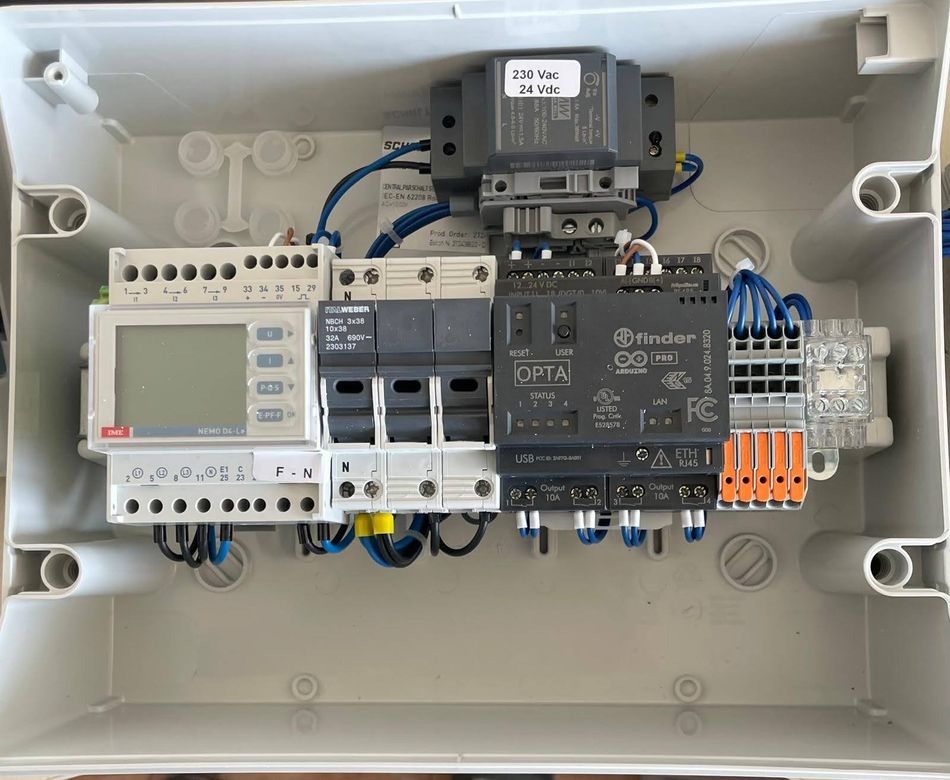
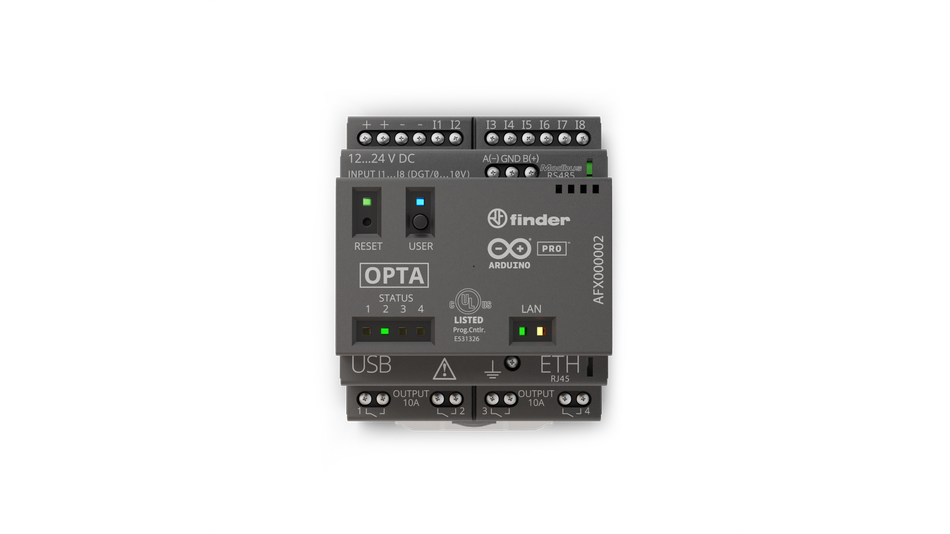
At the heart of Energietechnik’s solution is a small, modular control box built around the Arduino Opta, a micro PLC designed for industrial automation and edge computing. Opta brings together the programmability of Arduino’s open-source environment with robust industrial features such as certified relays, real-time monitoring capabilities, and IEC 61131-3 programming compatibility.
“Above all,” says Antonino Marturano, System Integrator at Energietechnik, “I love being able to program it using the Arduino language, based on C++. It opens up possibilities that traditional PLC environments just can’t offer.”
The solution also leverages Arduino Cloud, which enables secure remote access, visualization dashboards, and real-time data acquisition. This allows Energietechnik to oversee and fine-tune their clients’ electrical systems without the need for on-site visits, reducing both cost and carbon footprint.
Together, Opta and Arduino Cloud form a distributed energy control system that manages electrical loads dynamically, balancing demand across appliances, integrating renewable energy inputs, and keeping operations below the 100-kW legal threshold.
 Engineering Impact at Every Level
Energietechnik’s approach has already enabled clients to operate large-scale industrial kitchens at less than half their typical power demand – dropping usage from ~100 kW to ~49 kW, and in most cases eliminating the need for medium-voltage infrastructure altogether.
The compact unit (about the size of a shoebox and weighing around 5 kg) connects to measurement systems via Modbus and other common industrial protocols, making it ideal for retrofitting onto existing infrastructure. Its small form factor also means it replaces bulky cabinets with something more installable, transportable, and discrete.
Critically, the use of open-source software ensures there’s no vendor lock-in. Systems can be updated, customized, or integrated freely – maximizing lifespan and adaptability.
Marturano emphasizes this design philosophy: “That freedom is crucial. We can build exactly what our clients need, without compromise.”
Remote Optimization, Real Savings
Remote monitoring and automation are not only convenient – they’ve become central to achieving sustainable energy use. Energietechnik reports that the combination of Opta and Arduino Cloud reduces the need for on-site intervention by over 90%, thanks to real-time alerts, remote configuration, and predictive maintenance.
Clients also benefit from access to detailed, historical usage data, which supports continuous optimization over time. This data-led fine-tuning is essential as cities and electrical grids face saturation. “The real problem today isn’t the cost of electricity,” explains Marturano. “It’s that the grid can’t give us more than it already does. So, our mission is to use what we have as efficiently as possible. And Arduino is helping us do exactly that.”
Looking Ahead: Wireless and AI Integration
Energietechnik is now exploring wireless communication protocols such as LoRa®, Wi-Fi®, or powerline communication to further streamline installation and eliminate the need for dedicated cabling. This would allow even more scalable deployment – especially in facilities with spatial or structural constraints.
The team is also testing Portenta Machine Control, another Arduino Pro product, which may offer advantages in scenarios requiring higher-precision or deterministic control.
With active installations already operating across Italy, Belgium, the Maldives, Chile, and the UK, Energietechnik’s system is gaining traction far beyond its original scope. Their open, scalable solution is proving that power management innovation isn’t just possible – it’s practical, affordable, and essential for the energy-aware industries of tomorrow.