SIMSCAN-S Gen2: A New Benchmark in Portable High-Precision 3D Inspection
A next-generation handheld scanner that bridges the gap between traditional inspection limitations and modern production needs.

07 Apr, 2026. 8 minutes read
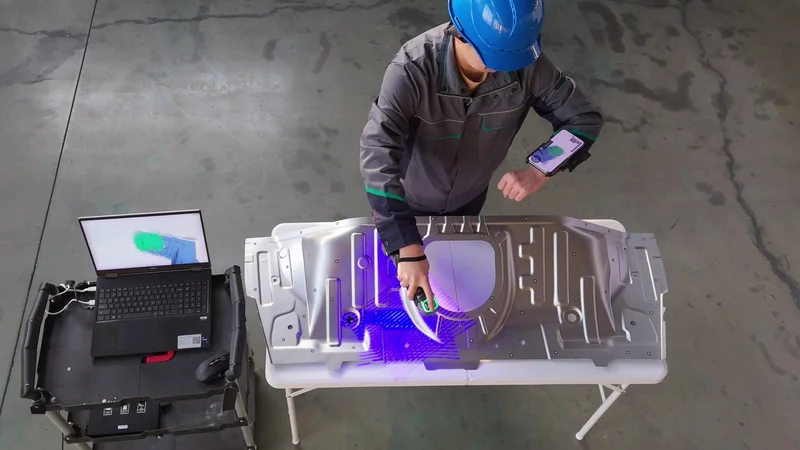
Manufacturing today is quite different from what it used to be a decade ago. With customer expectations on the rise, products are becoming more complex.[1] To keep up with the competition, companies are pushing toward reduced development time. For engineers, this means designing, validating, and producing parts swiftly. At the same time, it is crucial to adhere to the tight tolerances of modern manufacturing.[2]
While manufacturing processes are evolving with time, the inspection phase remains a bottleneck. Many companies still rely on traditional probing-based CMM tools. While they are simple and reliable, CMMs have their share of limitations. These tools can measure individual points on a surface. This works well for simple geometries, but not ideal when dealing with large parts and intricate geometries. These machines are sensitive to temperature fluctuations and vibrations. Also, CMMs do not provide a complete picture of the part. As a result, there is a possibility of defects in unmeasured areas of a part.[3]
To overcome these limitations, many industries are shifting toward full inspection workflows. Instead of measuring a few points, engineers now capture the entire geometry using 3D scanning tools. These scanners capture millions of data points across the surface. Data points are then used to create a data-rich point cloud. Engineers can utilize this data to compare the part directly with the original CAD model to find deviations.
Challenges in Modern Engineering Inspection
Increasing geometric complexity
Modern components are designed with a focus on performance and weight reduction. This has been pushing companies toward complex geometries such as curved surfaces and intricate internal features. Measuring these shapes using traditional tools is tricky and sometimes impossible.
Faster production cycles
Tight deadlines are one of the biggest challenges in manufacturing. To ensure a product gets an edge in the market, it needs to be released quickly. Companies also need to address issues highlighted through customer feedback in the next iteration. This requires a workflow that can continue without delays. Parts need to be inspected quickly to avoid a bottleneck in production.
Limited access to certain features
Many parts used in automotive and aerospace industries are not easy to measure due to deep cavities, holes, or internal features. For instance, a probe may not be able to move inside a cavity. It may even require multiple setup changes to access these regions. This increases the risk of missing errors in critical areas.
Frequent iterations and customisation
Responding to customer expectations, manufacturers are accommodating customization. To achieve this, companies work with small batches and update designs more often. This requires flexible inspection systems that can adapt quickly and can bring inspection to the factory floor rather than a dedicated lab.
High surface quality requirements
In precision industries, surface quality is critical. Even small deviations can affect the appearance of the final product. Additionally, any issue in surface quality can affect the end product’s performance. For instance, a slight problem in an airliner's surface quality can increase drag and reduce its fuel efficiency.[4]
Need for reliable data
If the measurement data is not reliable, it can lead to wrong conclusions about quality. Manual inspection methods often depend on the operator’s skill and judgment. Two people measuring the same part might get slightly different results. As a result, the system’s ability to deliver consistent accuracy takes a hit.
These challenges highlight the need for modern inspection tools that are not only accurate but also fast and easy to deploy.
Introduction to SIMSCAN-S Gen2
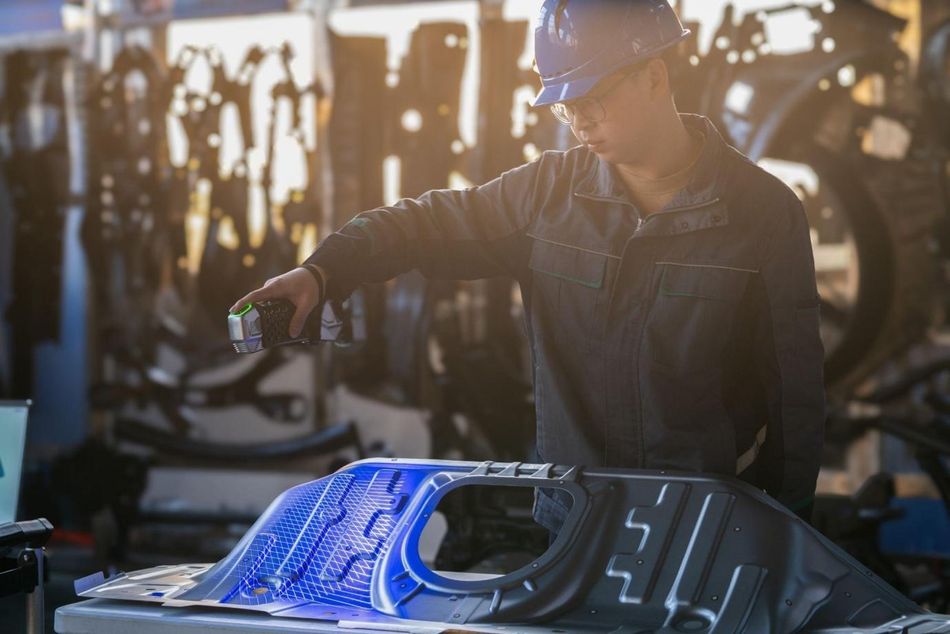
Scanology’s SIMSCAN-S Gen2 is a handheld 3D scanner designed to address the challenges of modern inspection. It combines high accuracy with a portable design. The scanner measures roughly 203 × 80 × 44 mm and weighs around 560 grams. It is small enough to be carried around the shop floor and used in tight spaces.
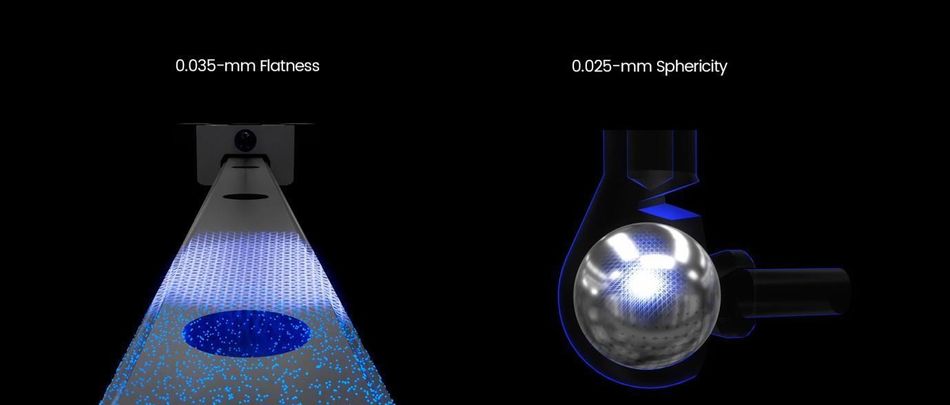
Despite its compact size, the SIMSCAN-S Gen2 delivers high measurement accuracy. It achieves up to 0.015 mm accuracy. It also supports 0.025 mm sphericity and 0.035 mm flatness. It can scan tricky features such as gaps, deep holes, slots, and channels at steep angles.
The scanner is compliant with ISO 10360 standards, which is an industry benchmark for accuracy and reliability. The SIMSCAN-S Gen2 is geared for precision industries such as aerospace and automotive.
Core Technology Behind SIMSCAN-S Gen2
Blue laser technology
The scanner uses 108 blue laser lines for data capture. Blue lasers have a shorter wavelength compared to traditional red lasers.[5] This provides several advantages. For starters, it enhances measurement accuracy. The shorter wavelength allows the scanner to capture finer details on the surface. It also performs better on reflective and dark surfaces. Additionally, it ensures better edge detection.
High-speed scanning
The SIMSCAN-S Gen2 can capture up to 8.1 million measurements per second. It operates at 180 frames per second, which allows engineers to scan parts quickly without losing detail. It is especially useful in production environments where faster scanning keeps workflows moving.
Multiple scanning modes
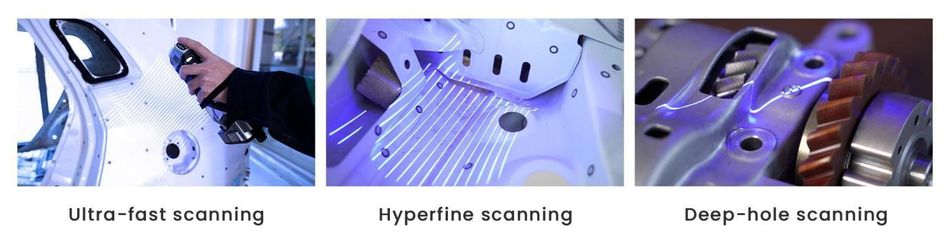
Different parts need different scanning approaches. The SIMSCAN-S Gen2 makes this possible with multiple scanning modes. The 'Ultra-fast scanning' mode helps you cover large areas quickly and efficiently. The 'Hyperfine' mode is useful when capturing intricate details. And for hard-to-reach areas like internal cavities, the 'Deep hole scanning' mode is helpful. These modes allow engineers to choose the right balance between speed and detail.
High point density
The scanner generates a dense point cloud, which is essential for accurate surface analysis. Capturing rich data improves decision-making when verifying tolerances. Additionally, creating an accurate scan of a part is essential to reverse engineering tasks.
The Role of DefinSight Software
The captured data must be processed and analyzed to be used as actionable insights. This is where DefinSight software makes a difference. The software supports the following key features:
Integrated workflow
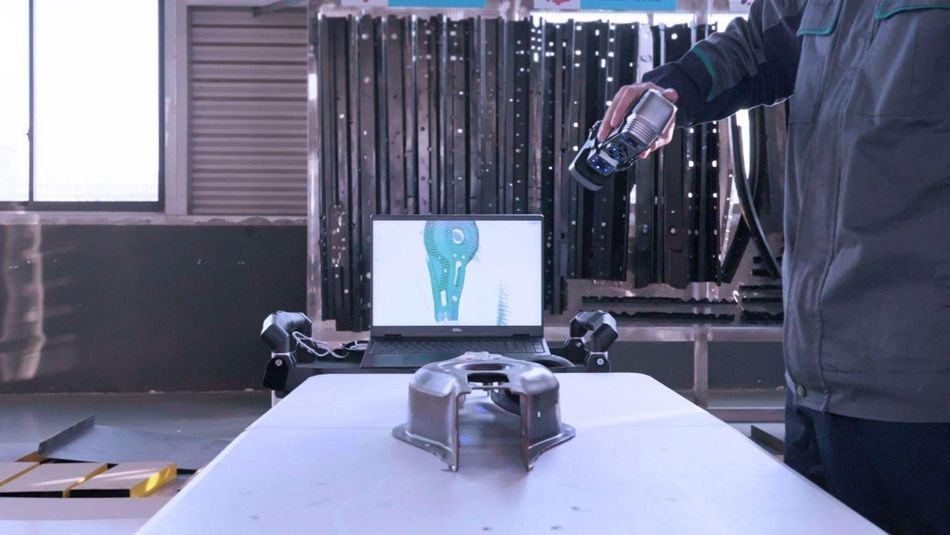
DefinSight simplifies the 3D inspection workflow by bringing scanning, data processing, and analysis into a single platform. Instead of using multiple software tools, engineers can manage everything in one place, making the process faster and more efficient.
Real-time meshing
As scan data is captured, DefinSight processes it in real time. This includes generating meshes on the go. As a result, engineers can review data and correct issues immediately. It helps reduce rework, speeds up inspections, and ensures that high-quality data is captured in a single pass.
CAD comparison
One of the most important features of DefinSight is CAD comparison. In this step, the scanned part is matched with its CAD model. The DefinSight software measures the deviations between the scanned data and the CAD design using a color map. Visual representation makes it easier to understand how much the part varies from the design.[6]
Measurement tools
DefinSight allows engineers to take measurements directly from the scan data without needing a separate tool. This includes basic dimensions such as distances, radii, and the positions of different features. For instance, engineers can quickly measure the distance between holes and check whether mounting features are in the correct position.
How SIMSCAN-S Gen2 Addresses Engineering Challenges
Durability and portability
The scanner is built with a magnesium alloy housing, which makes it durable while still keeping it lightweight. Because of this rugged build, the scanner is well-suited for wear and tear expected on shop floors and assembly areas.
Weighing in at 460 grams, the SIMSCAN-S Gen2 is easy to carry as a wireless scanner. Engineers can take it to the part instead of moving the part to a fixed setup. This is quite useful when working with medium to small sized components. By scanning parts in their actual location, companies can save time and transportation effort.
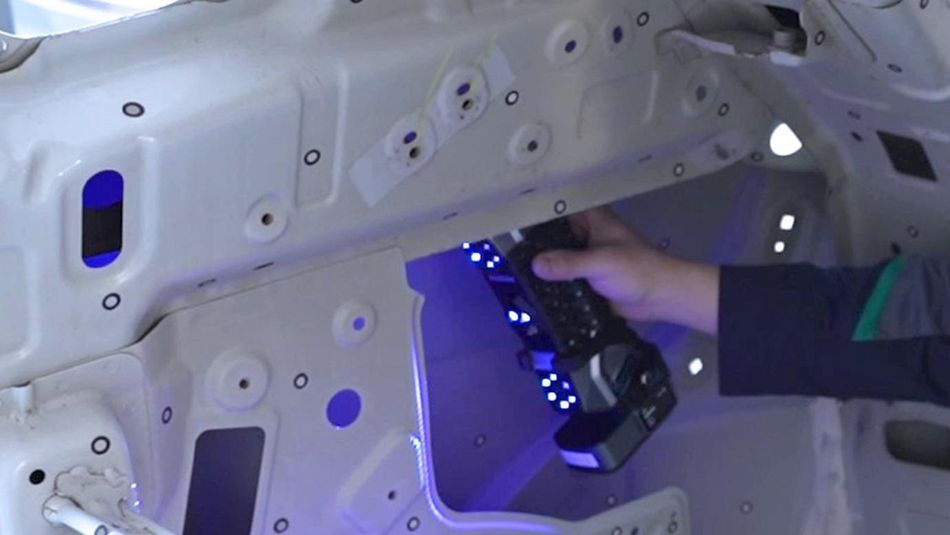 Compact design allows for use in difficult-to-maneuver environments
Easy access to tight spaces
The compact design of the scanner makes it easy to reach areas that are difficult to access. This includes tight gaps, slots, and deep channels that most 3D scanners struggle with. The onboard short-baseline camera design improves its ability to capture data in these restricted spaces. This is crucial where internal features or tight sections of the part need to be highly accurate.
Feature-based inspection
This feature enables engineers to measure specific elements of a part directly from the scan data. For instance, engineers can fit cylinders to holes to check their size and shape or validate alignment between components. These measurements are based on the actual geometry of the part, which makes them more useful for assembly validation. It helps ensure that parts will fit together correctly and work properly in the final product.
Full-field inspection
The scanner captures the entire surface of the part to create a 3D dataset instead of just measuring a few select points. This ensures that all areas of the part are inspected, including regions that might be missed with traditional probing CMM methods. Overall, you get a comprehensive understanding of the part's quality.
Case Study: Streamlining Automotive Die Inspection and Validation
Challenge
A tier-1 supplier provides large body panels to top car manufacturers across the globe. One of their critical tools is a door outer panel die. Over time, their die started showing signs of wear due to repeated use. This led to surface deviations on stamped panels, which became noticeable during final assembly in the form of uneven reflections and misalignments.
The company relied on a bridge-type CMM to inspect specific sections of the die. Due to its size and complex curved geometry, only limited points could be measured. Removing the die for inspection caused production downtime. The engineering team needed a solution that could capture the entire surface and provide actionable insights without disrupting the workflow for too long.
Solution
The team deployed the SIMSCAN-S Gen2 directly on the shop floor. Since the die was large and heavy, portability turned out to be a key advantage.
Using the scanner’s ultra-fast mode, engineers first captured the full surface of the die to get a complete dataset. Next, the hyperfine mode was used for areas suspected of wear. This allowed the team to capture subtle deviations. To inspect recessed features and narrow grooves, the deep hole scanning mode was used.
The scanned data was then processed in DefinSight software. The data was aligned with the CAD model of the die. The color map feature was used to perform deviation analysis. This visual representation made it easy to identify problem areas across the entire die surface. In addition to surface comparison, engineers performed feature-based inspection to check whether the die would produce parts within acceptable tolerances.
Results
The adoption of the SIMSCAN-S Gen2 led to measurable improvements. First, the inspection time was reduced significantly compared to traditional methods. Full surface coverage eliminated blind spots in inspection. It also became easier to trace defects, as issues in the final part could be traced back to worn regions of the die. Another major benefit was reduced downtime, as the die was inspected directly on the press line and the resulting data was used for predictive maintenance.
Conclusion
As parts become more complex and tolerances more precise, inspection becomes more demanding. Engineers need tools that can deliver accurate results without slowing down production. 3D scanning addresses this need by capturing the complete geometry of a part. This makes it easier to detect deviations and validate parts with confidence.
The SIMSCAN-S Gen2 takes it further by offering metrology-grade accuracy in a handheld form factor. The DefinSight software converts raw scan data into usable information with features such as real-time processing, CAD comparison, and measurement tools.
For teams aiming to improve inspection efficiency, maintain quality, and reduce turnaround time, the SIMSCAN-S Gen2 offers a practical solution. It supports a flexible and data-driven inspection workflow, aligned with the needs of modern manufacturing.
To find out how Scanology’s solutions can modernize your inspection workflow, click here to book a demo.
References:
- https://www.pelico.ai/resources/our-articles/how-the-new-consumer-trends-are-impacting-industrial-production
- https://www.alco.com/blog/achieving-perfection-the-importance-of-tight-tolerance-parts-in-modern-manufacturing
- https://cmm-compass.com/about/merit-and-demerit.html
- https://www.aero-mag.com/surface-roughness-and-its-impact-on-performance-and-durability
- https://www.3d-scantech.com/blue-vs-white-light-vs-laser-scanning-the-ultimate-guide
- https://measuremetrology.com/cmm-services/color-mapping