Second-generation 48V-to-12V bus converters cut full-load losses
OmniOn Power's new Osprey bus converters dissipate about 30% less at 54 V input and full load. Applications include data centers and high-density computing, distributed power architectures, and 12V intermediate bus applications.

05 Oct, 2026. 5 minutes read
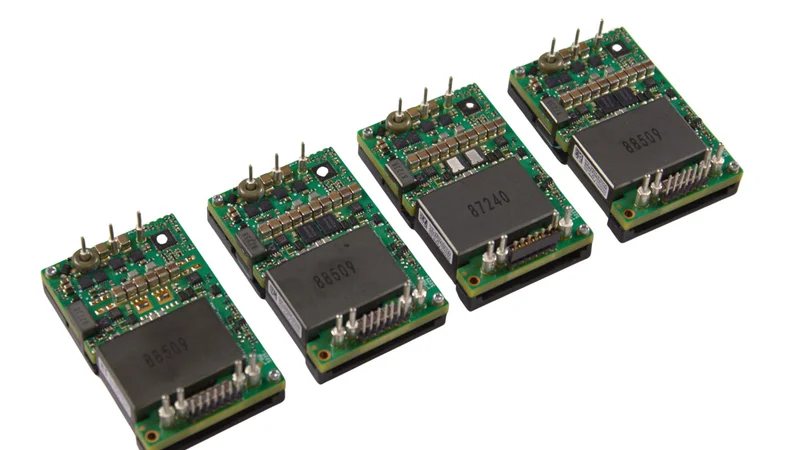
OmniOn's QODN Osprey bus converters.
What was announced
OmniOn Power, a power conversion manufacturer, announced four QODN bus converters as the second generation of its Osprey family: non-isolated, regulated modules that convert a 40 to 60 V rack supply to a 12 V intermediate bus.[1][2] The QODN108, QODN136, QODN167 and QODN217 deliver 1.3, 1.6, 2.0 and 2.6 kW in a 58.4 × 36.8 × 14.5 mm quarter brick, the same outline as the first-generation QODE modules launched in February 2025, which stopped at 2 kW. OmniOn claims a peak efficiency of up to 98.5%, "high, flat efficiency curves across their operating band", and up to 1% better efficiency than the QODE generation.[1][3]
Why it matters
The 2 kW QODN167 reaches a typical 98.0% at 54 V input, full load and 25 °C ambient, against 97.1% for the first-generation QODE167. Our calculation (loss = output power × (1/efficiency - 1)) puts dissipation at about 41 W for the QODN167 and 60 W for the QODE167, about 32% less. The QODN136 and QODN108 come out about 30% and 33% below the QODE136 and QODE108. At 20% load and 54 V the QODN167 curve reads about 97.5% against the QODE167's 96.2%, a wider gap.[4][5][6][7][8][9]
The 2.6 kW QODN217, at a typical 97.8% at 54 V and full load, dissipates about 58 W by the same calculation, close to the QODE167's 60 W. Derating curves agree: with a 25.4 mm high heatsink and about 3 m/s airflow at 54 V, the QODE167, QODN167 and QODN217 hold full current to roughly 46 °C, 65 °C and 47 °C ambient respectively.[2][4][5]
Flex Power Modules' BMR352, a competing regulated, non-isolated quarter brick announced in November 2024, is rated 2 kW continuous in the same outline, at a typical 97.5% at 54 V and full load, specified at a 25 °C module reference temperature where OmniOn uses 25 °C ambient. Advanced Energy's NDQ1600, a 1.6 kW module of the same type launched in August 2025, reaches 96.8% at full load and 50 V input.[10][11][12][13]
All four QODN models are most efficient at 51 V, then 54 V, among the 40, 51, 54 and 60 V curves OmniOn plots, over most of the load range. Those are the two nominal power shelf outputs in the Open Compute Project's Open Rack V3 (ORv3) specification.[14] At the 40 V minimum and full load, the QODN167's typical efficiency falls to about 95.8%, below roughly 97.5% for the QODE167 and 97.9% for Flex's BMR352. The QODN217 falls to about 94.7%, about 143 W on OmniOn's dissipation plot.[2][4][5][6][8][11]
Technical specifications: OmniOn Power QODN Osprey bus converters (2nd generation), by model.
Full part numbers add the suffix A0B.
| Spec | QODN108 | QODN136 | QODN167 | QODN217 |
|---|---|---|---|---|
| Continuous output power | 1300 W | 1600 W | 2000 W | 2600 W |
| Rated output current | 108 A | 136 A | 167 A | 217 A |
| Input voltage | 40 to 60 V (54 V nominal) | 40 to 60 V (54 V nominal) | 40 to 60 V (54 V nominal) | 40 to 60 V (54 V nominal) |
| Output voltage | 12.0 V regulated, 9.5 to 12.5 V programmable | 12.0 V regulated, 9.5 to 12.5 V programmable | 12.0 V regulated, 9.5 to 12.5 V programmable | 12.0 V regulated, 9.5 to 12.5 V programmable |
| Isolation | Non-isolated | Non-isolated | Non-isolated | Non-isolated |
| Footprint | Modified DOSA digital quarter brick | Modified DOSA digital quarter brick | Modified DOSA digital quarter brick | Modified DOSA digital quarter brick |
| Converter topology | not stated in datasheet | not stated in datasheet | not stated in datasheet | not stated in datasheet |
| Efficiency, full load, 54 V in, 25 °C ambient (typical) | 98.1% | 98.1% | 98.0% | 97.8% |
| Efficiency, full load, 51 V in, 25 °C ambient (typical) | 98.2% | 98.2% | 98.1% | 97.9% |
| Highest tabulated efficiency, 51 V in, 25 °C ambient (typical) | 98.4% at 60% load | 98.5% at 60% load | 98.5% at 60% load | 98.5% at 50% load |
| Guaranteed minimum efficiency | not stated | not stated | not stated | not stated |
| Surge output power | 1800 W for 70 ms in a 400 ms period | 2400 W for 3 ms in a 16 ms period (40 to 48 V in) or 70 ms in a 400 ms period (48 to 60 V in) | 3000 W for 3 ms in a 16 ms period (45 to 60 V in) | 4000 W for 3 ms in a 16 ms period (45 to 60 V in) |
| Switching frequency | 140 kHz | 140 kHz | 140 kHz | 140 kHz |
| Maximum input fuse | 40 A | 40 A | 80 A | 80 A |
| Thermal limit | 95 °C at reference point TH1 | 95 °C at reference point TH1 | 95 °C at reference point TH1 | 95 °C at reference point TH1 |
| Operating ambient | -40 to +85 °C, with current derating | -40 to +85 °C, with current derating | -40 to +85 °C, with current derating | -40 to +85 °C, with current derating |
| Dimensions (standard height) | 58.4 × 36.8 × 14.5 mm | 58.4 × 36.8 × 14.5 mm | 58.4 × 36.8 × 14.5 mm | 58.4 × 36.8 × 14.5 mm |
| Weight with base plate | 85.8 g | 86.6 g | 90 g | 90 g |
| Digital interface | PMBus, subset of the 1.2 command set | PMBus, subset of the 1.2 command set | PMBus, subset of the 1.2 command set | PMBus, subset of the 1.2 command set |
| IPC-9592 compliance as listed | Category 2, Class I | Category 2, class not stated | Category 2, Class I | Category 2, Class I |
| Calculated MTBF (Telcordia SR-332, 80% load, Tc 40 °C, about 1 m/s airflow) | 5.78 million h (Issue 3) | 5.68 million h (Issue 4) | 4.99 million h (Issue 4) | 4.05 million h (Issue 3) |
Sources: [2][4][6][8][15]
With a 25.4 mm high heatsink and about 3 m/s airflow at 54 V input, the QODN217 delivers roughly 120 A at 85 °C ambient. The QODN datasheets plot derating only at 51 V and 54 V input, so thermal behavior between 46 and 50 V, the lower part of the tolerance band for ORv3's 51 V option, has to be estimated or measured.[2][4][6][8][14] The QODN167 keeps the QODE167's pin assignment but needs twice the minimum external input capacitance (2 × 330 µF). The QODN217, QODN167 and QODN108 datasheets list IPC-9592 Class I where the QODE167 and QODE136 list Class II, and the QODN parts' calculated MTBF is lower at each shared rating.[2][4][5][6][7][8][9]
References
- OmniOn Power's Next-Generation Osprey Bus Converters Provide High, Flat Efficiency for AI Data Center Applications, Business Wire, 1 October 2026
- QODN217A0B: Osprey Series DC-DC Converter, OmniOn Power, 30 July 2026. Manufacturer datasheet, revision 3.46.
- OmniOn Power Introduces New Osprey-Series Non-Isolated Bus Converters for AI Server Applications, OmniOn Power, 27 February 2025
- QODN167A0B: Osprey Series DC-DC Converter, OmniOn Power, 5 August 2026. Manufacturer datasheet, revision 3.28.
- QODE167A0B: Osprey Series DC-DC Converter, OmniOn Power, 3 August 2026. Manufacturer datasheet, revision 1.16, first generation.
- QODN136A0B: Osprey Series DC-DC Converter, OmniOn Power, 5 August 2026. Manufacturer datasheet, revision 1.37.
- QODE136A0B: Osprey Series DC-DC Converter, OmniOn Power, 29 July 2026. Manufacturer datasheet, revision 1.8, first generation.
- QODN108A0B: Osprey Series DC-DC Converter, OmniOn Power, 29 July 2026. Manufacturer datasheet, revision 2.19.
- QODE108A0B: Osprey Series DC-DC Converter, OmniOn Power, 29 July 2026. Manufacturer datasheet, revision 2.0, first generation.
- BMR352 delivers unmatched power density, Flex Power Modules, 6 November 2024
- Datasheet BMR352 2200/031: 2000 W digital quarter brick DC/DC IBC, Flex Power Modules, 3 July 2025
- Advanced Energy Launches 1300 and 1600 W Ultra Efficient DC-DC Converter, Advanced Energy, 27 August 2025
- Artesyn NDQ1600 Series 1600W Quarter-Brick DC-DC Converter, Advanced Energy, 25 July 2025. Manufacturer datasheet.
- Open Rack V3 Base Specification, Revision 1.0, Open Compute Project, 22 September 2022. Section 12.1.
- Osprey Bus Converters, OmniOn Power, DigiKey, accessed 5 October 2026. Distributor listing; stock and prices change.