Privacy-Conscious Human Pose Estimation in Healthcare with Aratas's B5L and OKAO Vision AI
Aratas's B5L 3D Time-of-Flight sensor and OKAO Vision AI-powered Human Pose Estimation software enable privacy-conscious, real-time fall detection and posture monitoring in healthcare settings, ensuring reliable, lighting-independent, and camera-free human-aware automation.

15 Dec, 2025. 8 minutes read
Executive Summary
The demand for privacy-conscious monitoring solutions that can detect human activity and falls without capturing identifiable images is increasing in the healthcare industry. Aratas's Human Pose Estimation (HPE) software, powered by OKAO Vision AI, works with the B5L 3D Time-of-Flight (TOF) sensor to deliver intelligent, camera-free, and lighting-independent monitoring in healthcare environments.
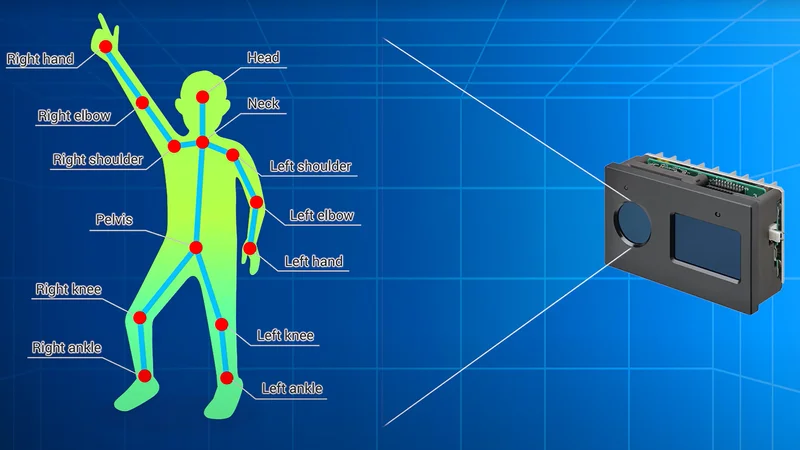
The B5L sensor measures 3D distance data using 940 nm near-infrared (NIR) light, accurately detecting both stationary and moving people under any lighting condition. When paired with HPE software, it transforms depth data into 13 skeletal points for real-time analysis of posture and motion. This unlocks applications like fall detection, mobility assessment, and rehabilitation monitoring.
Aratas's B5L and OKAO Vision AI-based HPE solution runs efficiently on standard PCs without using a Graphics Processing Unit (GPU), and the system integrates easily into existing infrastructure. Aratas enables healthcare providers and industries to transform monitoring and automation with intelligent, privacy-conscious sensing.
The Need for Privacy-Conscious Human Sensing
As the global population ages, there is a constantly growing need for monitoring. While the workforce available to cater to this requirement is also increasing steadily, there will never be enough to meet the demands. This gap has given rise to automated healthcare technologies across hospitals, nursing homes, and rehabilitation centers that can recognize when assistance is required and even offer help.

Traditionally, monitoring solutions include visible-light cameras that capture images or videos of a scene. They are integrated with systems that process this data with the help of image-processing software to recognize objects, movements, or identify people. These cameras depend on ambient illumination or artificial lights to form a clear picture of the scene. These cameras inevitably end up capturing everything visible to the human eye, including the faces and personal identities of the people in the scene, which may be unsuitable for situations where privacy must be protected.
Alternative technologies, such as LiDAR, measure only the distance but come with other drawbacks, such as high cost, bulky form factor, and high power requirements. This makes such alternatives less suitable for most environments.
The healthcare sector needs a monitoring technology that is:
Privacy-conscious, ensuring that no photographs or videos are captured
Intelligent, capable of detecting activities like falls
Compact, allowing it to be deployed in confined spaces
Light-independent, operating in both extremely bright and dark environments
Reliable, designed for continuous operation for a long period with minimal maintenance
Aratas addresses these needs with a cutting-edge solution that brings human-aware automation to privacy-conscious healthcare environments. The solution includes Aratas 3D TOF sensor modules and the HPE software that enable healthcare systems to monitor activity without capturing any visual imagery.
Aratas's B5L 3D TOF Sensor Module
On the hardware front, the solution is powered by Aratas's B5L 3D TOF sensor, which is a highly compact device engineered for precise depth measurement. The sensor captures 3D distance data by measuring the time it takes for modulated light to reflect off surrounding objects and return to the detector.
Precise NIR Sensing

The B5L works by emitting 940 nm NIR light, a wavelength outside the visible spectrum of the human eye, making the measurements completely non-intrusive. This NIR-based sensing method enables distance sensing with ±2% accuracy at a distance of 2 m, even under extreme ambient light levels.
High Stability and Interference Prevention
Aratas B5L can operate reliably in multi-sensor setups without signal overlap. A key feature of the product is its proprietary interference-prevention technology that allows up to 17 units of the sensors to operate simultaneously by dynamically adjusting the frequencies of the emitted light. This lets system designers scale the system from a single room to multiple rooms or wide spaces within a large facility.
Compactness and Robustness in Design
The product measures 108.6 mm X 64.3 mm X 43.1 mm and weighs approximately 305 g. This makes it easy to integrate it into wall-mounted, ceiling-mounted, or embedded systems. It also has a heat-dissipation structure that ensures the product can operate for 5 years continuously, making it suitable for permanent installations in smart healthcare facilities and smart infrastructure.
Versatile Output and Coordinate Systems
The sensor module is capable of outputting measured depth data in multiple coordinate systems, including Cartesian, rotated Cartesian, and polar, depending on the system requirements. HPE software uses a combination of polar coordinates and amplitude image to enable various standalone applications in healthcare and beyond.
Hardware Foundations for HPE Software
On its own, the Aratas B5L 3D TOF sensor can detect both stationary and moving objects, including humans, making it suitable for diverse environments such as service robots, industrial safety systems, and smart spaces that require precise spatial awareness.
While the B5L can function as a highly reliable standalone distance sensor, its full potential is realized when it is paired with Aratas HPE software. The integrated solution transforms raw 3D distance maps to interpretable human skeletal models, unlocking use cases where both privacy and contextual understanding are necessary.
HPE software Powered by OKAO Vision AI
Aratas's HPE software transforms depth data from the B5L sensor module into meaningful human posture information in real time. It uses Aratas's OKAO Vision AI technology to recognize, interpret, and quantify human motion without capturing any identifiable imagery.
AI-Driven Skeletal Point Extraction
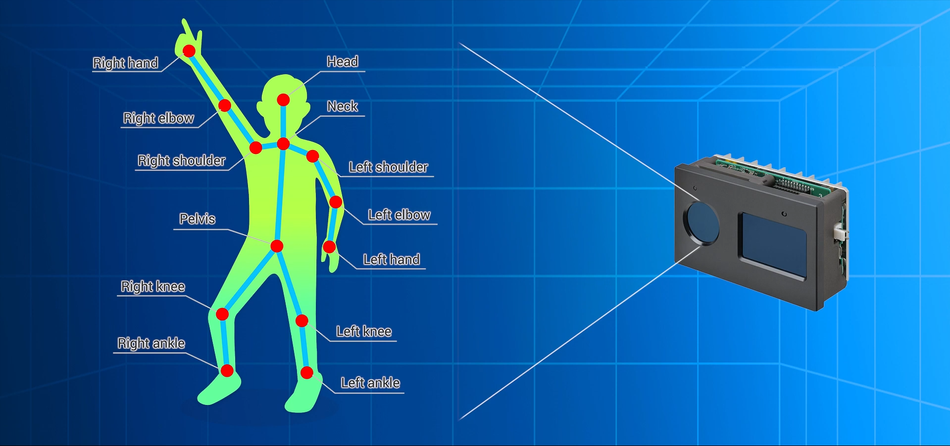
OKAO Vision AI is a comprehensive software library for human-specific image sensing technologies. The AI model for HPE is trained to interpret 3D distance maps from the B5L sensor module and generate 13 human skeletal points, including the head, shoulders, elbows, hips, and knees.
Each skeletal point is output with coordinates and confidence level, allowing downstream applications to assess posture and movement. Analyzing the continuous stream of distance maps from the B5L sensor module makes it possible to detect transitions in human pose. Specific transitions, like from standing to lying, can indicate a potential fall or a health incident.
Real-Time, GPU-Less Edge Processing
Aratas's HPE software comes with an efficient processing architecture. The lightweight and high-speed OKAO Vision AI runs on standard computing hardware without requiring a Graphics Processing Unit (GPU). Practically, PCs with a recent generation of Intel® Core™ Series processors can easily handle HPE tasks on the edge at approximately 5 FPS.
Reliable in All Lighting Conditions
As the B5L sensors use 940 nm NIR illumination, the system maintains a stable performance under all practical lighting conditions, like bright sunlight, artificial lights, or complete darkness. The software also uses enhancements powered by deep learning to minimize false detections caused by environmental objects like beds and chairs, further improving the reliability in cluttered and ever-changing indoor spaces.

Multi-Person and Multi-Posture Recognition
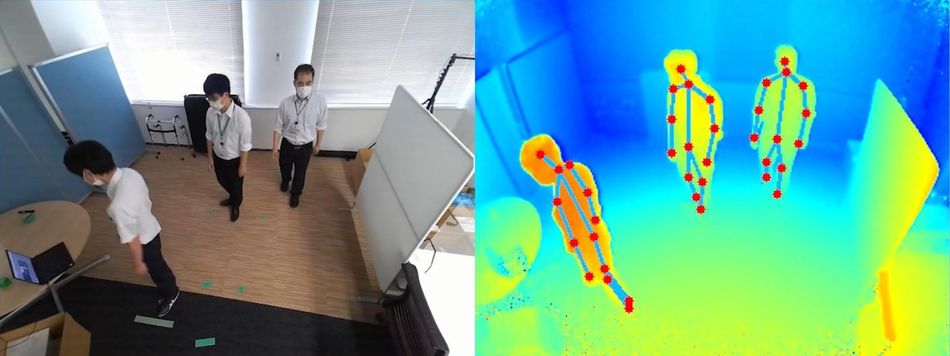
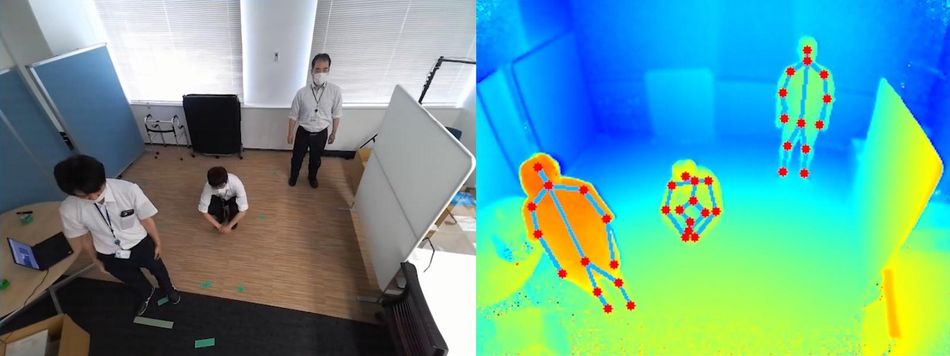
When multiple subjects are present in the scene, the HPE software can detect and track up to three people simultaneously. If more than three subjects are present, the system prioritizes the most confident skeletal detections. The software supports the detection of a wide range of posture states and movements, such as:
Standing
Walking
Bending
Sitting
Lying down
Proposed Application: Real-Time Fall Detection in a Nursing Facility
Falls and Tumbles are known to be the most frequent accidents that endanger patient safety in nursing and elderly-care environments. Caregivers often need to continuously monitor the residents and respond immediately in the event of an accident, which significantly increases the workload, especially in facilities with multiple patients and limited staff.
In the following section, we illustrate how a nursing facility could replace a camera-based monitoring system with a privacy-conscious fall detection system that combines the Aratas B5L 3D TOF sensor module with HPE software. This proposed application demonstrates how the system can enable continuous and non-intrusive monitoring of a person’s posture and movement in a room in real-time.
In this scenario, let’s consider a nursing facility that intends to implement a privacy-conscious fall detection system that combines a B5L 3D TOF sensor module with HPE software. The objective is to enable continuous and non-intrusive monitoring of a person’s posture and movement in each room in real-time.
System Overview
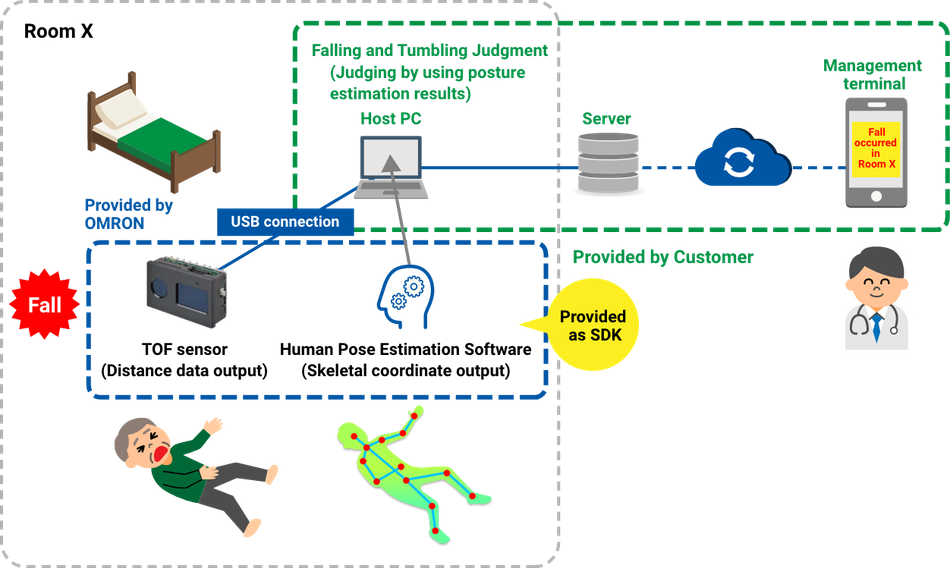
The proposed system includes a combination of hardware and software components to meet the monitoring requirements set by the customer.
A B5L TOF sensor module would be installed in each room. The sensors would capture depth data maps using NIR illumination, invisible to the human eye.
The sensor data would be routed to the HPE software, powered by OKAO Vision AI, to provide 13 human skeletal points along with their coordinates and confidence levels.
The HPE software would run on a Host PC, and it would interpret the information provided by the software to identify body posture. The system would be configured to detect a fall or extended periods of inactivity.
In case of a detected fall or extended inactivity in any room, the host PC would immediately trigger an alert to a cloud server, customised to push a high-priority notification to the caregiver's smartphone.
Expected Results and Outcomes
Post deployment, the system could offer improvements across the nursing facility, such as:
Reliable performance round-the-clock: The system is expected to operate consistently in daytime, when the sunrays hit the room directly, and at night, when the room turned pitch-black. This would be a key improvement over the camera-based monitoring system that could struggle in low-light conditions and cause privacy concerns among the elderly and patients.
Reduced caregiver workload and faster response: Caregivers who had to constantly patrol the rooms or watch the camera feeds would be able to prioritise the tasks that actually need attention. In case of accidents, they will be able to immediately respond and manage the situation.
Enhanced privacy and satisfaction: Residents and families would likely express higher satisfaction levels knowing that the monitoring system would no longer capture or store footage of the room. This could also help the facility meet the internal privacy standards while improving the accident-detection process.
Seamless integration with existing infrastructure: Since the system would be capable of working without a GPU, it can be integrated with the existing IT systems of the facility without the need for any major investments. The system will require minimal calibration.
Additional Applications Beyond Fall Detection
Beyond fall-detection, the same setup’s capabilities could be expanded further to support additional application scenarios.
Caregivers could analyze the activity levels, motion range, and body orientations of the users to gather insights about their daily movement patterns. These insights would allow caregivers to evaluate a patient’s mobility and identify early signs that could potentially lead to complications later. This way, a nursing facility can enhance a reactive fall-detection system and turn it into a preventive system that could predict accidents before they occur.
The collected data could also be used for the assessment of rehabilitation progress. By tracking posture transitions, range of motion, and symmetry in movement, therapists can assess recovery more objectively without requiring the patients to use wearable sensors or undergo manual observations.
Conclusion
As the healthcare industry moves ahead with a more connected and automated infrastructure, the need for intelligent and privacy-conscious automation is more prevalent than ever. Aratas's HPE solution, including the B5L 3D TOF sensor module and HPE software powered by OKAO Vision AI, provides a technically precise and ethically designed way of building the next generation of monitoring systems.
The intelligent platform enables healthcare providers to detect falls, monitor posture, and interpret activity without recording, storing, or transmitting any identifiable imagery. The highly versatile system supports deployment with a single sensor per room, multiple rooms, or multiple sensors within a large space. It captures accurate depth data in conditions ranging from complete darkness to full daylight, all without requiring a GPU.
Whether integrated into nursing care facilities, rehabilitation systems, or smart healthcare systems, the HPE solution acts as an enabling platform for privacy-conscious AI vision.
Get in touch with Aratas to bring next-generation sensing intelligence to your applications.
References
[1] Nursing Home Abuse Center. Falls in Nursing Homes [Internet]. Reviewed by Julie Rivers, MBA, Eldercare Advocate & Expert. Available from: https://www.nursinghomeabusecenter.com/nursing-home-injuries/falls-fractures/
[2] OMRON. 3D TOF Sensor Module B5L [Internet]. Kyoto (Japan). Available from: https://components.omron.com/us-en/sites/components.omron.com.us/files/ds_related_pdf/E598-E1.pdf
[3] OMRON. B5L 3D TOF Sensor Module: Real-time 3D sensing of distance to humans or objects [Internet]. Kyoto (Japan). Available from: https://components.omron.com/us-en/sites/components.omron.com.us/files/datasheet_pdf/E597-E1.pdf