Micro-machined 150 A relay targets the slow step in hybrid DC breakers
Californian company Atomic Machines announced a surface-mount relay it says opens to 1,500 V isolation in 50 µs, for 800 V DC data centers.

08 Oct, 2026. 4 minutes read
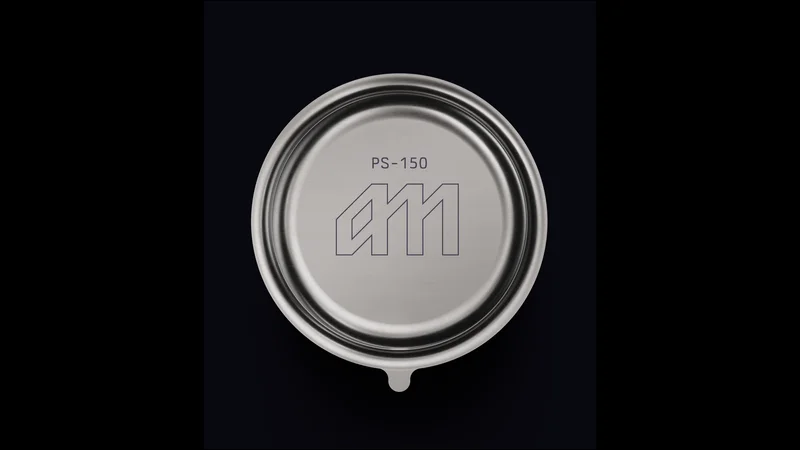
PrimeSwitch relay by Atomic Machines
What is the announcement
On October 7, 2026, Atomic Machines announced PrimeSwitch PS-150, a bistable electromechanical relay designed as the metal contact in hybrid circuit breakers for 800 V DC AI data centers. Atomic Machines says PS-150 is made on the Matter Compiler, its new micro-machine manufacturing system, which builds multi-material parts with features down to single-digit microns from design files, without masks or hard tooling.[1][2] The New York Times reports the system's 13 automated machines build and test components, while engineers move parts between machines and help assemble the final device.[3] PS-150 is rated 150 A continuous with 200 µΩ on-resistance and opens to 1,500 V galvanic isolation in 50 µs, Atomic Machines says; it is sampling to early-access customers.[1][4]
Why it matters
NVIDIA's 2026 800 VDC white paper credits solid-state circuit breakers (SSCBs) and hybrid breakers with ultra-fast DC clearing. For 125 A branches in initial systems NVIDIA accepts molded-case circuit breakers (MCCBs), though clearing in up to about 20 ms needs feed redundancy or extra hold-up time, and expects SSCBs to take over.[5]
In a December 2025 paper, Siemens and NVIDIA engineers put SSCB interruption below 0.5 ms, at the cost of conduction heat, and hybrid breakers, which conduct through metal and interrupt with a parallel semiconductor, at 1 to 3 ms, because the semiconductor waits until the contact opens far enough not to break down.[6]
PS-150 is aimed at that wait. If the 50 µs figure holds, a hybrid could approach SSCB interruption times with what Atomic Machines calls a small bypass, provided fault current rises slowly enough.[1][6] Atomic Machines' 2024 patent application, written for smart breakers in building load centers, describes a MEMS relay about 10 mm across that opens in 50 µs or less, noting that a MOSFET bypass's conduction energy grows with the cube of opening time when fault current rises linearly.[7]
A comparable surface-mount part, rated on different terms, is Menlo Micro's MM9200 MEMS switch: 10 A, 300 V minimum breakdown, 6 mΩ typical and 10 µs maximum switching time, in a preliminary brief. Menlo said in 2024 its U.S. Navy breaker would pair the MM9200 with a solid-state switch, and in March 2026 reported a 1,000 V, 500 A panel of four 1,000 V, 125 A modules.[8][9][10]
An Atomic Machines patent on a MEMS power relay, which does not name PS-150, describes a magnetically latching laminated actuator moving a crossbar across two 200 µm gaps in sealed nitrogen, with liquid-metal contacts tested below 100 µΩ.[11]
A breaker built around PS-150 still needs fault detection, a pulse driver, the semiconductor and its energy absorber, and a series isolating contact, because the semiconductor leaks when off.[6][7]

Technical specifications: PrimeSwitch PS-150
| Spec | Value |
|---|---|
| Type | Bistable (latching) electromechanical relay, SPST |
| Continuous current | 150 A, AC or DC, no active cooling needed |
| On-resistance | 200 µΩ |
| Opening time | 50 µs to 1,500 V |
| Galvanic isolation (open) | 1,500 V |
| Holding power | Zero |
| Package | Hermetically sealed SMD, 9.5 mm diameter × 3 mm |
| Current interruption | Not stated (in the vendor's hybrid-breaker use, a parallel solid-state bypass interrupts) |
| Actuation drive (pulse current, voltage, energy) | Not stated |
| Operating temperature range | Not stated |
Sources: [1][4]; all values as stated by Atomic Machines.
At 150 A, the stated 200 µΩ means a 30 mV drop and about 4.5 W of conduction loss (our calculation, assuming the resistance holds at full current and temperature). Before designing PS-150 in, an engineer needs its actuation drive, its endurance under fault openings and the temperature basis of its 150 A rating, which set the driver, the reliability case and the thermal design. In its 2024 patent application, Atomic Machines times opening from the open command to a gap that holds the rated voltage; if PS-150's 50 µs is timed the same way, it sets how long the bypass semiconductor must carry the rising fault current.[4][7]
Recommended Reading: Power Architecture for AI Data Centers: The Shift Toward HVDC Distribution. Why rack power approaching 1 MW pushes distribution from 48 VDC to 800 VDC or ±400 VDC, with the current and busbar-loss arithmetic behind the shift.
References
- Atomic Machines Emerges from Stealth with $250 Million to Launch the Matter Compiler, an AI-Native Manufacturing System That Builds Micro-Machines from Code, Business Wire, October 7, 2026 (company press release)
- The Matter Compiler, Atomic Machines, accessed October 7, 2026 (company web page)
- The startup that wants to build ‘microrobots’ with AI, The New York Times (Cade Metz), republished by The Star, October 8, 2026
- PrimeSwitch, Atomic Machines, accessed October 7, 2026 (product page)
- 800 VDC Architecture: Industry Alignment & Execution, NVIDIA, 2026 (white paper)
- Protections for Data Centers Powered by Direct Current, Siemens Industry, December 2025 (technical paper by Siemens and NVIDIA engineers)
- US20240396324A1: Hybrid digitally controlled circuit breaker utilizing MEMS relay, Atomic Machines (applicant), published by the USPTO, November 28, 2024 (patent application)
- MM9200 Power Switch, preliminary product brief v6.6, Menlo Microsystems, undated
- Menlo Microsystems Awarded Defense Innovation Unit Contract to Develop Advanced Circuit Breakers for Defense Systems, Menlo Microsystems, August 6, 2024 (company press release)
- Menlo Micro Achieves Key Milestone in U.S. Navy Advanced Circuit Breaker Program, Validating Scalable MEMS Power Switching Leadership, Menlo Microsystems, March 23, 2026 (company press release)
- US12469659B2: Microelectromechanical systems power relay, Atomic Machines (assignee), granted November 11, 2025 (US patent)