Podcast: Moby Dick Finally Gets a Fitbit
In this episode, we explore how Ocean Alliance uses 3D-printed drone systems to deploy wearable tags on whales, unlocking continuous data on how these giants move, dive, and live underwater.

05 Mar, 2026. 13 minutes read
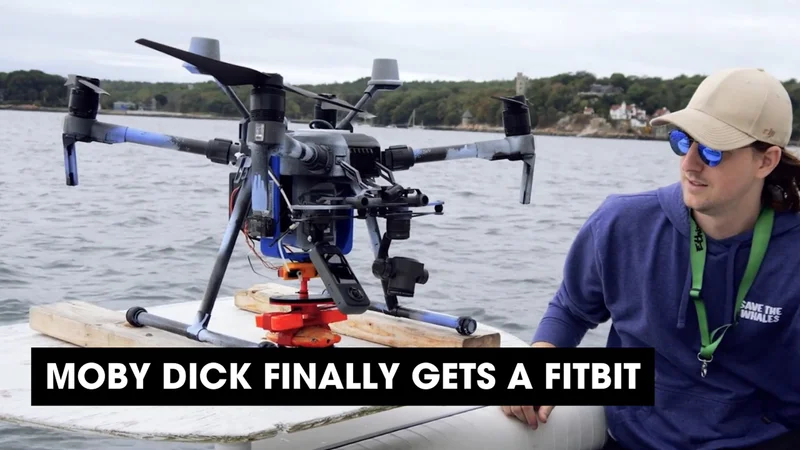
In this episode, we explore how Ocean Alliance uses 3D-printed drone systems to deploy wearable tags on whales, unlocking continuous data on how these giants move, dive, and live underwater.

This podcast is sponsored by Mouser Electronics.
Episode Notes
(3:07) How Ocean Alliance Uses 3D Printing for Drone-Based Whale Tagging
(06:04) Innovative Solutions: The Snapbot and Snot Analysis
(12:10) The Role of Additive Manufacturing in Whale Research
This episode was brought to you by Mouser, our go-to source for electronics parts for any hobby or prototype. Click HERE to learn more about how to make healthcare more customizable with 3D printing.
Become a founding reader of our newsletter: http://read.thenextbyte.com/
Transcript
Welcome aboard, matey. On this episode of the Next Byte Podcast, we are going whale watching. That's right. Not whale hunting, whale watching. We're going to be looking at drones and whales and additive manufacturing and how we can better understand our own ecosystem. So, if that's got you excited, then pirate up. Let's get into it.
What's up friends, this is The Next Byte Podcast where one gentleman and one scholar explore the secret sauce behind cool tech and make it easy to understand.
Farbod: What's going on folks. Welcome back to the Next Byte. Today we're talking about whales, whale watching and drones. So that's already pretty exciting, but before we get started, let's talk about today's sponsor and that's going to be Mouser Electronics. So, if you've been with us at any point over the last five years, you know we like working with Mouser because they're very aligned with what we try to do here at the Next Byte, right? They learn about interesting stuff from both their partners in academia and industry. Then they try to share that information with everybody else through their technical resources. Well, today we're linking one of those technical resources in the show notes. And it goes over how additive manufacturing, a.k.a 3D printing, is being used by medical professionals to create implantable medical devices. Big term, but really what it boils down to is like implantables. Like if you have a hip replacement, for example, they talk about how the original approach for doing stuff like that was incredibly time consuming on the manufacturing side. It was limited in terms of like the designs you could do because you were constrained by the manufacturing approaches available to you. And even on material finishes, there was a very set number of parameters you could fine tune to make it work with someone's body. And then all of a sudden you had this additive manufacturing revolution, which allowed doctors to work with engineers to use 3D printing to come up with whatever design they want that best suits each patient's bodies. So, they talk about how creating microstructures allows you to benefit from a metal like titanium so that ah instead of just being one solid piece, you can have these voids in there. So, as the patient moves, it kind of bends with their body while you still benefit from all the rigidity that titanium is known for. They talk about how surface finishes allow the implant to be better registered with bodies that have different immune responses, which I didn't even know about, which was really cool. But all that to say, if you are interested in learning about the role of additive manufacturing in the medical realm, you should definitely check it out. It's a great primer.
Daniel: I mean, we frequently talk on this podcast about how well aligned we feel Mouser is with our mission, but this is just another example. Check out those technical resources. Learn about what's the latest and greatest going on in the world from someone who's at the seat of industry and understands exactly what's going on.
Farbod: Absolutely. And on that note, let's segue into today's episode. And that's going to be about, again, whale watching. Have you heard about this organization, which is spearheading the article Ocean Alliance before?
Daniel: No, I haven't, but I've been whale watching before.
Farbod: I know you have and I haven't and I'm really jealous about that. But Ocean Alliance has been doing ocean studies for like a couple of decades at this point. They want to understand the health of whales because that gives us lot of insight about the health of the ocean and therefore the health of our planet and therefore the health of us, if you want to keep extrapolating out. But these folks in this article, they're talking about how the primary way for them to study whales in the past has been, you know, waiting for them to come up using these darts to do biopsy, which is invasive. Cause you know, you're taking a piece of the animal out.
Daniel: I didn't really know how that worked until I read the article and I had to look it up. It's like, it's pretty gnarly dude. I watched a video of it. They're like, so they basically take a crossbow and they shoot it at the whale and they've got this like projectile that basically bites into the skin of the whale and like takes a chunk of its skin and then it bounces off the whale and it floats in the water. Once the whale swims away, they go and pick up this pod that like basically these jaws that they shot out of a crossbow that like bit a chunk of skin out of the whale. Then they go take that chunk of skin and analyze it in the lab and be like, all right, here's what we can tell about that whale. It's like, imagine if every single time you went to the doctor, they had to prick your finger instead of just like asking questions about what's going on or I'm like a smart wearables’ person. I love, I've got a Garmin smart smartwatch on and wearing an aura smart ring. Like it'd be like every time I wanted to check the app to get one of the updates from one of those things, it's like taking a chunk of my skin out. Does not seem like a pretty sustainable way of learning and understanding what's going on. Obviously, like you said, it's invasive to like shoot whales with crossbows every time you want to study them. And then at the same time, it's like, only get that split second of understanding. You don't get any ongoing data on how the whale is doing, where it is, how it's diving, moving, eating, resting. You just kind of get a snapshot of what that chunk of skin looked like at the time you shot it with a crossbow. I think it was still worth them doing. Like these people care about ocean conservation. They care about whale health. They're not trying to hurt whales. So, like that it was a necessary evil, but if there's a better way to do it, that's where the solution comes in. But like, if there's a better way to do it, I'm sure they were looking for a way to do it that doesn't require them to shoot these whales.
Farbod: For sure. And I feel for them because they're trying to be friends to whales. But the only way you can be friends with them is taking a chunk out of them to make sure that they're doing okay.
Daniel: Yeah. I mean, like imagine checking in on your friend. You just have to like shoot them with a dart to check in on them.
Farbod: Like I'm trying to make sure you're doing it and I'm just stalking you every time you go to the grocery store, throwing a dart at you and taking a chunk of you out. Just when you can't tell. But anyways. It doesn't. Anyways, all this let this team to be like, can we start leveraging other technologies to help us out here? And that was the genesis of what they call the Snapbot. The Snapbot is a drone that would fly over the whales as they're going up and down in the waters. And whenever the whales would use their blow holes to blow stuff out, some other SNOT will be in there. This drone was capturing that SNOT, I don't know, particulates and analyzing it to get some of the data that they would actually be getting if they were doing the invasive stuff. So that was like the first blip for them in terms of what they can do with technology. And over the years, go ahead…
Daniel: The drones also are like significantly different from like, I've tried being in a boat and whale watching very close to whales. Nellie and I just did it this winter, like up in the, literally in the Arctic circle. It was so cool. One of the coolest experiences of my life, but at the same time, like the whales are swimming around in the water, you're in a tiny boat. So, you're trying to navigate your way to see the whales when they come up for air. And then they go back underwater and then they pop up somewhere else and you're, you know, there might be 180 degrees from where you were facing in the boat. If you're to shoot these darts, relies on a clear line of sight to the whale you're trying to study. And doing that in a boat is really challenging, but doing that with a drone is not quite as challenging. Drones are much more agile. They're much more navigable. They can follow the whale from above, watch them, and then watch as they come to the surface and then fly over there. That's one of the things that I guess like the form factor of a drone versus trying to shoot with a crossbow from a boat, that with the Snapbot, like that was already a major improvement, but they still had more up their sleeve, right?
Farbod: Yeah. Well, that's what I was going to say. The drone kind of showed them how much promise there is in using a different platform to do their study. So, they started by just doing the SNOT analysis. Then the next layer they added on was doing image analysis. Like, you know, the SNOT has limited amount of info in comparison to taking a chunk of the animal out. But now with image and the SNOT, they could use the image to be like, is this whale getting fat? Which apparently is by the way, a really important indicator of not just how that whale is doing, but you know, the people in that, the whales in that community are doing. Then the latest piece, which is what this article is about, is how they use these darts, these smart darts. And you were talking about your smart watch earlier to essentially act as a Fitbit on these whales. The Snapbot flies over, it drops a payload with suction cups, it grabs onto it. And now you don't even have to worry about like being in line of sight or whatever. It's just going to let the Fitbit go with the whale down in the water, monitor 24 seven, and you get all this data about how deep the sensor is in. How much time has elapsed from one data point to another, their speed, their acceleration, their orientation. And again, now you have multiple layers of data being gathered, all non-invasively that tell you this holistic picture of not just how the singular whale is doing, but how this entire community of whales are doing.
Daniel: In addition, like it compounds upon compound because it's not just way more convenient to access the whales. You're also getting continuous data flow as opposed to a data flow from one snapshot in time. So, they've got additional access to whales using the drone platform rather than doing it with a crossbow from a boat. Like that's already one major improvement, but this new system that's now it's not just safer, safer and faster and cheaper. It also lets them get constant data collection. And I'm like eating a little bit into this. what here? But they mentioned that they were able to tag more than 200 whales in two years, which they weren't able to study 200 whales in two years using the darts. And now they've got continuous data flow from 200 whales over a two-year period. Their total data on whales must have expanded exponentially from when they first started trying to get a couple dozen snapshots per year in time, up to 200 plus whales of constant data flow, which is pretty awesome.
Farbod: Absolutely. And there's a video on the Wevolver article that we linked to the show notes. The, one of the researchers at Ocean Alliance is like, any data is valuable. Like we have such limited data on this entire ecosystem that anything we can get our hands on is really, really valuable. And now they have a very reliable, consistent, high frequency source of data. So, imagine how powerful this has been for this single organization. Now we've talked about additive manufacturing at the very beginning. The way it ties into this is that this entire Fitbit model, even the construction of the SNAP, to a great extent, is done by additive manufacturing, right? So, these folks, their bread and butter is studying whales, not manufacturing, right? They should not be spending all their time figuring out the best practices for injection molding and spending thousands of dollars on machining equipment to get the perfect part and then having to worry about what revision are we gonna make today so that like 10 years from now we can still use the same part? No, no, no. These folks can focus on what really matters to them and within a matter of hours can revision on new designs that best suit their needs on site, right? But in addition to that, they can create tools that other researchers anywhere else in the world can also benefit from also in a matter of hours, as long as they have additive manufacturing capabilities with them. So, 200 whales in two years from this one organization with a tool that is now readily available for any other researcher out there. So, imagine like how exponentially this is going to compound in terms of the data that we have available that we can then build on and better understand the ecosystem and therefore what's happening to our planet.
Daniel: Well, and I liked the word that you used before, platform, because that's really what they've designed here, right? The way that they were able to iterate with 3D printers from Ultimaker is they were not only able to make a bunch of different attachments, like different tools for different jobs. They were also able to make like unique interchangeable interfaces. So, like one drone using the same interface, you could switch out the tools pretty easily. So, like this one's for a Snapbot studying, this one's carrying a camera payload. This one's carrying the tag payload that we're going to drop on and basically be like a Fitbit for the whale. They're able to 3D print all the different interchangeable mechanisms like that. They were also able to actually Fitbit itself is 3D printed and a lot of the motor mounts, motor parts, all that stuff that's on the drone, the drones themselves are also 3D printed with a tough PLA. And what that takes me to another thing here that we haven't, I guess, subject we haven't encountered so far in this discussion is like the ability to repair this. They are often studying whales. I think Ocean Alliance, weren't they in this video, they're studying in Wales and Antarctica?
Farbod: Yeah.
Daniel: Nellie and I had to study Wales or visit Wales in the Arctic circle. And Wales swim, travel thousands and thousands of miles throughout the year. like sometimes they're in the tropics, sometimes they're at the poles, sometimes they're at the coast. Like they are all over and these researchers are following the whales with them. I imagine it's would be pretty challenging to bring an entire machine shop with them but it's not too challenging to bring a 3D printer with you. And you know, like from a pure mechanical perspective, maybe you would prefer to have, I don't know, machined aerospace grade titanium or aluminum for these parts. But if something breaks and you want a 3D printer replacement, you don't want to have to wait for a machine shop to get a block of titanium and then machine it down to the part geometry that you need and then send it to you when you're in the middle of nowhere in Antarctica, you can just have a 3D printer with you on your boat that you can print that new part right then and there. And as you mentioned, it also gives you the ability to iterate. Also gives the ability to send the file to someone else across the world who also just has a 3D printer sitting on their desk and do the same thing. So, I think there's like, there's a lot of places where 3D printing does not make sense for like production manufacturing. This is not one of them. This makes a ton of sense to use 3D printing. And you know, I've been around the hype cycles on 3D printing a couple of times, working at a 3D printing company and then not working in a 3D printing company and seeing people all the different ways that they like to and not to use 3D printing. can tell you, this is an application that absolutely makes sense.
Farbod: I agree with you, man. And ah it's the perfect highlight of it, in my opinion. You see all the benefits in terms of everything you said, plus not needing to be an expert in whatever domain you are to benefit from something like this. I love the fact that you can have biologists leveraging these tools. The world's come together and we're all better for it, right? So that's really exciting for me. Just to kind of like wrap it all up, the so-whats and everything we covered it, but so far, the traditional method of studying whales has been pretty invasive. You're taking a chunk of their flesh out. You then analyze it. You get this immediate snapshot of what that data looks like, but we haven't been able to continuously, non-invasively monitor a lot of their behaviors. Well, these folks over at Ocean Alliance have been leveraging drones to analyze things like their snots, their body weight using their shape, and now they're deploying these smart Fitbits that are darts which go onto them non-invasively and monitor their behavior even when they go underwater. So, all of these put together allow us to better understand an ecosystem that we don't get a lot of access to. And overall, it makes us better understand how our oceans are doing and what we're doing to our oceans and how to better preserve them. So even if you don't care about the whales, I'm assuming you care about yourself. So, this topic should be pretty important to you.
Daniel: Boom! I love it, man.
Farbod: Sweet. Anything else or are we good to wrap up?
Daniel: No, I think we're good.
Farbod: Awesome. Thank you, folks.
As always, you can find these and other interesting & impactful engineering articles on Wevolver.com.
To learn more about this show, please visit our shows page. By following the page, you will get automatic updates by email when a new show is published. Be sure to give us a follow and review on Apple podcasts, Spotify, and most of your favorite podcast platforms!
--
The Next Byte: We're two engineers on a mission to simplify complex science & technology, making it easy to understand. In each episode of our show, we dive into world-changing tech (such as AI, robotics, 3D printing, IoT, & much more), all while keeping it entertaining & engaging along the way.