LAMP Helps Robots Find a Way Through
CMU Researchers Develop System That Helps Robots Collaborate in Crowded Spaces

30 Sep, 2026. 3 minutes read
This article was first published on
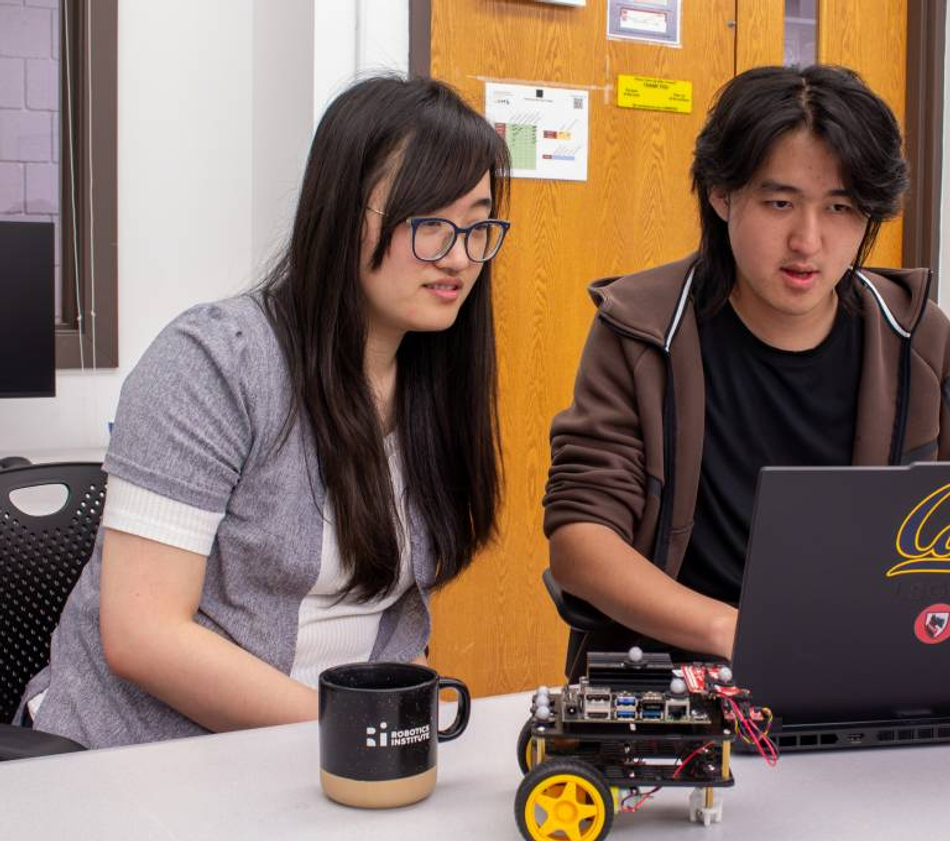
www.ri.cmu.eduJiaoyang Li (left) and Shuai Zhou (right) are developing LAMP, a system that helps teams of robots work together to move objects through cluttered spaces. The team also includes RI Ph.D. student Yorai Shaoul.
Researchers from the Carnegie Mellon University School of Computer Science are developing a new way for teams of robots to work together to move objects through heavily cluttered spaces, where poor decisions can leave the robots stuck with no way forward.
The work addresses a fundamental challenge in multirobot manipulation. Even when there’s a clear path from an object to its destination, obstacles may prevent the robots from reaching the positions they need to move it. This challenge is especially relevant in environments such as warehouses, where robots may need to work together to move objects through crowded spaces while navigating around shelves, equipment and other impediments.
Long-Horizon Adaptive Manipulation Planning (LAMP) helps robots plan not only where an object needs to go, but also how they can work together to get it there.
“LAMP is one example of the kind of robotics research being developed at Carnegie Mellon to make robots more capable of operating in complex, real-world environments,” said Jiaoyang Li, an assistant professor in the university’s Robotics Institute (RI).
The planning system considers whether robots can reach the positions they need to be in to push or manipulate an object, navigate around obstacles, and coordinate their movements over a long sequence of actions.
“We want the benefits of using multiple robots, such as needed stability, control and efficiency, but that comes at the cost of coordination,” said Shuai Zhou, a master’s student in the RI. “With LAMP, we plan the motions of the object and robots together, rather than treating them as separate problems.”
LAMP combines learned models of how an object can be moved locally with search-based planning to find a path through the environment. The researchers call this approach LAMP-A*. The system generates possible local movements for manipulating the object and uses those movements in a global search to determine how the robots can move the object from its starting position to its destination.
The team also developed LAMP-Lazy, a variation that avoids spending time verifying every possible movement before a task begins. Instead, it checks movements as they become necessary and can update its plan based on new information from the robot and its environment.
“It’s kind of a feedback loop. We get new information about what happened and use that information to update the plan.” said RI Ph.D. student Yorai Shaoul. “That lets us respond to what’s actually happening in the environment and continue making progress toward the goal.”
In testing, LAMP successfully completed multistep activities with sequential, interdependent actions that had challenged previous approaches. The researchers also tested the system in increasingly crowded environments, including a demonstration that spelled out the name of the conference where the work will be presented.
The 2026 IEEE/RSJ International Conference on Intelligent Robots and Systems (IROS) will take place in Pittsburgh this fall. In the demonstration, multiple robots transported 12 objects individually to assemble the letters “IROS,” continually adjusting their plans as the workspace changed.
“Our acceptance at IROS gives us an opportunity to share this approach with the broader robotics community, especially as we welcome researchers from around the world to Pittsburgh,” Li said. “It’s meaningful to present this work here, where the research began, and to share it with the robotics community coming to our city.”
The research was partially supported by the National Science Foundation. Learn more about LAMP and the team’s work on the project website.