Industrial Object Detection with Long-Range, Wide-Angle Time-of-Flight Sensing: OMRON E3AS-HF
Conventional photoelectric sensors used for object detection and distance measurement can struggle with dark, glossy, or irregular targets because they rely on light intensity. Time-of-flight laser sensors overcome these challenges by using distance-based sensing instead.

08 Jul, 2026. 8 minutes read
Introduction
Object detection is one of the foundational tasks in industrial automation. Whether confirming the presence of a component, tracking products on a conveyor, or verifying pallet positions in a warehouse, sensors provide the information that machines need to make decisions in real time.
In real-world applications, however, reliable detection is never as straightforward as it seems. Production environments are filled with variables that can complicate sensing. Parts to be detected may vary in color, shape, or surface finish. Some could be highly reflective, while others could absorb most of the incident light. Environmental factors like dust, oil mist, and changing lighting can further affect performance. Present-day productivity demands require high-speed operation, which makes it difficult to maintain consistent detection.
This article explains how time-of-flight (ToF) sensing addresses the limitations of conventional photoelectric sensors in challenging industrial applications. It uses OMRON’s E3AS-HF as an example to showcase how manufacturers can achieve more reliable long-range object detection across varying targets and environmental conditions.
Conventional Photoelectric Sensors and Their Challenges
Photoelectric sensors are electronic devices used to detect the presence or distance of an object without making physical contact. Traditional photoelectric sensors are highly effective in many simpler applications and are widely used in the industry. They can be classified based on their working principles.
Light-Quantity Methods
Sensors using light-quantity methods detect an object by projecting a light beam and monitoring whether it is interrupted or by measuring changes in the amount of light reflected. Types of light-quantity methods include:
Through-Beam Sensors
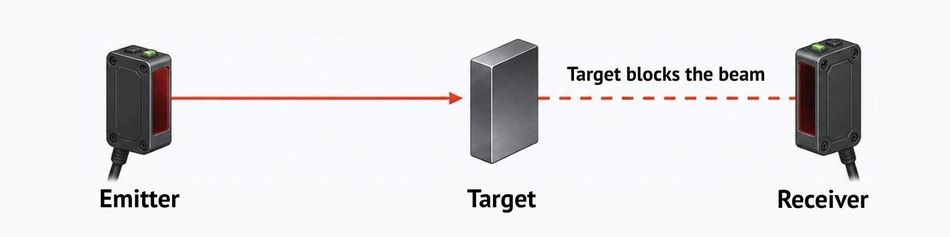
Through-beam sensors separate emitter and receiver units positioned opposite each other. Detection occurs when an object blocks the beam. This approach offers long sensing distances with strong detection margins but requires access to both sides of the target.
Retroreflective Sensors
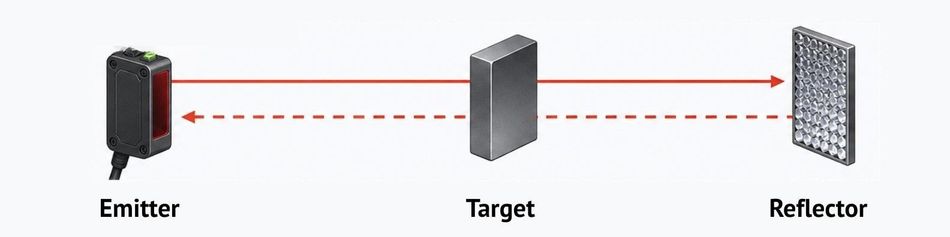
Retroreflective sensors combine emitter and receiver in a single housing. They use a reflector to return the light beam. While the installation is simple, alignment and reflector placement become important to consider.
Diffuse-Reflective Sensors
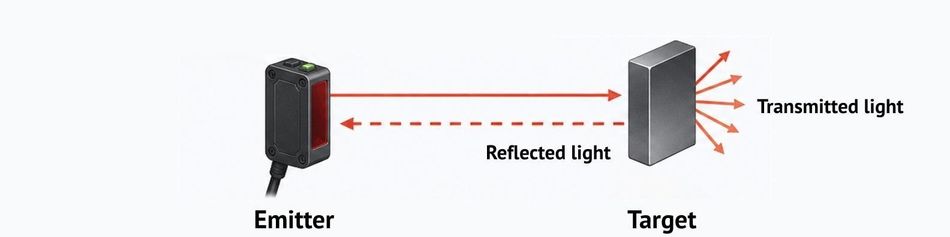
Diffuse-reflective sensors detect light reflected directly from the target. They are easy to install but are more sensitive to variations in color, reflectivity, and finish.
In all these cases, performance depends to some degree on how much light reaches the receiver. Dark or low-reflectivity objects return weaker signals, while glossy or metallic surfaces can reflect light away from the sensor. Dust, oil mist, and ambient light can further reduce detection margins.
Distance-Setting Methods
Distance-setting methods use triangulation to estimate the position of a target by analyzing the angle formed between the incident light from the emitter and the reflected light reaching the receiver. Because they estimate distance rather than relying just on light intensity, they can better distinguish targets and support more precise position-based detection.
Their usable sensing range, however, is typically shorter than that of through-beam sensors, and performance is still influenced by target surface properties, measurement distance, and mounting constraints.
When Detection Conditions Become More Demanding
For many applications, conventional photoelectric sensors remain the most practical and cost-effective solutions. Problems arise when the target material varies, installation space is limited, or operating conditions change frequently.
A production line may need to detect matte-black rubber, polished metal, painted surfaces, and irregularly shaped parts, often at different angles and distances. To maintain stable performance under such conditions, engineers need to adjust thresholds, reposition sensors, or switch to different sensing technologies for different stations.
By determining how far away an object is rather than relying primarily on the amount of reflected light, TOF sensors can deliver more consistent results across a wider range of materials and operating conditions.
ToF Sensing: A More Reliable Way
Unlike conventional reflective photoelectric methods, which can be highly dependent on the intensity of reflected light, ToF sensing determines distance by measuring the time it takes for emitted laser light to return from the target. As light travels at a known speed, that elapsed time can be converted directly into distance. This makes detection less affected by target color, reflectivity, and surface finish while still requiring sufficient returned light for stable measurement. For example, a matte black rubber component and a polished metal part may reflect very different amounts of light, but as long as enough light returns to be measured, the sensor can determine how far away each object is.
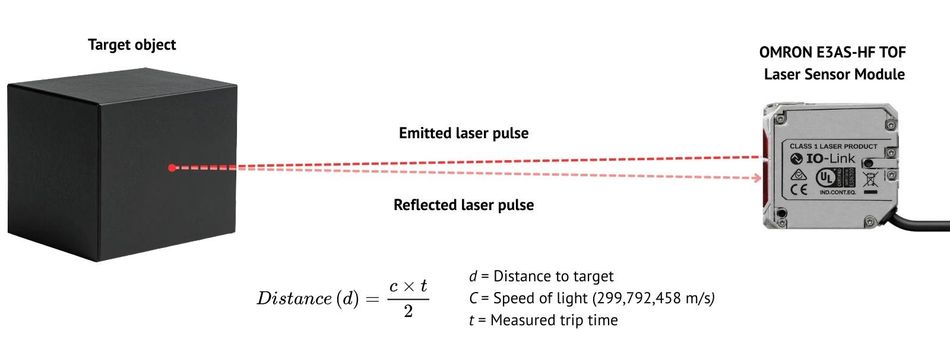
ToF sensing still presents engineering challenges. The returning signal can be extremely weak, particularly when detecting dark objects at long distances. Ambient light and electrical noise can obscure the signal, and temperature changes can affect the characteristics of optical components over time.
Therefore, achieving stable measurements requires more than simply measuring elapsed time. It depends on high-speed sampling, precise signal processing, and compensation techniques that maintain accuracy under changing conditions.
When properly implemented, ToF sensing provides a practical solution to detect a wide range of objects with greater consistency. It can also simplify installation by allowing sensors to be mounted farther away from the target while still maintaining reliable operation. This combination of robustness and flexibility has made ToF sensing increasingly attractive for applications in the automotive industry, logistics, manufacturing, and more.
OMRON E3AS-HF ToF Laser Sensor
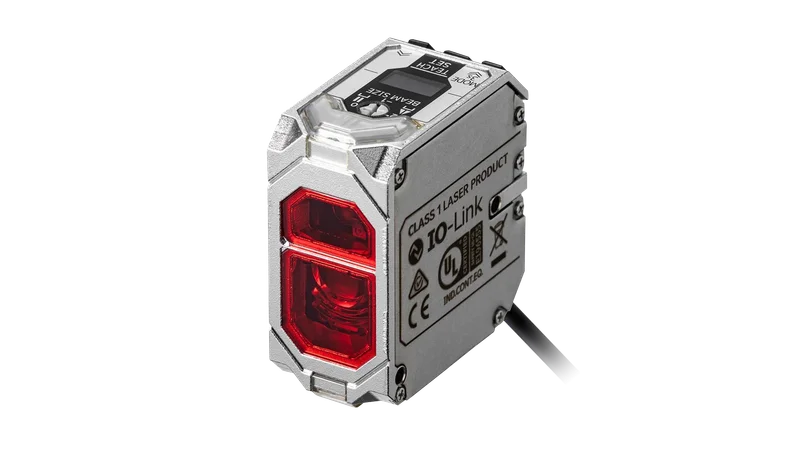
The OMRON E3AS-HF is a high-sensitivity ToF laser sensor designed for applications where target conditions and installation constraints can make conventional sensing methods difficult to implement. By combining long-range distance measurement with wide-angle detection characteristics, it provides greater flexibility in how and where sensors can be installed.
The sensor supports a sensing range from 50 mm to 6,000 mm and is available in separate spot-beam and diffused-beam models. Depending on model type, dial position, and installation distance, beam options include approximately 2 mm (spot), 9 mm (parallel), and 40 mm (wide-area) detection.
One of the defining characteristics of the E3AS-HF is its angular performance. The sensor can detect at installation angles up to ±85° when measured at 5 m using black paper with 10% reflectance and a 200 ms response time, making it possible to mount the sensor away from moving equipment, robots, and operator pathways.
The E3AS-HF brings several features that make setup and maintenance easy. An OLED display provides direct access to settings and measured values, while a bottom-mounted status indicator remains visible when the sensor is installed in elevated or hard-to-reach locations. IO-Link is supported as standard on applicable models, enabling remote parameterization, diagnostics, and condition monitoring.
Table 1: Key specifications of OMRON E3AS-HF
Specification | OMRON E3AS-HF |
Sensing range | 50 mm to 6,000 mm |
Beam types | Spot beam and diffused beam |
Light source | Class 1 red laser (660 nm) |
Response time | 2 ms, 10 ms, 50 ms, or 200 ms |
Outputs | NPN or PNP digital outputs, 4–20 mA analog output |
Communication | IO-Link v1.1 (COM3, 230.4 kbps) |
Operating temperature | –30°C to 55°C |
Environmental ratings | IP67, IP69K, IP67G, ECOLAB |
Display | OLED with five language options |
The E3AS-HF combines the sensing range typically associated with larger photoelectric systems with the flexibility of an all-in-one sensor. Its 6 m maximum range allows the sensor to be mounted away from conveyors, robot arms, and other moving equipment, while the selectable response times let engineers balance speed and measurement stability for different applications.
Support for both digital and analog outputs, along with IO-Link communication, makes the sensor easy to integrate into modern automation architectures. At the same time, the rugged housing and broad operating temperature range allow it to be used in environments that involve washdowns, cutting oil, dust, and low temperatures.
Design Features Behind Stable Detection
The E3AS-HF combines a number of design elements to ensure consistent measurements across diverse materials, surfaces, and environmental conditions.
High-Speed Sampling and Signal Accumulation
When measurement distances increase, the amount of light returning to the sensor can get extremely small. This is especially true for detecting dark targets such as black rubber or painted metal. To extract useful information from these weak signals, the E3AS-HF accumulates approximately 10 million data points via ultra-fast sampling at 10 billion times per second to improve measurement stability.
Avalanche Photodiode-Based Photodetection
The sensor uses an avalanche photodiode (APD), which offers significantly higher sensitivity than conventional photodiodes. Even when a faint amount of light is reflected from the target, the APD can amplify the weak signal, allowing the sensor to measure the distance reliably.
Inbuilt Heating and Real-Time Temperature Compensation
Optical components are known to change their characteristics as temperatures shift. Since this is their natural behavior, it cannot be avoided but only compensated for. The E3AS-HF uses APD-based photodetection with real-time temperature correction to reduce characteristic variation. Separately, an integrated heater and temperature sensor support low-temperature operation.
Automatic Mutual Interference Prevention
In industrial settings, multiple sensors are often installed close to one another. Emitted laser pulses can interfere, causing false detections. The E3AS-HF is built to handle this challenge by automatically selecting a different emission pattern, which avoids interference without requiring any manual settings. Manual configuration is available too if needed.
Adjustable Beam Characteristics
The sensor is available in spot-beam and diffused-beam versions, with an adjustable beam diameter to match the application. The sensor, when set at a narrow beam, can detect small targets, while at a wider beam, it spreads over larger areas.
Environmental Protection and Antifouling Design
A contaminated lens reduces signal quality over time. To withstand demanding industrial environments, the sensor features an antifouling coating on the lens and carries IP67, IP69K, and IP67G ratings, along with ECOLAB approval for resistance to cleaning agents. It also supports operation from –30°C to 55°C, with an integrated heater and temperature sensor that enables operation down to –30°C (warm-up may be required at temperatures below –10°C).
Industrial Application Scenarios
OMRON’s E3AS-HF is a versatile ToF laser sensor suitable for a broad range of automation tasks.
Automotive Manufacturing
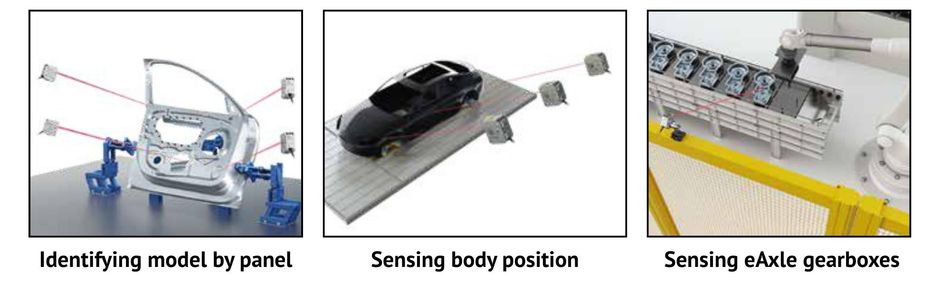
Automotive production lines include a mix of painted body panels, machined metal components, and dark plastic parts, each exhibiting different optical properties. The E3AS-HF can verify part presence, identify vehicle body types, and confirm the position of painted panels, even when the sensor is mounted at an angle or far from moving robots and tooling.
Logistics and Warehousing
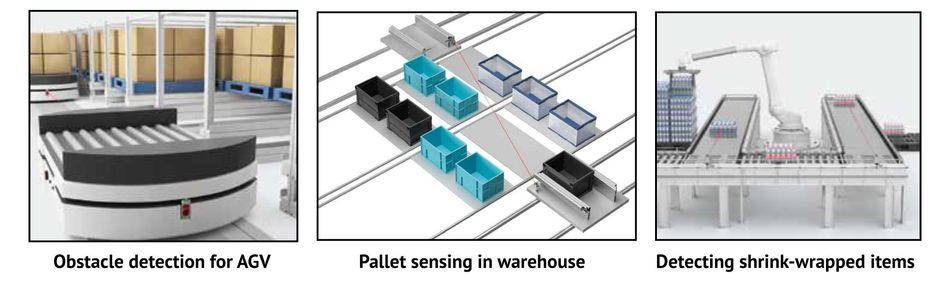
In warehouses and distribution centers, sensors are used to detect pallets, cartons, and moving shuttles. Because package colors and surface finishes can vary, maintaining stable detection with intensity-based methods can be difficult. The E3AS-HF’s distance-based operation and automatic mutual interference prevention make it well-suited for pallet detection, conveyor tracking, and automated storage and retrieval systems.
Manufacturing and Assembly
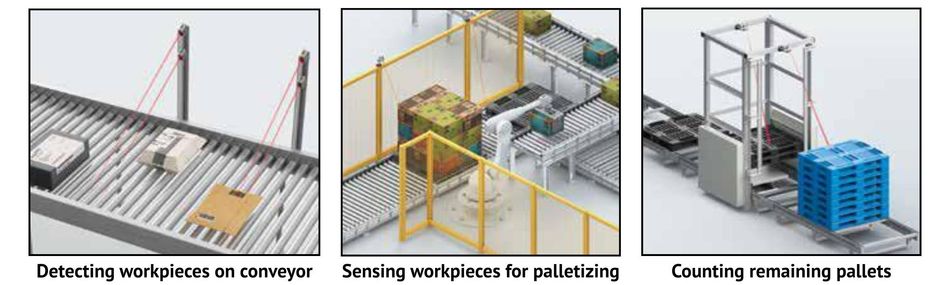
General manufacturing applications often involve object positioning, height verification, and counting tasks. The E3AS-HF offers accurate distance measurement with selectable beam characteristics, allowing engineers to select a sensing area for small features or larger surfaces. Its analog current output and scaling function can also be used to detect subtle height differences over a narrow measurement range.
Toward More Flexible Industrial Sensing
As production environments become more automated and product variation continues to increase, sensors are expected to perform reliably under a wider range of conditions. Differences in color, reflectivity, shape, and installation geometry can all affect detection performance, particularly when sensing methods depend heavily on the amount of light blocked/returned by the target.
ToF sensing offers a different approach compared to traditional photoelectric sensors by measuring distance directly. This makes detection less dependent on the target’s appearance and more on the quality of the sensors deployed.
For engineers designing systems that detect diverse targets and require reconfigurability, OMRON’s E3AS-HF offers a practical way to maintain more consistent sensing performance.