In-Series Diagnostics for Industrial Machine Safety with Banner RSio Remote Safe I/O
Industrial facilities are in constant need of upgrades, with machines regularly added, removed, or replaced. With the Banner RSio, safety systems engineers can transition to a more optimized distributed safety architecture, making upgrades and maintenance easier.

25 Jun, 2026. 7 minutes read
Introduction
Safety in industrial automation systems is a fundamental requirement that ensures operators and machines remain protected during unexpected events. While the primary purpose of safety systems is to protect human lives, they also affect machine uptime, troubleshooting efficiency, and overall system reliability. As systems get larger and more distributed, manufacturers are expected to implement solutions that meet the compliance requirements without adding much unnecessary complexity or costs.
This article explains the challenges of traditional safety systems and how an architectural shift to distributed safety systems with In-Series Diagnostics is solving them. It uses Banner’s Remote Safe I/O as an example to show how industrial safety system engineers can build a highly safe environment within their facility.
The Limits of Traditional Centralized Safety Architectures
Most industries use centralized safety architectures today. With this approach, the control of safety-critical functions is consolidated into a single powerful controller. It does prove to be quite effective for small and low-complexity machines, but gets challenging to scale for large and complex setups. Some limitations of this architecture are:
High Wiring Density and Panel Complexity
In a centralized setup, each safety device needs to be wired back to the control panel. These devices could be placed far from each other, especially in applications like material handling or conveyor lines. As the number of devices in the facility increases, the volume of cabling increases too. It makes it harder to manage, install, label, and check cables. Beyond a certain point, routing also affects signal integrity. This is when the approach itself becomes a design constraint.
Limited Fault Visibility at the Device Level
Centralized safety architectures provide device status and information at the circuit/channel level, rather than at the individual device level. During fault conditions, such as an open circuit or safety device trip, manual inspection must be performed, which limits real-time feedback from the system. This lack of granular diagnostics increases downtime and manual efforts, especially in interconnected safety components.
Increased Commissioning Time
During commissioning, each connection must be individually verified from the control cabinet to the device. In case of a wiring or configuration issue, troubleshooting involves tracing connections across the whole system. This sequential manual process can extend commissioning timelines.
Limited Scalability and Expansion Flexibility
Often, the space available in established safety systems is limited. Expanding the system by adding new devices or modifying the existing zones requires significant additional wiring back to the cabinet, which should accommodate new terminations within the available panel. Even if the hardware supports this, it almost always disrupts ongoing operations.
Distributed Safety I/O and In-Series Diagnostics
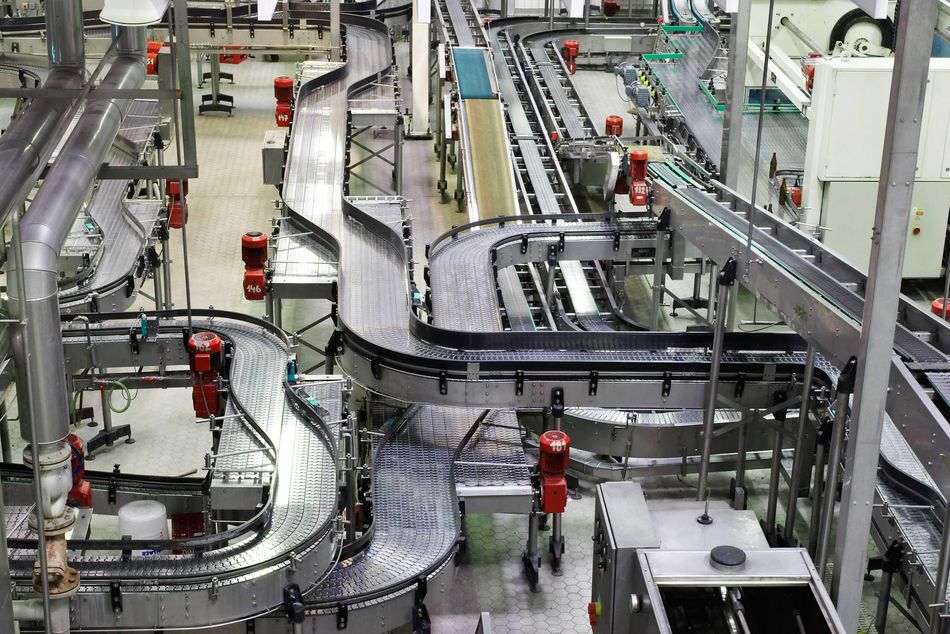
To overcome the limitations of centralized architectures, safety system engineers are adopting distributed safety. Instead of routing every safety signal back to a central cabinet, they prefer placing safety I/O modules closer to the devices they monitor. It comes across as a minor change, but in practice, it reduces wiring complexity and allows safety systems to be organized in a more modular way. With this approach, the systems can be distributed into different sections or zones.
Distributed safety systems are flexible in how inputs and outputs are configured. They include hybrid designs, in which channels can be assigned as either inputs or outputs depending on the application requirements. For engineers, this helps standardize hardware across different machines while still supporting varied safety requirements. This small design change reduces the number of unique components required across projects.
Another notable development in this safety architecture is the use of In-Series Diagnostics. With this capability, multiple safety devices are connected in series on a single input channel, while still providing individual device-level status. This is unlike the traditional series wiring, where multiple devices share a single signal and faults are difficult to isolate. In-Series Diagnostics enables each and every connected device to share its status independently.
Distributed safety systems are often integrated with network-based safety protocols such as Common Industrial Protocol (CIP) Safety. This allows safety data to be exchanged alongside standard control information. The aim is to support system behavior while maintaining required safety integrity.
Distributed safety architecture and In-Series Diagnostics help engineers build safety systems better suited to the demands of modern industrial machines.
Banner Engineering’s RSio Remote Safe I/O
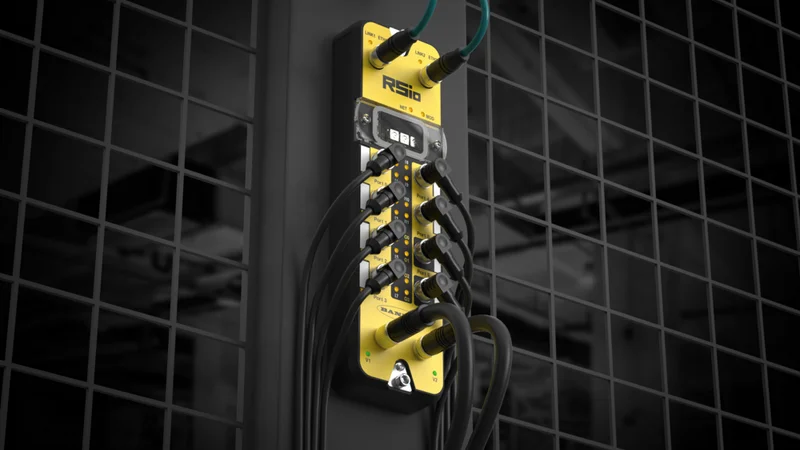
Banner Engineering is a leading innovator and manufacturer of industrial automation products. Banner addresses the needs of distributed safety architectures with the RSio Remote Safe I/O. RSio is a machine-mountable safety I/O platform that features six independently configurable hybrid channels. These channels can function as either safety inputs or outputs.
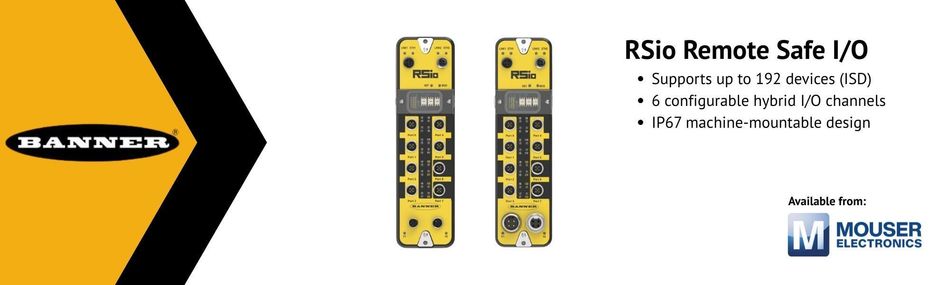
Each port can support up to 32 In-Series Diagnostics-enabled devices, allowing a single module to monitor up to 192 devices. This capability supports high-density safety systems without significantly increasing wiring complexity.
RSio is available with either mini power connectors supporting up to 10 A pass-through current or M12 L-Code connectors supporting up to 16 A. Both variants provide the same core functionality and M12 A-Code I/O connectivity, allowing machine builders to select the power standard that best fits their application.
RSio includes two configurable safety outputs, each rated at 1 A. These outputs can be used for controlling safety actuators or signaling devices, providing additional flexibility at the machine level.
The system supports communication over industrial networks using CIP Safety. This enables safety signals to be transmitted alongside standard control data while maintaining integrity.
RSio modules feature an IP67-rated housing. This allows the modules to be robust enough to operate in industrial environments without requiring an additional enclosure within a control cabinet.
RSio is designed to meet high safety integrity requirements. This includes Category 4, Performance Level e (PLe) and Safety Integrity Level 3 (SIL3) capability, the highest level of machine safety, requiring redundant (dual-channel) architecture with high diagnostic coverage (>99%) and a low probability of dangerous failure.
The system also offers input reaction times as low as 6 ms and output response times of around 5 ms. These reaction times are more than sufficient for most of the critical industrial applications.
Table 1: Key Specifications of Banner Engineering RSio Remote Safe I/O
Parameter | Specification |
I/O Configuration | 6 independently configurable hybrid channels (input/output) |
Maximum Devices Supported | Up to 192 in-series diagnostics-enabled devices per module |
Safety Outputs | 2 configurable outputs |
Output Current Rating | 1A per channel |
Power Connector Options | Mini (10A pass-through) or M12 L-Code (16A pass-through) |
Communication Protocol | CIP safety |
Mounting | Machine-mountable |
Ingress Protection | IP67 |
Operating Temperature | -25°C to +70°C |
Safety Rating | Category 4, PLe, SIL3 |
Input Reaction Time | ~6ms + configurable debounce |
Output Reaction Time | ~5ms |
Application Scope | Distributed safety systems, modular machines, and large-scale automation |
RSio supports configuration through Rockwell Automation's Studio 5000®, an integrated engineering environment used to develop, configure, and maintain Logix-based control and safety systems. Engineers can configure RSio, including hybrid I/O and In-Series Diagnostics capabilities, within the same software environment used for GuardLogix® safety controllers, eliminating the need for additional configuration tools.
Architectural Advantages of Distributed Safety I/O with RSio
Moving to distributed, machine-mountable I/O brings practical advantages beyond wiring reduction. When implemented with RSio Remote Safe I/O, these benefits become more apparent. They include:
Reduced Cabinet Footprint: By putting safety I/O modules directly on the machine, fewer components need to be housed within the main control cabinet. This drastically simplifies panel design, reduces overall size, and frees up space for other critical components.
Lower Wiring Complexity: As devices can be connected to nearby I/O blocks, cable length is reduced and routing is simplified. These benefits show up more prominently in large or modular systems.
Simplified Scalability: With the expansion of facilities, more I/O blocks can be easily added. This has little impact on the overall design. New safety devices could be added closer to where they need to be used, without having to take extra wiring back to a central source.
Faster Fault Localization: RSio supports In-Series Diagnostics to help operators see the status of connected safety devices. It allows faults to be located to individual devices rather than just at the circuit level, saving a lot of time.
Application Scenarios and Industrial Use Cases
Distributed safety I/O with In-Series Diagnostics is particularly useful in applications where machines are physically large. Some typical application scenarios include:
Long Conveyor Systems
Conveyor-based systems extend across large distances. They are known to incorporate multiple safety devices, including:
Emergency stop pushbuttons
Rope pull switches
Segmented safety zones
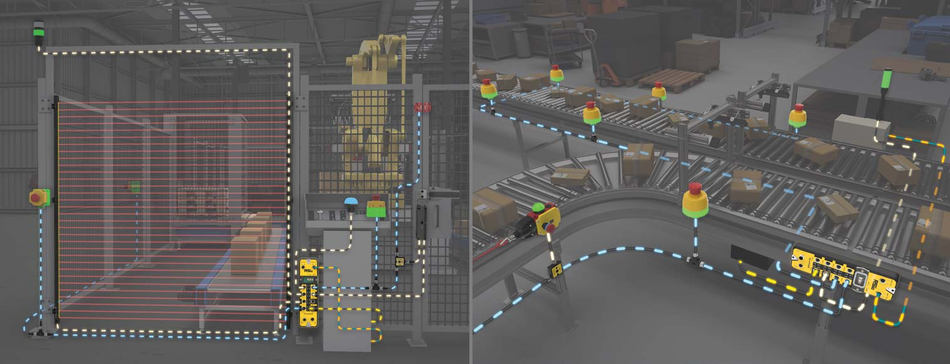
With distributed safety architecture, modules can be placed along the conveyor to let devices connect locally. In-Series Diagnostics enables identification of the exact device to assist manual inspection.
Robotic Palletizing and Work Cells
Robotic cells involve multiple safety components, such as:
Safety light curtains for operator access points
Gate interlocks on fenced enclosures
Reset stations and indicator devices
Emergency stops within and around the cell
Distributed safety I/O allows these components to work together. If a specific safety device is triggered, device-level diagnostics can help operators quickly determine the source.
Material Handling and Third-Party Logistics Facilities
Material-handling environments or third-party logistics operations combine conveyors, sortation systems, and robotic elements across wide areas. They carry out frequent system expansion or reconfiguration. At the same time, they have high uptime requirements. In such a scenario, RSio enables scalable system design. It allows completely new zones or devices to be added without major rewiring.
To simplify setup for industrial applications further, Banner's Add-On Profile (AOP) Electronic Data Sheet (EDS) file includes user-selectable port presets for common safety devices such as emergency stop buttons, light curtains, and safety switches. These predefined configurations also make system deployments more consistent.
Designing for Scalability, Maintainability, and Compliance
The one thing constant about production requirements is that they change. Machines often need to be expanded or modified. Distributed safety I/O devices, such as RSio, allow additional devices or zones to be integrated without overhauling the entire safety system. New modules can be added where needed, supporting incremental scaling.
Using flexible, hybrid I/O modules lets engineering teams standardize safety hardware across their production lines. Instead of building new safety panels for each system, similar distributed architectures can be replicated with minimal variation. This simplifies workflows, reduces efforts, and makes documentation more consistent.
Device-level diagnostics provided by In-Series Diagnostics enable maintenance teams to identify faults more precisely. Rather than inspecting multiple devices in a safety loop, they can pinpoint the specific device requiring attention. This makes troubleshooting fast while also reducing the effort required to restore normal operation.
Modern safety systems must meet established functional safety standards while remaining practical to implement. RSio is designed to support high safety integrity levels. This makes sure the system design can align with requirements such as Category 4, PLe, and SIL3.
Conclusion
Traditional safety methods remain effective for smaller systems but introduce challenges when applied to modern, large-scale equipment. As industrial machines scale, safety system designs must evolve from centralized, wiring-intensive approaches to more distributed and modular architectures.
Distributed safety I/O with In-Series Diagnostics brings in a more structured way to enable device-level visibility and reduced wiring dependencies. Banner’s RSio helps build machines that are not only safe and compliant but also more manageable throughout their lifecycle.
Explore Banner Engineering’s RSio Remote Safe I/O Block, available at Mouser Electronics.